
Most travel agencies try Facebook and Instagram ads by pressing “Boost post” on a pretty beach photo. A few hundred people like it, nobody enquires, and the conclusion is that social ads don’t work for travel.
They do. But they work differently from Google Ads. On Google, you catch people who are already searching for a trip. On Facebook and Instagram, you reach people who aren’t searching yet, and give them a reason to start planning with you. That needs a different setup, different creative and a lot more patience with follow-up.
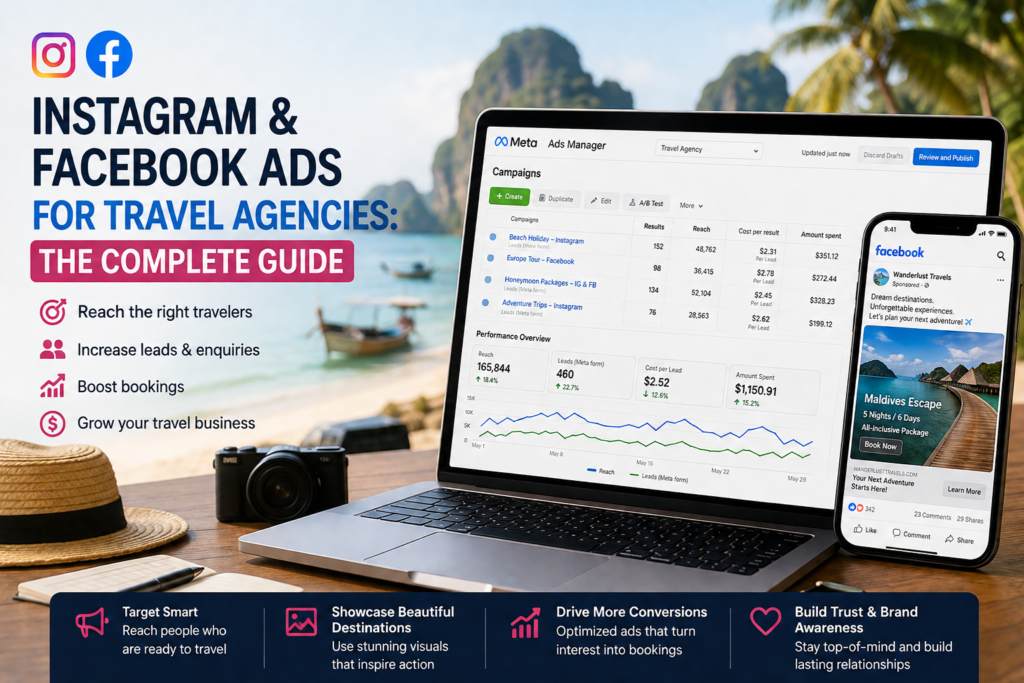
This guide shows you how to run Facebook and Instagram ads (Meta ads) for a travel agency: the setup, the three campaigns worth running, who to target, what creative works, how to budget, and the mistakes that waste most agencies’ money.
Quick answer: For a travel agency, Meta ads work best as three connected campaigns: prospecting (reaching new people with inspiring video or carousels), remarketing (showing specific packages and reviews to people who’ve visited your site or engaged with you), and past-customer offers. Install the Meta Pixel first, use the Leads objective with an instant form or a landing page, give each campaign enough budget to learn, and follow up every lead within minutes, ideally on WhatsApp.
When Meta ads make sense for a travel agency
Facebook and Instagram are visual, and travel is an emotional, visual purchase. That makes them good at:
- Creating demand: putting a trip in front of someone who hadn’t thought about it yet.
- Remarketing: reminding people who visited your site or watched your videos.
- Reaching specific groups: recently engaged couples, parents, people who follow travel content.
They’re weaker at catching people who want to book right now. That’s what Google search is for. Many agencies get the best results running both: Google for people already searching, Meta to fill the pipeline. Our comparison of Google Ads vs Facebook Ads for travel agencies helps you decide where to start.
Set up the foundations first
Before you spend anything, get these in place.
1. A business portfolio
Run your ads from a Meta business portfolio (previously called Business Manager), not a personal profile. It keeps your Facebook Page, Instagram account, ad account and Pixel under your business, and lets you give staff or a freelancer access without sharing your password. You can reach it through Meta Business Suite.
2. The Meta Pixel (and Conversions API if you can)
The Pixel is a small piece of code on your website that tells Meta who visited which pages and who sent an enquiry. Without it you can’t remarket to website visitors, Meta can’t learn who your best leads are, and you can’t see which ads bring enquiries.
Install it before you launch anything, even if you’re not ready to advertise. It starts building your remarketing audiences from day one. If your website platform supports Meta’s Conversions API as well, turn it on. It sends the same events from your server and makes tracking more reliable.
3. Your Facebook Page and Instagram account, connected
Link them in your business portfolio so one campaign can run on both, and so you can reply to comments and messages in one place.
Choose the right campaign objective
Meta has six campaign objectives: Awareness, Traffic, Engagement, Leads, App promotion and Sales. For most travel agencies:
- Leads is the main one. It optimises for enquiries, whether through an instant form, a landing page, or a message on WhatsApp or Messenger.
- Engagement can work for video views when you’re building a remarketing audience.
- Traffic sends people to a page, but Meta will find people who click, not people who enquire. Use it sparingly.
- Awareness suits a new destination or a new market, if you have the budget for the long game.
Avoid Boost post for lead generation. It’s a quick way to get likes, not enquiries.
The 3-campaign system for travel agencies
Rather than one big campaign, run three that work together.
Campaign 1: Prospecting (new people)
Who: people who don’t know you yet. What to show: inspiring Reels and carousels of trips you sell, with a soft call to action like “Get a free itinerary”. Goal: enquiries from people who are ready, and a bigger warm audience for Campaign 2.
Campaign 2: Remarketing (warm people)
Who: people who visited your website, watched most of a video, engaged with your Instagram, or opened an instant form and didn’t submit. What to show: the specific package they looked at, real reviews, what’s included, and a direct call to action like “Get my quote”. Goal: enquiries. This is usually where the cheapest leads come from. See our guide to remarketing for travel agencies.
Campaign 3: Past customers
Who: past clients, uploaded as a customer list. What to show: “Where next?” ideas, early access to new trips, and referral offers. Goal: repeat bookings and referrals, which are usually your most profitable.
How to split the budget: a common starting point is to put most of it into prospecting, a solid share into remarketing, and a small amount into past customers. Then adjust based on cost per enquiry. If your remarketing audience is still small, it can’t spend much yet, which is another reason to install the Pixel early.
Who to target
Remarketing audiences (highest priority)
Build custom audiences from:
- Website visitors, split by what they viewed. People who looked at your Maldives page should see Maldives ads.
- Video viewers, especially people who watched most of a video.
- Instagram and Facebook engagers.
- People who opened an instant form but didn’t submit.
Exclude people who’ve already enquired, so you’re not paying to show them the ad they just responded to.
Lookalike audiences
A lookalike audience finds people similar to a source list, such as your past customers or recent enquirers. Start with the closest match (1%) in your country. The better your source list, the better the lookalike, so use real customers rather than everyone who ever liked your page.
Interest and broad targeting
Meta’s targeting has become more automated. Its Advantage+ audience setting uses your targeting as a suggestion and looks beyond it when it finds better prospects. For a new account, a sensible approach is:
- Start with your location (where your customers live, not the destination) and an age range that fits your trips.
- Add a few interest suggestions that match the trip: honeymoon, family travel, luxury travel, specific destinations.
- Let Meta expand from there once your Pixel has enquiry data.
Some detailed targeting options, such as income-based targeting, aren’t available everywhere. Don’t build your strategy around one interest that may disappear.
Creative that stops the scroll
On Facebook and Instagram, the creative does most of the targeting. A good video tells Meta who to show it to by who watches it.
Formats that work for travel
- Reels and short vertical video (9:16): the strongest format for prospecting. Show the experience: arrival, the room, the view, a local meal. The first second has to grab attention.
- Carousels: good for showing several resorts, an itinerary day by day, or “3 ways to do Georgia in a week”.
- Single images: fine for remarketing with a clear offer, less good for cold audiences.
- Customer content: clients’ photos and short clips (with permission) feel more real than polished stock footage.
Most people scroll with the sound off, so add captions or on-screen text.
Ad copy that works
- Start with the traveller, not the agency: “Planning your honeymoon and drowning in resort reviews?” beats “Sunrise Travel has 10 years of experience.”
- Be specific: the trip, what’s included, and a “from” price if you can keep it current.
- One clear call to action: “Get my free itinerary”, “Chat with a specialist on WhatsApp”.
Instant forms or a landing page?
Meta lets people enquire without leaving the app, using an instant form. It’s convenient, so you usually get more leads, but some are less serious. You have three ways to manage that:
- Choose the “Higher intent” form type. It adds a review step where people confirm their details before submitting. Fewer leads, usually better ones.
- Ask one or two qualifying questions, such as travel month or budget range. Conditional logic can route people who aren’t a fit to a different ending.
- Follow up immediately. Instant-form leads forget they enquired surprisingly quickly.
The alternative is sending people to a landing page on your site. It usually brings fewer but more considered enquiries, and lets you show more detail. Our guide to travel agency landing pages covers what to put on it. A third option is click-to-WhatsApp ads, which start a conversation directly in WhatsApp, often the fastest way to reach travellers in markets like the UAE.
Budget and the learning phase
There’s no minimum that guarantees results, but budget matters more on Meta than you might expect, because of the learning phase. Meta needs a certain number of results, around 50 optimisation events in a week for an ad set by commonly cited guidance, before its delivery settles down. Until then, costs are less stable.
What that means for a small agency:
- Use fewer ad sets with more budget each, rather than many small ones that never finish learning.
- Don’t edit an ad set every day. Big changes to budget, targeting or creative can restart learning.
- Judge results over weeks, not days. Travel enquiries can take a while to turn into bookings.
- Start with what you can sustain for at least a month, then scale what works.
How to measure success
Focus on these numbers:
- Cost per lead: what each enquiry costs.
- Lead quality: how many leads you actually reach, and how many become real conversations or quotes. Track this yourself in a spreadsheet or CRM. It matters more than cost per lead.
- Click-through rate: a quick signal of whether the creative is interesting.
- Frequency: how many times the average person has seen your ad. If it keeps climbing and results fall, refresh the creative.
Review weekly. Refresh creative regularly, because the same people will tire of the same video.
Common Meta ads mistakes travel agencies make
- Boosting posts instead of running proper Leads campaigns.
- No Pixel, so no remarketing and no learning.
- Targeting the destination instead of where customers live.
- Asking cold audiences to “Book now” when they’ve never heard of you.
- Using stock photos that look like every other agency’s ads.
- Too many small ad sets, none with enough budget to learn.
- Slow follow-up. A lead that waits until tomorrow for a reply has often moved on.
- Changing everything every few days instead of giving campaigns time.
FAQ
How much should a travel agency spend on Facebook and Instagram ads?
Start with an amount you can keep running for at least a month, and enough that your main ad set can gather results each week. Then judge by cost per qualified lead and adjust. Spreading a small budget across many ad sets is the most common way to waste it.
How long before Facebook ads bring travel bookings?
Enquiries can arrive in the first few days. Bookings take longer, because travellers compare options and check dates. Judge campaigns on enquiries and conversations first, then on bookings over a longer period.
What’s the best Facebook ad format for a travel agency?
Short vertical video (Reels) for reaching new people, carousels for showing several trips or an itinerary, and specific offers with reviews for remarketing.
Can I run Facebook ads without a website?
Yes. Instant forms and click-to-WhatsApp ads let people enquire without visiting a website. A website still helps, both for trust and so the Pixel can build remarketing audiences.
How do I target people in the UAE for travel ads?
Set your location to the UAE or your city, so you reach people who live there, and choose trip-based interests and lookalikes of past customers. Don’t target the destination country unless you sell trips to visitors arriving there.
Should I use Facebook ads or Google Ads?
Use Google Ads to catch people already searching for a trip, and Meta ads to create interest and remarket. If you can only afford one, Google usually brings higher-intent enquiries first.
Start with remarketing
If you’re starting from zero, install the Pixel today, run a small prospecting campaign with your best video, and add remarketing as your audience grows. Remarketing to people who already know you is usually the quickest win.
For the full picture of travel marketing channels, see our complete guide to digital marketing for travel agencies. To grow your organic reach alongside ads, read how to use Instagram to grow your travel agency, and for targeting details, see Facebook ads targeting for travel agencies.