
Landing Page vs Website for Travel Agencies: What You Actually Need 🌍
🎯 TL;DR A website introduces your whole travel agency — it serves every type of visitor and every stage of the buying journey. A landing page does one specific job — convert a specific visitor from a specific traffic source into an enquiry. Travel agencies need both: a website for credibility, SEO, and brand building, and dedicated landing pages for each paid campaign and major destination. Sending paid traffic to your homepage instead of a dedicated landing page is the single most common and most expensive mistake travel agencies make with digital marketing.
💡 Summary Most travel agencies either have a website with no dedicated landing pages (and wonder why their ads don’t convert) or obsess over landing pages and neglect their website (and wonder why organic traffic doesn’t trust them). This guide clarifies exactly what each one does, when to use each, and how to combine them into a system that builds credibility AND generates consistent enquiries.
“Do I need a landing page or a website?”
It’s one of the most common questions travel agencies ask when starting out with digital marketing — and the answer is almost always: both, but for different jobs.
The confusion comes from treating them as alternatives when they’re actually complements. A website and a landing page serve fundamentally different purposes. Using one where you should use the other is one of the most common — and most expensive — digital marketing mistakes a travel agency can make.
This guide explains the difference clearly, tells you exactly when to use each one, and shows you how to combine them into a system that works together. 👇
What Is a Website and What Does It Do?
The short answer: A travel agency website is your digital headquarters — it introduces your whole agency, serves every type of visitor, and builds the credibility and trust that turns strangers into enquiries over time.
Your website is the place a potential customer goes when they want to understand your agency fully. Who are you? What do you specialise in? Where have you sent people? Why should they trust you with a £5,000 holiday?
A well-built travel agency website does several things simultaneously:
Builds credibility and trust: When someone sees your agency mentioned on social media, receives a referral from a friend, or finds you through a Google search, they’ll visit your website to check you out. A professional, content-rich website tells them you’re legitimate and expert.
Serves SEO: Your website is your long-term organic search asset. Blog posts, destination guides, and optimised pages rank in Google over time and generate free traffic indefinitely. A landing page can’t do this — it’s designed for conversion, not for ranking.
Supports the full customer journey: Some visitors are ready to enquire immediately. Others are browsing, comparing, and considering. Your website serves all of them with different content at different stages — inspiration, information, social proof, and ultimately conversion.
Acts as the hub for everything else: Your Google Ads, Instagram posts, email newsletters, and Facebook Ads all point somewhere. Your website is that somewhere — the home base of your entire digital marketing operation.
What a Website Is NOT Good For
A website is not optimised for converting paid traffic. It has navigation menus, multiple pages, multiple CTAs competing for attention, and content designed for every type of visitor — not one specific person from one specific campaign.
When someone clicks a Google Ad for “Maldives honeymoon specialist” and lands on your homepage, they have to hunt for relevance. They see your full range of services, your blog, your about page, your contact form — and they make a decision in seconds about whether to stay or go. Most go.
This is exactly the problem a landing page solves.
What Is a Landing Page and What Does It Do?
The short answer: A travel agency landing page is a focused, single-purpose page designed to convert one specific visitor from one specific traffic source into one specific action — usually an enquiry. It removes everything that doesn’t contribute to that single goal.
A landing page is not a simplified version of your website. It’s a fundamentally different tool built for a fundamentally different job.
The key differences:
Single purpose: A website serves many purposes. A landing page serves one — get this specific visitor to submit an enquiry (or download a lead magnet, or call your number).
No navigation: Paid traffic landing pages remove the navigation menu entirely. The visitor has two options: enquire, or leave. Every link that takes them somewhere else is a conversion lost.
Message-matched: A landing page is built specifically for the audience arriving from a specific source. A Maldives honeymoon landing page looks and reads differently from a Kenya safari landing page — because the visitors are different people with different desires.
Conversion-optimised: Every element — the headline, the imagery, the form, the social proof, the CTA — is chosen and positioned specifically to maximise the percentage of visitors who enquire.
What a Landing Page Is NOT Good For
A landing page can’t build SEO authority on its own. It ranks poorly in organic search because it’s thin on content and lacks the depth Google rewards. It also can’t serve visitors who want to explore and research — it’s too focused for that.
And a landing page without a credible website behind it can actually hurt conversions — because when potential customers click away to check if you’re legitimate and find nothing substantial, they don’t come back.
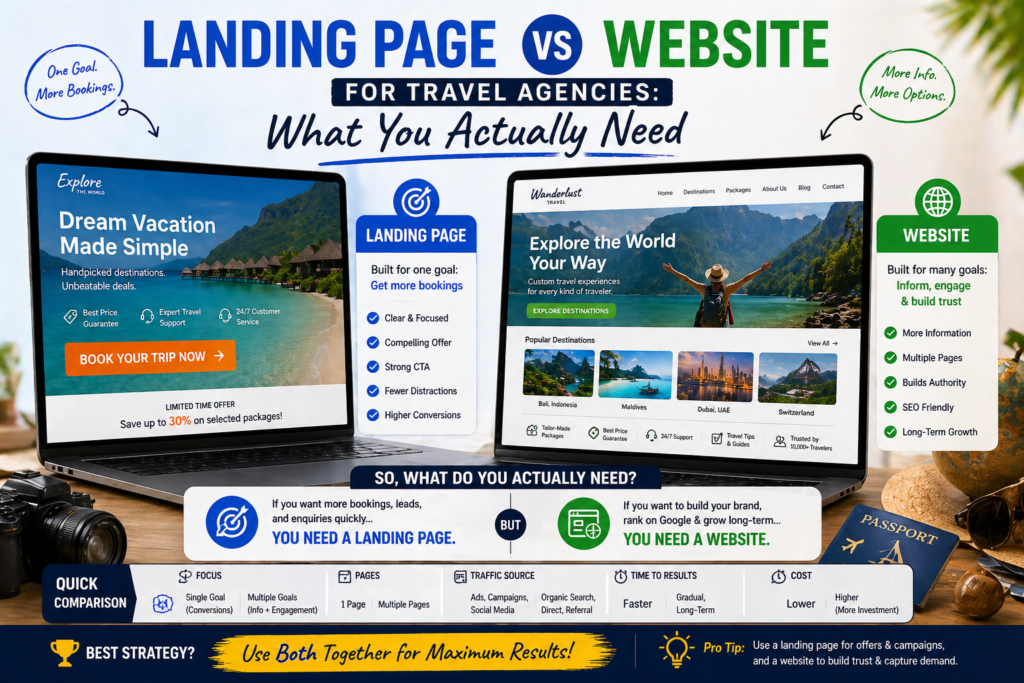
The Key Differences — Side by Side
| Element | Website | Landing Page |
|---|---|---|
| Purpose | Introduce agency, build trust, serve all visitors | Convert one specific visitor into one specific action |
| Navigation | Full navigation menu | None (for paid traffic) |
| Content depth | Deep — multiple pages, blog, guides | Focused — everything serves the CTA |
| Traffic source | All sources — organic, direct, referral | Specific source — one ad or campaign |
| SEO value | High — ranks in Google over time | Low — not optimised for organic ranking |
| Conversion focus | Multiple CTAs across multiple pages | Single CTA |
| Audience | All types of visitors | One specific audience segment |
| Best for | Credibility, SEO, brand building | Paid campaigns, lead generation |
When to Use a Website
Use your website as the destination for:
Organic search traffic (SEO): Blog posts, destination guides, and service pages that rank in Google send visitors to your website. These visitors are in research mode — they want depth and information before they make contact.
Direct traffic: People who already know your agency and type your URL directly. They want to explore fully.
Referral traffic: Someone a friend recommended your agency to. They want to verify you’re credible before reaching out.
Social media bio links: Your Instagram bio link, Facebook page website field, and LinkedIn profile all point to your website. Followers who click through want to learn more about your agency.
Email newsletter links: Links in your email newsletters to destination guides, blog posts, or agency news all go to relevant pages on your website.
When to Use a Landing Page
Use a dedicated landing page as the destination for:
Google Ads campaigns: Every ad group should have its own landing page matching the specific keywords and ad copy. A Maldives ad goes to a Maldives landing page. A Kenya safari ad goes to a Kenya safari landing page.
Facebook and Instagram Ads: Paid social campaigns targeting cold audiences convert better on focused landing pages than on websites — because the message match is tighter and there are fewer distractions.
Email CTAs with a specific offer: When your email newsletter promotes a specific offer or free guide, send readers to a dedicated landing page for that offer — not your homepage.
Lead magnet promotions: When promoting a free destination guide or planning checklist, the download page should be a focused landing page with a minimal form.
Seasonal campaigns: A specific early-bird offer or seasonal promotion deserves its own landing page built around that campaign’s messaging.
The Travel Agency Digital Marketing System — How They Work Together
The short answer: A travel agency’s most effective digital marketing system uses the website for SEO, credibility, and organic traffic, and landing pages for every paid campaign — with both feeding leads into the same CRM and email nurture sequence.
Here’s how the two work together in a complete system:
The Awareness Stage
A potential customer searches “best time to visit Maldives” on Google. Your blog post (on your website) ranks on page one. They read it, find it genuinely useful, and notice your agency at the bottom. They’re not ready to enquire yet — but they now know you exist.
The Consideration Stage
Three weeks later, the same person searches “Maldives honeymoon travel agent.” Your Google Ad appears. They click it and land on your dedicated Maldives honeymoon landing page. They read the page, see the testimonials, check the ATOL logo, and decide to get in touch. They submit the enquiry form.
The Trust Verification Stage
Before submitting, they open a new tab and search for your agency name to verify you’re legitimate. They land on your website — see your blog, your about page, your team’s expertise, your Google reviews. Satisfied, they go back and submit the form.
The Nurture Stage
After submitting, they receive your automated email sequence. Some emails link back to destination guides on your website — adding value and deepening their trust between the enquiry and the booking.
Without the website, the trust verification stage fails and many leads don’t convert. Without the landing page, the Google Ad traffic goes to the homepage and leaks leads at 5× the rate. Both are essential.
Do You Need a Website Before Landing Pages — Or Vice Versa?
The short answer: Build your website first for credibility, then add landing pages as you start running paid campaigns — but if budget and time are limited, a simple 3–5 page website combined with one well-built landing page per destination is enough to start.
If You’re Just Starting Out
Minimum viable setup:
- A simple website with: Homepage, About, Destinations overview, Contact page
- One dedicated landing page per major destination you’re promoting
This gives you credibility (website) and conversion capability (landing pages) without requiring a massive build before you can start generating leads.
Tools to build it:
- Website: WordPress with a clean theme (Astra, GeneratePress)
- Landing pages: Elementor (if on WordPress) or Leadpages
If You Have a Website But No Landing Pages
This is the most common situation — and the most fixable.
You likely have a website that looks professional but converts paid traffic poorly. Every time someone clicks your Google Ad and lands on your homepage, you’re losing 70–90% of potential enquiries compared to a dedicated landing page.
What to do:
- Identify your top 2–3 paid campaign destinations
- Build a dedicated landing page for each one
- Redirect your paid traffic to those pages
- Measure the conversion rate improvement
Most travel agencies see a 3–5× improvement in conversion rate when they switch from sending paid traffic to the homepage to using dedicated landing pages.
If You Have Landing Pages But No Proper Website
This is less common but equally problematic. Landing pages generate leads efficiently, but without a credible website behind them, potential customers who do their due diligence before submitting find nothing to reassure them.
What to do:
- Build a minimum 4–5 page website — Homepage, About, Destinations, Reviews, Contact
- Make sure your Google Business Profile links to your website
- Publish at least 3–4 blog posts demonstrating destination expertise
- Display ATOL/ABTA accreditation prominently
Common Mistakes When Choosing Between Landing Pages and Websites ❌
1. Sending all paid traffic to the homepage The most common and most expensive mistake. Your homepage serves everyone — it converts nobody particularly well. Every paid campaign deserves its own landing page.
2. Building a landing page without a credible website Leads who click through from a landing page to verify your agency and find a thin or non-existent website don’t convert. Build website credibility alongside your landing pages.
3. Using your website as a landing page by adding a form to the homepage Adding a form to your homepage doesn’t turn it into a landing page. The navigation menu, multiple CTAs, and general content all undermine conversion. Build separate, focused landing pages for campaigns.
4. Building landing pages but never updating the website Your website is your long-term SEO and credibility asset. If the blog hasn’t been updated in two years and the About page still says “new agency established in 2022”, it undermines trust even when your landing pages are excellent.
5. Thinking one or the other is enough This is the core mistake this guide addresses. They do different jobs. You need both.
The Travel Agency Content Hub — Connecting Everything
The most sophisticated travel agencies use a content hub structure that connects their website and landing pages into a single, coherent system:
Website (content hub):
- Pillar pages for each destination (comprehensive guides)
- Cluster content (best time to visit, what to pack, sample itineraries)
- Blog posts targeting long-tail SEO keywords
- About page, team page, customer reviews
Landing pages (conversion hub):
- One per destination for Google Ads
- One per trip type for Facebook Ads
- Lead magnet pages for each destination guide
- Seasonal campaign pages
The connection: Every landing page links back to the relevant website destination guide. Every website destination guide has a CTA pointing to the relevant landing page. Every email sequence links to both. Google crawls the website. Paid traffic converts on landing pages.
This is exactly the structure we’ve built throughout the Complete Digital Marketing Guide for Travel Agencies series — a website-based content hub linked to conversion-focused landing pages, all feeding into a single lead nurture system.
Frequently Asked Questions
What is the difference between a landing page and a website for a travel agency? A website is your digital headquarters — it introduces your whole agency, serves all types of visitors, builds credibility, and supports long-term SEO. A landing page is a focused, single-purpose page designed to convert one specific visitor from one specific traffic source into an enquiry. Websites build trust over time; landing pages convert traffic right now.
Can a travel agency use only landing pages without a website? Technically yes — you can generate leads using landing pages and social media without a full website. However, many potential customers will search for your agency name to verify legitimacy before submitting their details. Without a credible website, some of these verification checks fail and leads don’t convert. A minimum website (4–5 pages) significantly improves landing page conversion rates.
Should I send my Google Ads traffic to my website or a landing page? Always send Google Ads traffic to a dedicated landing page — never to your homepage. A dedicated landing page that’s message-matched to your specific ad converts at 4–8% for travel. A homepage converts at 1–2% at best. The difference is significant: for every 100 clicks, a landing page generates 4–8 enquiries while a homepage generates 1–2.
How many landing pages does a travel agency need? At minimum, one landing page per major destination or campaign you’re actively promoting with paid advertising. A travel agency running Google Ads for Maldives, Kenya, and Japan needs at least three landing pages — one per destination. Add seasonal campaign pages and lead magnet pages as your strategy grows.
Can a landing page replace a website for SEO purposes? No — landing pages are not designed for SEO. They’re conversion-focused, thin on content, and often exclude navigation that Google uses to discover other pages. Your website — specifically your blog posts and destination guides — is your SEO asset. Landing pages generate immediate paid traffic leads; your website generates long-term organic leads.
What should be on a travel agency website that isn’t on a landing page? Your website should include: a comprehensive About page with team bios and credentials, a full destination overview showing your range of specialisms, a blog with destination guides and travel tips, customer reviews and testimonials, ATOL/ABTA accreditation, contact information, and a privacy policy. Landing pages contain only what’s needed to convert one specific visitor — a headline, value proposition, form, social proof, and CTA.
How do landing pages and websites work together for SEO? Your website ranks in Google through its blog posts, destination guides, and optimised service pages. When organic visitors find your site, they browse and eventually enquire through your website’s contact form or linked landing pages. Your landing pages are primarily for paid traffic — they don’t rank organically but they convert the paid traffic your ads generate. Together, the website provides organic leads over time while landing pages convert immediate paid traffic.
What is the fastest way to build a travel agency landing page? The fastest approach is using a dedicated landing page builder — Leadpages, Unbounce, or Elementor (for WordPress users). Most have travel-specific templates you can adapt in 1–2 hours. For a complete guide to the best tools, see our Best Landing Page Builders for Travel Agencies guide.
Final Thoughts
The landing page vs website question has a simple answer: you need both, and you need them working together.
Your website builds the credibility and trust that makes potential customers feel safe submitting an enquiry. Your landing pages convert the paid traffic that your ads generate. Your SEO content on your website attracts organic visitors over time. Your landing pages convert them efficiently when they’re ready to act.
Remove either one and the system underperforms. Put both in place — connected, coherent, and consistently optimised — and you have a digital marketing infrastructure that generates leads from every channel you invest in.
Start with a simple website if you don’t have one. Build your first landing page for your most important destination. Connect them both to your email nurture sequence. Measure what converts. And keep improving.
For everything you need to build high-converting travel landing pages, explore the full series:
- 🛬 Travel Landing Pages That Convert
- ✍️ How to Write Landing Page Copy for Travel Agencies
- 🎨 Landing Page Design Tips for Travel Agencies
- 📈 How to Increase Landing Page Conversion Rate for Travel
And for the complete travel agency digital marketing strategy, head back to our Complete Digital Marketing Guide for Travel Agencies. 🌍