
How to Write Google Ads Copy For Travel Agencies ✍️
💡 Summary Most travel agency Google Ads sound identical — and that’s exactly why they don’t convert. Writing great ad copy for travel isn’t about clever wordplay. It’s about understanding what your customer needs to hear at the exact moment they’re searching, and saying it better than anyone else on the page. This guide walks you through exactly how to do that — with real travel ad examples, proven headline formulas, and a complete framework for writing ads that get clicked and convert.
Open Google right now and search “luxury Maldives holiday.” Look at the ads that appear.
You’ll see something like this:
“Luxury Maldives Holidays | Book Online Today” “Maldives Luxury Packages | Great Deals Available” “Maldives Holidays | Best Prices Guaranteed”
They’re all saying the same thing. Generic headlines, vague descriptions, identical CTAs. If you’re a travel agency running ads that look like these, you’re invisible — even if you’re paying to be at the top of the page.
Google Ads copy for travel agencies is one of the most underleveraged advantages in the market. Because almost everyone is writing mediocre ads, writing genuinely good ones puts you ahead immediately — and often lets you pay less per click while getting more enquiries.
This guide shows you exactly how to write travel ads that stand out, get clicked, and convert browsers into bookers. 👇
Why Google Ads Copy Matters More in Travel Than Almost Any Other Industry
In most industries, Google Ads copy is important. In travel, it’s critical — for three specific reasons.
The decision is high-stakes and emotional. A holiday is one of the largest discretionary purchases a person makes. The right ad copy doesn’t just communicate information — it connects emotionally with what the person is actually dreaming about.
The competition is brutal. On any valuable travel keyword, you’re competing against OTAs with enormous budgets, direct hotel and airline websites, and other agencies. Your copy is often the only differentiator visible to the searcher.
The searcher has options immediately above and below you. A travel customer searching for holidays will read multiple ads before clicking. If yours doesn’t speak more directly to their need than the one above or below it, they’ll click something else. You’ll pay for the impression and get nothing.
Getting your copy right isn’t optional. It’s the difference between a campaign that generates a steady stream of enquiries and one that burns through budget with a 1% click-through rate.
Understanding Search Intent Before You Write a Single Word
The single most important principle in writing Google Ads copy for travel is this: write for what the person actually wants, not what you want to say about your agency.
Before writing any ad, ask: what is the person who typed this keyword actually looking for right now?
Different keywords have different intent — and your copy needs to match:
| Keyword | Intent | What Your Ad Needs to Say |
|---|---|---|
| “luxury Maldives holiday” | Dream + research | Inspire + demonstrate expertise |
| “Maldives holiday deals 2025” | Price comparison | Lead with value + credibility |
| “best travel agent for Maldives” | Seeking an expert | Lead with expertise + trust signals |
| “book Maldives holiday” | Ready to act | Make booking frictionless + urgent |
| “tailor made Maldives itinerary” | Wants customisation | Lead with personalisation + process |
The same destination, five completely different search intents. Each one needs different copy. An ad that works brilliantly for “book Maldives holiday” will underperform for “luxury Maldives holiday” because the intent is different.
Map your keywords to intent before you write. It will transform the relevance — and therefore the performance — of every ad you create.
The Anatomy of a Google Search Ad for Travel
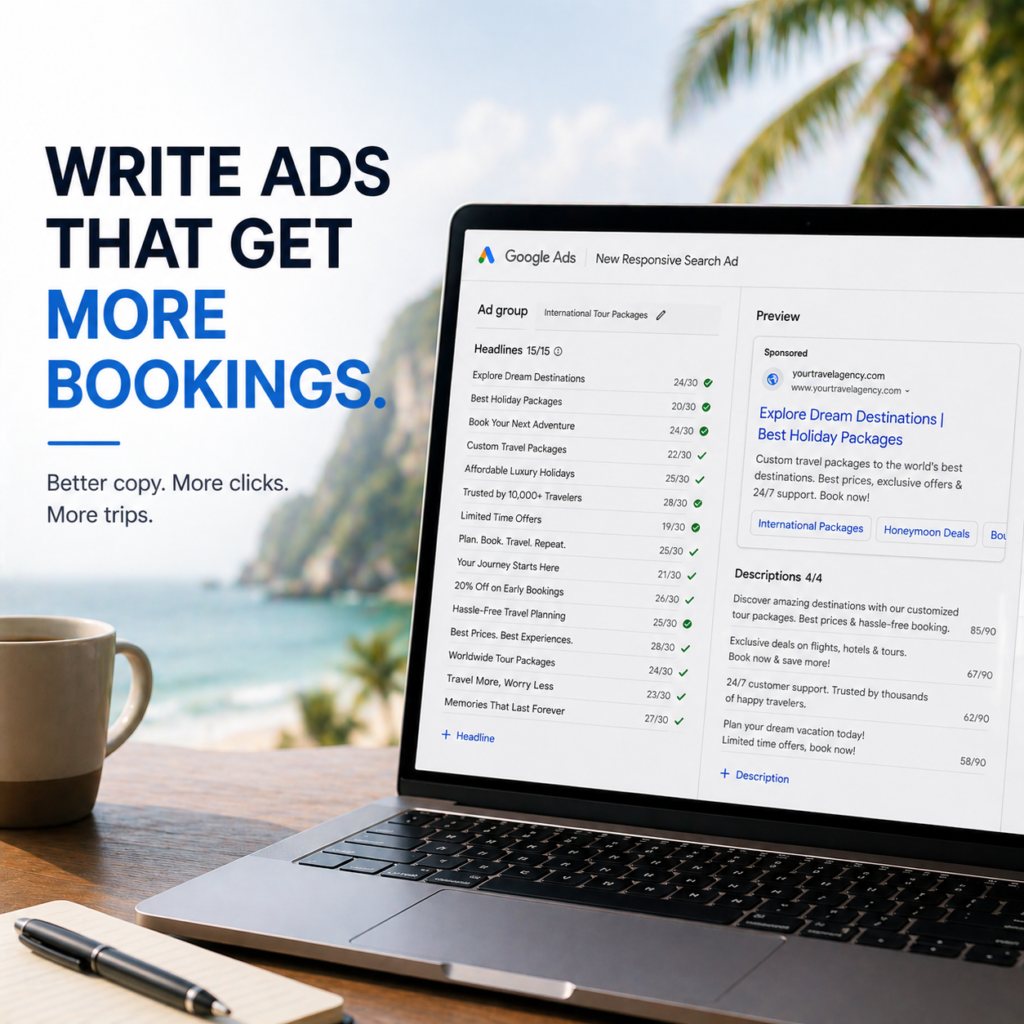
A Google Responsive Search Ad (RSA) consists of:
- Up to 15 headlines (30 characters each) — Google tests combinations and shows the best-performing ones
- Up to 4 descriptions (90 characters each) — Google shows 2 at a time
- Display URL — your domain + two optional path fields (e.g. youragency.com/Maldives/Luxury)
Google dynamically combines your headlines and descriptions to find the highest-performing combinations. This means you need to write each headline and description so it works both independently and in combination with others — they need to make sense in any order.
The Display URL — An Overlooked Opportunity
Most advertisers leave their display URL path fields blank or use generic terms. This is a mistake.
Your display URL paths are prime keyword real estate. Use them to reinforce relevance:
- youragency.com/Maldives/Luxury-Holidays
- youragency.com/Honeymoon/Maldives-Packages
- youragency.com/Safari/Kenya-Holidays
A searcher for “luxury Maldives holiday” who sees your display URL ending in /Maldives/Luxury-Holidays immediately gets a relevance signal before they’ve even read the ad.
Writing Headlines That Get Clicked
Your headlines are the most important part of your ad. They’re the first thing a searcher reads, they carry the most visual weight, and they determine whether someone reads the rest of the ad or scrolls past.
With 15 headline slots available in an RSA, you have space to cover multiple angles. Here’s how to think about it:
Headline Category 1: Keyword-Match Headlines (Write 3–4)
These headlines contain the target keyword or a very close variant. They’re essential for relevance signals — both to the searcher and to Google’s Quality Score algorithm.
Examples for “luxury Maldives holiday”:
- Luxury Maldives Holidays 2025
- Tailor-Made Maldives Packages
- Maldives Luxury Holiday Specialists
- Award-Winning Maldives Holidays
Headline Category 2: Benefit & Differentiation Headlines (Write 4–5)
What makes your agency different? Why should someone book with you rather than going directly to a hotel website or using an OTA? These headlines communicate your unique value.
Travel agency differentiators that make strong headlines:
- Expert Advice Included — Free
- Hand-Picked Resorts & Villas
- Fully ATOL Protected Holidays
- No Hidden Fees — Price Match Promise
- Speak to a Maldives Expert Today
- We’ve Visited Every Resort We Sell
- 100% Tailor-Made to Your Budget
- 500+ 5-Star Customer Reviews
Headline Category 3: Emotional & Aspirational Headlines (Write 2–3)
Travel is emotional. These headlines speak to the dream, not the transaction. They work especially well in the middle position where Google often places a second headline.
Examples:
- Your Dream Maldives Holiday Awaits
- Wake Up Over the Indian Ocean
- The Honeymoon You’ll Never Forget
- Experience the Maldives Like a Local
Headline Category 4: Call-to-Action Headlines (Write 2–3)
These tell the searcher exactly what to do next. They create momentum and reduce friction.
Examples:
- Get Your Free Quote in 24 Hours
- Speak to an Expert — No Obligation
- Start Planning Your Trip Today
- Request Your Free Itinerary Now
- Call Us Now — Expert Advice Free
Headline Writing Rules for Travel Ads
Use title case consistently. “Luxury Maldives Holidays” not “Luxury maldives holidays.” Title case looks more professional and performs better.
Avoid punctuation at the end of headlines. Google may place two headlines side by side — a period or exclamation mark mid-sentence looks odd.
Don’t repeat the same idea across multiple headlines. You have 15 slots — use them to cover different angles, not to say the same thing 5 different ways.
Include numbers where possible. “500+ 5-Star Reviews” is more credible than “Hundreds of Great Reviews.” “ATOL Protected Since 2003” is more trustworthy than “Fully Protected.”
Test location-specific headlines for local agencies. “Maldives Experts Based in London” or “Award-Winning Dubai Travel Agency” adds a local trust signal that national OTAs can’t match.
Writing Descriptions That Convert
Your descriptions have 90 characters each — enough space to make a genuinely compelling argument. Most travel agency descriptions waste this space on generic statements like “We offer great deals on holidays worldwide.” That tells the searcher nothing useful.
Great description copy does three things: expands on the headline promise, addresses a specific concern or desire, and drives action.
Description Formula for Travel Agencies
Description 1 — Value + Expertise Lead with your strongest differentiator, then support it with specifics.
“Our Maldives specialists have personally visited every resort we recommend. Fully tailor-made packages, ATOL protected, with 24/7 support throughout your trip.”
Description 2 — Social Proof + CTA Trust signals followed by a clear, specific call to action.
“Rated 4.9/5 by 600+ travellers. No booking fees, no hidden costs. Get your personalised Maldives itinerary — free, no obligation. Enquire today.”
What to Include in Travel Ad Descriptions
Trust signals that work in travel:
- Star ratings and review counts (“Rated 4.9★ by 600+ customers”)
- Industry accreditations (“ATOL & ABTA Protected”)
- Years of experience (“20 Years of Maldives Expertise”)
- Guarantees (“Price Match Promise | No Booking Fees”)
Value propositions specific to travel agencies:
- “Fully tailor-made — no two trips are the same”
- “We handle flights, transfers, accommodation and experiences”
- “Expert advice included — free, no obligation”
- “24/7 support while you travel”
CTAs that work in travel:
- “Get your free itinerary today”
- “Speak to a specialist — no obligation”
- “Request your personalised quote”
- “Start planning your dream trip”
Avoid vague CTAs like “Learn More” or “Click Here.” Be specific about what happens when someone takes action — and make it sound easy and risk-free.
Ad Extensions — The Copy Real Estate Most Agencies Ignore
Ad extensions add additional information to your ad, make it physically larger on the page, and improve both click-through rate and Quality Score. They’re free to add and consistently improve performance.
For travel agencies, these are the extensions that matter most:
Sitelink Extensions
Add links to specific pages beneath your main ad. Each sitelink has a headline (25 chars) and two description lines (35 chars each).
Travel agency sitelinks to use:
- “Maldives Holidays” → destination landing page
- “Customer Reviews” → testimonials page
- “How We Work” → your booking process page
- “Current Offers” → deals page
- “Contact Us” → enquiry form
Callout Extensions
Short phrases (25 chars) that highlight key selling points. These appear as additional text beneath your ad.
Travel agency callouts:
- ATOL & ABTA Protected
- Free Expert Consultation
- No Booking Fees
- 24/7 Holiday Support
- Price Match Promise
- Tailor-Made Itineraries
- 500+ 5-Star Reviews
Call Extensions
Show your phone number directly in the ad. For travel agencies, this is essential — many customers prefer to call and speak to someone before making an enquiry, especially for high-value bookings.
Structured Snippet Extensions
Allow you to list specific items under a header. For travel agencies, “Destinations” is the most relevant header.
Destinations: Maldives, Kenya, Japan, Sri Lanka, Seychelles
This immediately communicates your specialisms and attracts searchers looking for those specific destinations.
Location Extensions
If your agency has a physical office, location extensions show your address and link to Google Maps. Particularly valuable for local agencies — it adds a local trust signal that many OTAs lack.
Promotion Extensions
Highlight a specific offer — a discount, an added value, or a seasonal deal. Useful for time-sensitive promotions.
“10% Off Maldives Honeymoon Packages — Book by 31 March”
Ad Copy for Different Travel Campaign Types
Different campaigns need different copy approaches. Here’s how to adjust your copy framework for the most common travel agency campaign types:
Destination Campaigns (e.g. Maldives, Kenya, Japan)
Focus: Destination expertise + inspiration + personalisation Key message: “We know this destination better than anyone — let us plan it for you” Best headline angle: Expertise + unique access (“We’ve visited every resort we recommend”)
Trip Type Campaigns (e.g. Honeymoons, Family Holidays, Adventure Travel)
Focus: Understanding the specific need of that traveller Key message: “We specialise in exactly this type of trip” Best headline angle: Specificity (“Honeymoon Specialists | 1,000+ Couples”)
Deal/Offer Campaigns (e.g. Early Bird, Last Minute)
Focus: Value + urgency + credibility Key message: “This is a genuinely good deal from an agency you can trust” Best headline angle: Specific offer + social proof (“Save 15% on Maldives — 4.9★ Rated Agency”)
Competitor/OTA Campaigns
Focus: Why an agency beats booking direct or through an OTA Key message: “Expert advice, personalised service, and the same (or better) price” Best headline angle: Comparison + reassurance (“Better Than Booking.com — Here’s Why”)
Testing Your Travel Ad Copy
Writing great copy is only half the job. The other half is testing — systematically finding out what resonates most with your specific audience.
What to Test in Travel Ads
Test different headline angles against each other:
- Expertise vs. emotion (“Maldives Specialists Since 2005” vs “Wake Up Over the Indian Ocean”)
- Social proof vs. offer (“600+ 5-Star Reviews” vs “Free Expert Consultation Included”)
- Destination-specific vs. agency-wide (“Maldives Holiday Specialists” vs “Award-Winning Travel Agency”)
Test description approaches:
- Leading with trust signals vs. leading with the offer
- Long, detailed descriptions vs. short, punchy ones
- Questions (“Ready for the holiday of a lifetime?”) vs. statements
How to test properly:
- Run at least 2–3 ad variants per ad group simultaneously
- Give each variant enough impressions to be statistically meaningful (minimum 200–300 impressions per variant)
- Judge by conversion rate and cost per enquiry — not just click-through rate
- Pause the weakest performer, replace it with a new variant, and repeat
This iterative testing process means your ads get better every month — which means your cost per enquiry keeps falling over time.
Real Before & After: Travel Ad Copy Transformation
Here’s what the difference looks like in practice:
Before (Generic — typical of most travel agencies)
Headline 1: Luxury Maldives Holidays Headline 2: Book Online Today Headline 3: Great Deals Available Description: We offer luxury Maldives holidays at competitive prices. Book online or call us today for more information about our packages.
After (Specific, benefit-led, intent-matched)
Headline 1: Maldives Honeymoon Specialists Headline 2: Every Resort Personally Visited Headline 3: Free Itinerary — No Obligation Description 1: Tailor-made Maldives honeymoons designed around your budget and style. ATOL protected, no booking fees, 24/7 support throughout your trip. Description 2: Rated 4.9★ by 600+ couples. Speak to a Maldives specialist today — free, personalised itinerary within 24 hours. Enquire now.
The “after” version is more specific, more credible, more emotional, and more actionable. It speaks directly to a honeymooning couple rather than everyone. It will get a higher click-through rate from the right people — and a lower one from the wrong people, which is exactly what you want.
Common Travel Ad Copy Mistakes to Avoid ❌
1. Writing copy about your agency instead of the customer’s dream “We’ve been in business since 1998” tells the searcher nothing about what’s in it for them. Lead with their outcome, not your history.
2. Using the same ad copy for every destination A searcher for “Japan holiday” and a searcher for “Maldives holiday” have completely different mindsets and desires. Each destination campaign deserves its own tailored copy.
3. Ignoring the 30-character headline limit Many advertisers write headlines that get truncated mid-word because they’re over the character limit. Every headline should deliver its full message within the character count.
4. Writing descriptions that repeat the headline Your headlines and descriptions should work together to cover different selling points — not say the same thing twice.
5. Forgetting to add ad extensions Ad extensions are free, improve your Ad Rank, and increase your ad’s visual presence on the page. There is no reason not to use them.
6. Never testing or refreshing copy Ad copy fatigue is real. If your CTR has been declining steadily, your copy needs refreshing. Make testing a monthly habit.
Final Thoughts
Writing great Google Ads copy for travel agencies comes down to one principle: understand exactly what your customer needs to hear at the exact moment they’re searching, and say it more clearly and compellingly than everyone else on the page.
Match your copy to search intent. Lead with benefits, not features. Use social proof and trust signals. Make your CTA specific and risk-free. Test consistently.
The travel agencies that get this right don’t just get more clicks — they get better clicks. Higher-intent, better-qualified enquiries from people who’ve already been sold on why your agency is the right choice before they’ve even landed on your page.
For the full picture of running Google Ads as a travel agency, explore the rest of our travel marketing series — starting with our Complete Digital Marketing Guide for Travel Agencies. 🌍