
How to Write Landing Page Copy for Travel Agencies (That Actually Converts) ✍️
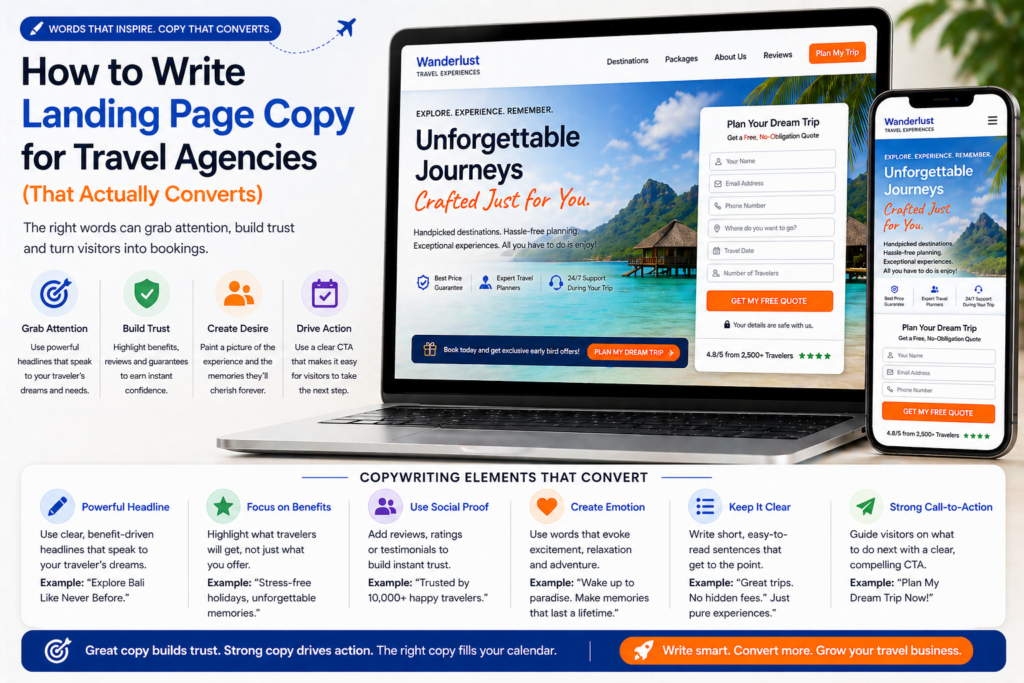
💡 Summary Great landing page copy doesn’t just describe your travel agency — it speaks directly to what your ideal customer wants, addresses their hesitations, and moves them confidently toward making an enquiry. In this guide, I’ll walk you through how to write every section of a travel agency landing page — from the headline to the CTA — with proven formulas, real examples, and the copywriting principles that consistently drive bookings.
Most travel agency landing pages are written by people who know their product inside out — and that’s exactly the problem.
When you know your destinations deeply, you write about the destinations. You describe the resorts, the experiences, the itineraries. You talk about your agency’s history and expertise. You explain how the booking process works.
All of that is useful. But none of it is what great landing page copy for travel agencies is actually about.
Great landing page copy starts with the customer — not the product. It speaks to their desire, acknowledges their concern, and makes taking the next step feel easy and obvious. It’s less about what you offer and more about what they’ll experience.
This guide shows you exactly how to write it — section by section. 👇
The Core Principle: Write for One Person, Not Everyone
Before writing a single word, get specific about who you’re writing for.
A landing page written for “anyone who wants a holiday” will convert almost nobody. A landing page written for “couples in their late 30s planning their honeymoon, who want something genuinely special but feel overwhelmed by the options and aren’t sure where to start” will convert the right people at a significantly higher rate.
The more specifically you can picture the person reading your page — their dream, their concern, their situation — the more directly you can speak to them. And the more directly you speak to them, the more they feel understood. And when people feel understood, they trust you. And when they trust you, they enquire.
Before writing any landing page, answer these questions:
- Who is this person? (Age, relationship status, income, travel experience)
- What do they want? (The dream outcome — “a once-in-a-lifetime honeymoon that’s completely stress-free”)
- What are they afraid of? (Spending a lot of money and being disappointed, not knowing which resort to choose, the trip not living up to expectations)
- What have they already tried? (Googled Maldives, read TripAdvisor, looked at Booking.com, felt overwhelmed)
- Why haven’t they booked yet? (Unsure who to trust, worried about cost, not sure if a travel agent is worth it)
With these answers in hand, you have everything you need to write copy that speaks directly to a real human being rather than a generic audience.
Section 1: The Headline — Your Single Most Important Line of Copy
Your headline is the first thing every visitor reads. It determines whether they stay and read the rest of the page — or leave immediately.
Most travel agency headlines fail because they’re written from the agency’s perspective:
- “Welcome to Sunrise Travel”
- “Your Trusted Travel Partner Since 2003”
- “Holidays for Every Budget”
These tell the visitor about you. Great headlines tell the visitor about them — specifically, what they’ll get and why it matters.
The 4 Headline Formulas That Work for Travel Landing Pages
Formula 1: Outcome + Differentiator [What they want] — [What makes you the right person to deliver it]
- “Your Perfect Maldives Honeymoon — Planned by Specialists Who’ve Visited Every Resort”
- “A Kenya Safari Built Exactly Around You — Not Around What’s Easy for Us to Book”
- “The Japan Holiday You’ve Always Imagined — Designed Around Your Dates, Budget and Style”
Formula 2: Specificity + Benefit [Specific destination/trip type] — [Specific benefit]
- “Tailor-Made Maldives Honeymoons — Free Personalised Itinerary Within 24 Hours”
- “Luxury African Safaris — Fully Planned, ATOL Protected, 24/7 Support Included”
- “Caribbean Cruises for Families — Expert Advice, No Booking Fees, Best Price Guarantee”
Formula 3: Problem + Solution [The frustration they feel] — [How you solve it]
- “Planning a Luxury Holiday Is Overwhelming — We Handle Everything”
- “Hundreds of Maldives Resorts, No Idea Which One Is Right for You — We Do”
- “Dream Honeymoon, Zero Stress — That’s What We Do”
Formula 4: Direct Question [A question that articulates their exact desire]
- “Ready to Stop Dreaming About the Maldives and Actually Go?”
- “Want a Kenya Safari That Goes Beyond the Tourist Trail?”
- “Looking for Someone Who Actually Knows Japan?”
Headline Writing Rules
- Keep it under 12 words — shorter headlines are read more completely
- Be specific — “Maldives Honeymoon Specialists” beats “Luxury Holiday Experts”
- Avoid jargon — “bespoke” and “curated” have been overused to meaninglessness in travel
- Don’t try to be clever — clarity always beats creativity on a landing page
- Test at least two different headlines — even small wording changes can shift conversion rates significantly
Section 2: The Sub-headline — Expand and Invite
Your sub-headline (the line directly below your main headline) has one job: expand on the headline promise and invite the visitor to take the next step.
It should answer two implicit questions: “How?” and “What do I do now?”
Sub-headline formula: [How you deliver the promise] + [What to do next] + [Risk removal]
Examples:
- “Tell us about your dream trip and we’ll design a personalised itinerary — free, no obligation, within 24 hours.”
- “Our Maldives specialists have personally visited every resort we recommend. Get your free consultation today — no commitment required.”
- “We handle every detail from flights to experiences. Start planning your trip with a free, no-obligation quote.”
Note the consistent elements: what you’ll do, how fast, and the explicit removal of risk (“free”, “no obligation”, “no commitment”). These three components together significantly reduce the hesitation that stops visitors from taking action.
Section 3: The Benefits Section — Sell the Outcome, Not the Features
Most travel agencies write benefit sections that list features:
- ✓ ATOL Protected
- ✓ 20 Years Experience
- ✓ Tailor-Made Itineraries
- ✓ 24/7 Support
These are fine — but they’re not compelling because they describe what you have, not what the customer gets.
Great benefit copy translates every feature into an outcome the customer actually cares about.
Feature-to-Benefit Translation for Travel
| Feature | Benefit |
|---|---|
| ATOL Protected | “Your money is 100% protected — if anything changes, you’re covered” |
| 20 Years Experience | “Two decades of relationships with the best resorts, guides and suppliers in the world” |
| Tailor-Made Itineraries | “Your trip is built around you — not a template, not what’s easy for us to sell” |
| 24/7 Support | “If anything goes wrong while you’re travelling, we answer the phone. Night or day.” |
| Personally Visited Resorts | “We’ve stayed in the properties we recommend — so we know what actually lives up to the photos” |
| No Booking Fees | “You pay the same price as booking direct — but with a specialist looking after every detail” |
When writing your benefits section, lead with the outcome in bold and follow with a sentence that makes it tangible and specific.
Section 4: Social Proof Copy — The Words That Build Trust
The social proof section of your landing page is where you prove your claims — and the copy surrounding your reviews and testimonials is just as important as the testimonials themselves.
How to Frame Testimonials
Don’t just drop a quote and a star rating. Introduce each testimonial with a sentence that highlights the specific thing it proves.
Example framing:
“Don’t just take our word for it — here’s what our customers say about planning their Maldives honeymoon with us:”
Then the testimonial:
“We had no idea where to start. [Agency] designed our entire trip — flights, transfers, resort, and experiences — and it was more perfect than we’d imagined. The overwater villa they recommended had the best house reef we’ve ever snorkelled. We’ll never book a big trip any other way.” — Sarah & James, Maldives Honeymoon, October 2024
Notice the specific details: what they were worried about before, what you delivered, one specific highlight. Generic praise (“great service, 5 stars!”) builds no trust. Specific, experiential testimonials build enormous trust.
Writing Your Review Count Line
Don’t just display a star rating — frame it with context:
Weak: ⭐⭐⭐⭐⭐ 5 Stars Strong: “Rated 4.9/5 by 600+ travellers — 96% say they’d recommend us to a friend”
The second version is more credible because it’s specific and it includes a social proof metric (recommendation rate) that goes beyond a star rating.
Section 5: The Enquiry Form Copy — Every Word Matters
The copy surrounding your enquiry form is doing conversion work right at the moment of maximum hesitation. Get every element right.
Form Headline
Don’t leave your form unlabelled. A short headline above the form reinforces the offer and removes uncertainty.
Weak: “Contact Us” Strong: “Get Your Free Maldives Honeymoon Itinerary” Strongest: “Tell Us About Your Dream Trip — We’ll Design Your Itinerary Free Within 24 Hours”
Field Labels
Label every field clearly. Use helpful placeholder text inside the field to guide completion.
- First Name: placeholder: “e.g. Sarah”
- Email: placeholder: “We’ll send your itinerary here”
- Destination: placeholder: “e.g. Maldives, Kenya, Japan”
- Travel Dates: placeholder: “Approximate dates are fine”
- Budget: placeholder: “e.g. £5,000–£8,000 per couple”
Small details like “approximate dates are fine” and “per couple” reduce friction and pre-answer the questions that make visitors hesitate.
Submit Button Copy
Never use “Submit.” It’s passive, cold, and tells the visitor nothing about what happens next.
Use action-oriented copy that describes the outcome:
- “Get My Free Itinerary”
- “Start Planning My Trip”
- “Speak to a Specialist”
- “Request My Free Quote”
- “Yes — Plan My Dream Trip”
Privacy Line
A single reassurance line beneath the button reduces abandonment:
“We’ll never share your details. No spam, ever. Unsubscribe any time.”
What Happens Next
Tell visitors exactly what to expect after they submit. Uncertainty is a conversion killer.
“Once you submit, you’ll receive an immediate confirmation. One of our [Destination] specialists will review your enquiry and send you a personalised itinerary within 24 hours — completely free, no obligation to book.”
Section 6: The FAQ Copy — Answer Objections Directly
Your FAQ section is where you write directly to the doubts and concerns that are stopping hesitant visitors from enquiring.
The key is to write FAQ answers that are honest, specific, and confidence-building — not vague corporate-speak.
FAQ Copy Examples for Travel Agencies
Q: How much does it cost to use your service?
Weak answer: “Our prices are competitive and we offer great value.”
Strong answer: “There’s no fee for our planning and consultation service — it’s completely free. You pay the same price as booking direct with the hotel or airline, and in many cases less, because of our supplier relationships. We’ll always be upfront about exactly what’s included and what isn’t before you commit to anything.”
Q: How quickly will you respond to my enquiry?
Weak answer: “We aim to respond as quickly as possible.”
Strong answer: “We respond to all enquiries within 24 hours on weekdays, usually sooner. You’ll receive an immediate confirmation email when you submit, and a personalised itinerary or response from your specialist within one working day.”
Q: Is my money safe if I book through you?
Weak answer: “Yes, we’re fully accredited.”
Strong answer: “Absolutely. Every booking we make is ATOL protected — which means if anything goes wrong with your flights or package, your money is 100% covered and we’ll get you home. We’re also ABTA members, which gives you additional financial protection and access to a dispute resolution scheme if you ever need it.”
The pattern is consistent: be specific, be reassuring, and demonstrate knowledge rather than hiding behind vague corporate language.
Section 7: The Conclusion CTA — Close with Confidence
Your final CTA, at the bottom of the page, speaks to visitors who’ve read everything and are almost ready — but need one final nudge.
The closing CTA should:
- Acknowledge the journey (“You’ve made it this far because you’re serious about this trip”)
- Reinforce the zero-risk nature of the next step
- Give a specific, confident invitation
Example closing CTA copy:
“You’ve spent a long time dreaming about this trip. Let us help you make it real.”
“Getting started is completely free — no commitment, no pressure. Just tell us what you’re looking for and we’ll design something remarkable.
[Get My Free Itinerary]
Questions first? Call us on [number] or chat with us on WhatsApp — we’re here Mon–Fri 9am–6pm.”
This closing section is warm, confident, and removes every remaining barrier to action.
The Travel Landing Page Copywriting Checklist
Before publishing any landing page, check every section against this list:
Headline:
- Speaks to the customer’s desired outcome, not your agency
- Specific to this destination or trip type
- Under 12 words
- Matches the ad or search result that sent the visitor here
Sub-headline:
- Expands on the headline promise
- Tells the visitor what to do next
- Includes risk removal language
Benefits:
- Each benefit is written as an outcome, not a feature
- Specific and credible — no vague claims
Social Proof:
- Testimonials include name, destination, and trip date
- At least one testimonial includes a specific detail about the trip
- Review count is stated with context
Form:
- Headline above the form reinforces the offer
- 6 fields or fewer
- Submit button uses outcome-oriented copy
- Privacy reassurance line present
- “What happens next” statement present
FAQ:
- Addresses the top 4–5 actual objections
- Answers are specific and confidence-building — not vague
Closing CTA:
- Reinforces zero-risk
- Includes a specific, warm invitation
- Offers an alternative (phone/WhatsApp) for visitors not ready to submit a form
Common Copywriting Mistakes on Travel Landing Pages ❌
1. Writing for everyone Copy that speaks to every possible customer type ends up speaking to nobody powerfully. Pick one customer profile and write directly to them.
2. Using travel industry jargon “Bespoke”, “curated”, “hand-picked”, “tailor-made” — these words have been so overused in travel that they’ve lost all meaning. Replace them with specific, concrete language.
3. Telling instead of showing “We’re the best Maldives specialist in the UK” is a claim anyone can make. “We’ve personally visited 40 Maldives resorts and planned over 1,200 Maldives holidays since 2008” is evidence.
4. Burying the CTA in copy Your CTA should stand visually apart from the body copy — it should be impossible to miss. Don’t embed it in a paragraph of text.
5. Making it about the destination, not the customer Destination information belongs in your blog content. Your landing page copy should be primarily about what the customer will experience — not an encyclopaedia entry about the Maldives.
6. Never testing copy variations Your first headline is a hypothesis, not a final answer. Test at least two headline variants before deciding which performs better. Small wording changes can produce large conversion rate differences.
Final Thoughts
Writing great landing page copy for travel agencies comes down to one discipline: putting the customer’s desire and concern at the centre of every word you write.
Lead with what they want. Prove you can deliver it. Remove every barrier to taking the next step. And do it in the specific, credible, human voice that makes a potential customer feel they’ve found exactly the right specialist for their trip.
The copy framework in this guide — headline, sub-headline, benefits, social proof, form, FAQ, closing CTA — gives you a complete structure to work from. Apply it to your highest-traffic destination page first, measure the improvement, then systematically apply it across your full landing page portfolio.
For more on getting every element of your travel landing pages right, read our guides on landing page best practices for travel agencies and landing page design tips for travel agencies. And for the complete travel agency digital marketing strategy, head back to our Complete Digital Marketing Guide for Travel Agencies. 🌍