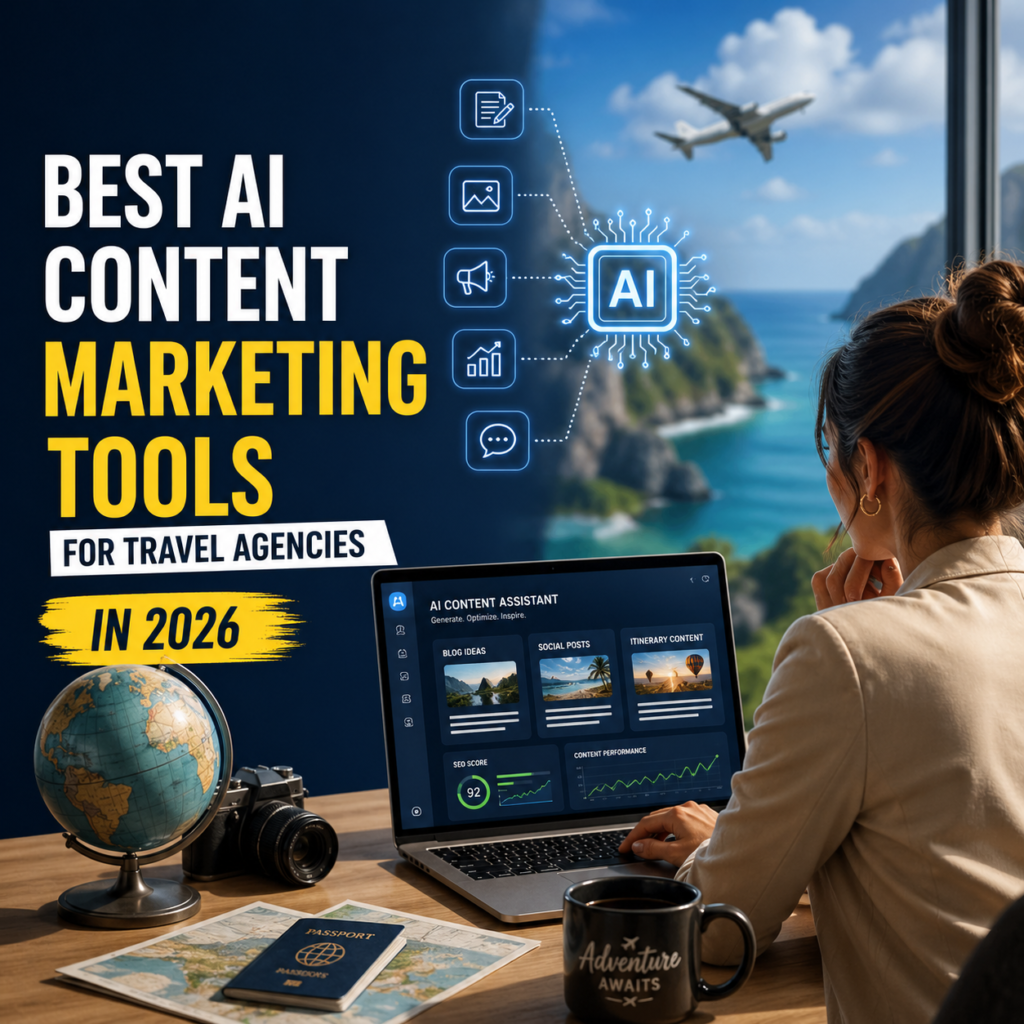

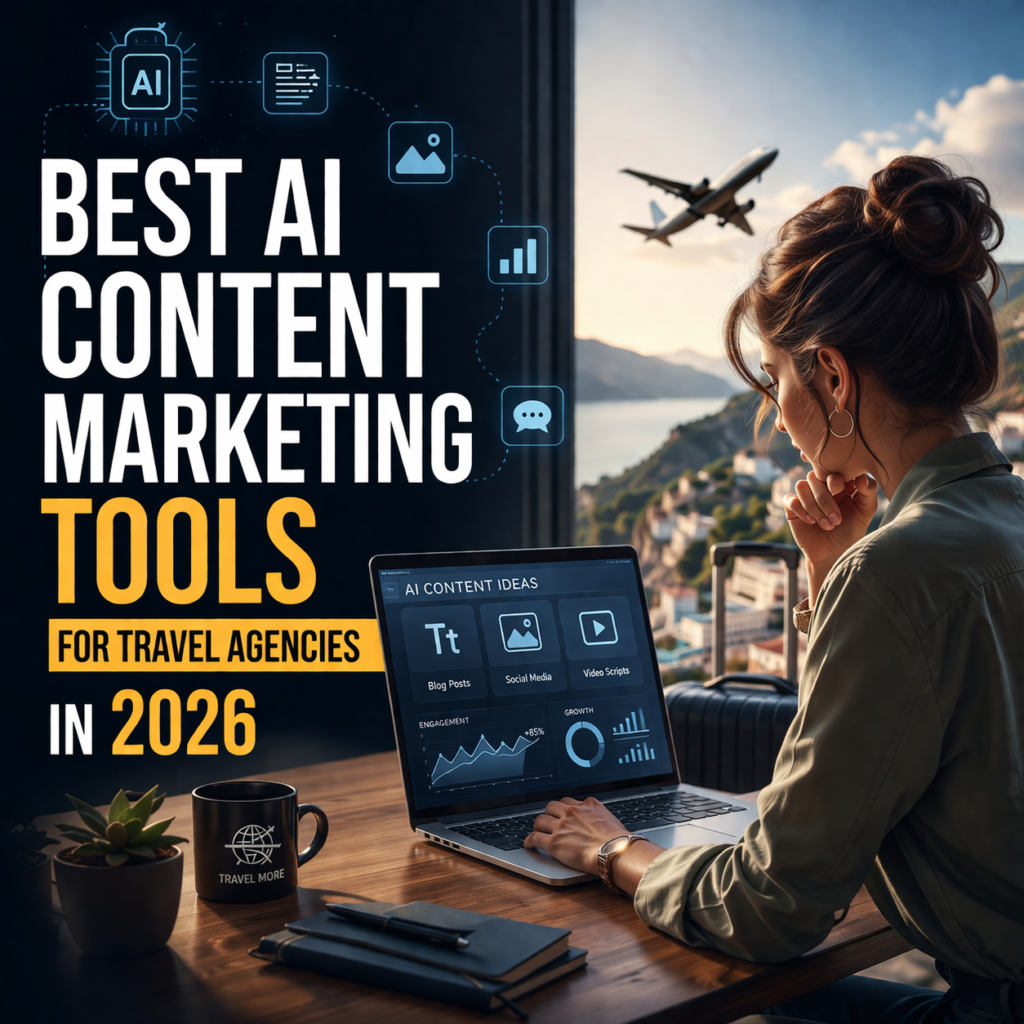
Best AI Content Marketing Tools for Travel Agencies in 2026
🎯 TL;DR
Small travel agencies are now using AI content marketing tools to produce blog posts, social media captions, email campaigns, and destination videos in a fraction of the time — without hiring a full marketing team. Tools like ChatGPT, Canva AI, Buffer, and Brevo help agencies stay visible online, attract more enquiries, and convert leads into bookings. The best approach is to start with a simple 3-tool stack and expand from there.
💡 Summary
Running a travel agency means you’re already juggling enquiries, itineraries, supplier relationships, and client follow-ups. Creating consistent marketing content on top of all that? Most small agencies either skip it or post sporadically — and then wonder why bookings are slow.
AI content marketing tools for travel agencies change that equation. They don’t replace your expertise or your voice. They remove the blank-page problem, cut production time, and help you show up consistently across the channels where your potential clients are already scrolling.
This guide covers the best AI tools across five content categories — writing, visuals, social media, email, and video — and finishes with a simple starter stack you can implement this week.
Why Travel Agencies Are Turning to AI for Content Marketing
The short answer: Small travel agencies are competing against OTAs with massive marketing budgets. AI tools level the playing field by doing in minutes what used to take hours — without sacrificing quality.
Here’s the problem most small agencies face: you know your destinations inside out. You’ve got great client reviews. You have genuine expertise that no booking website can replicate. But you’re posting once a fortnight on Instagram, your last blog post was three months ago, and your email list hasn’t heard from you since the January sale.
It’s not a strategy problem. It’s a time problem.
Large online travel agencies (OTAs) employ entire content teams. They publish daily. They A/B test subject lines. They produce destination videos every week. Independent agencies can’t match that output — not without help.
That’s exactly what AI tools provide. According to a 2025 survey by Arival, three in five tour operators are already using AI to write product descriptions, website copy, and social media content. The agencies not using these tools are already falling behind.
The good news? You don’t need to adopt a dozen tools at once. A focused AI content marketing stack of three to four tools can transform your output without overwhelming you.
AI Writing Tools — Draft Blogs, Emails and Captions in Minutes
The short answer: AI writing tools take your raw knowledge — a destination, an itinerary, a client story — and turn it into polished, publish-ready content in seconds.
ChatGPT, Claude and Gemini
These general-purpose AI writing assistants are the easiest entry point for travel agencies. You feed them context and they produce drafts you can edit and publish.
Practical prompts that work well for travel content:
- “Write a 600-word blog post about the best time to visit the Maldives for a couple celebrating their anniversary.”
- “Turn these 5 bullet points about our Bali package into an Instagram caption with a call to action.”
- “Write a follow-up email to a client who enquired about a safari but hasn’t booked yet.”
The key is specificity. The more detail you give — destination, traveller type, tone of voice, key selling points — the better the output.
Always review the draft before publishing. AI writing tools are fast, but your personal knowledge of the destination and your client relationships are what make the content trustworthy and distinctive.
Jasper
Jasper is built specifically for marketing copy, which makes it particularly useful for travel agencies producing high volumes of promotional content. It excels at:
- Destination highlights and package descriptions
- Google and Facebook ad copy
- Email subject lines and promotional announcements
- Blog post introductions that hook readers immediately
If you regularly need to produce variations of the same content — say, five different caption versions for a Dubai package — Jasper speeds that up considerably.
Internal link: Already running Google Ads for your agency? Read our guide to Google Ads copy for travel agencies to see how AI-assisted copy can improve your ad performance too.
AI Image and Video Tools — Create Scroll-Stopping Visuals
The short answer: You no longer need a design budget or a video production team to produce professional-looking travel content. AI visual tools make it possible for any agency to create on-brand graphics and short videos in minutes.
Canva AI
Canva has long been the go-to design tool for small businesses, and its AI features have made it even more powerful for travel agencies. With Canva’s Magic Design and text-to-image tools, you can:
- Generate destination-inspired graphics for Instagram and Facebook posts
- Create branded story templates for promotions and announcements
- Produce carousel posts with consistent layouts across every slide
- Resize one design automatically for multiple platforms
The AI image generator is particularly useful for atmospheric destination visuals — think moody Santorini sunsets or lush Bali rice terraces — when you don’t have your own photography.
[Alt: Travel agency using Canva AI to create Instagram destination graphics]
Runway and Pika (Short-Form Video)
Short-form video is now the highest-performing content format on Instagram, Facebook, and TikTok. But producing video used to require a camera, a location, editing software, and time.
Tools like Runway and Pika allow travel agencies to create short destination videos from images, text prompts, or existing footage. You can produce a 15-second atmospheric clip of a Greek island or a Kenyan safari for a fraction of what professional production would cost.
One important caveat: travellers still value authenticity. Real photos from your client trips and genuine behind-the-scenes content will always outperform purely AI-generated visuals for building trust. Use AI tools to supplement your real content, not replace it.
AI Social Media Scheduling Tools — Stay Consistent Without the Daily Grind
The short answer: Consistency beats frequency. AI scheduling tools help travel agencies show up every week without spending an hour a day on social media.
Most travel agencies know they should be posting consistently on Instagram and Facebook. Most don’t — because creating and scheduling content daily is genuinely time-consuming when you’re also running trips and handling enquiries.
Buffer and Later
Both Buffer and Later are social media scheduling platforms with built-in AI features for caption generation, hashtag suggestions, and optimal posting time recommendations.
The workflow is simple:
- Upload your destination photo or video
- Give the AI a brief description of the destination or offer
- Review and edit the generated caption
- Schedule it at the AI-recommended posting time
Neither tool replaces a good social media strategy, but both dramatically reduce the friction of showing up consistently.
Best posting times for travel content (based on platform data):
- Instagram: Tuesday and Wednesday, 10am–12pm and 7pm–9pm
- Facebook: Tuesday to Thursday, 1pm–3pm
- LinkedIn (for B2B travel): Tuesday to Thursday, 8am–10am
The “Batch and Schedule” Workflow
Rather than creating content daily, batch your social media content once a week. Set aside 60–90 minutes on a Sunday or Monday to:
- Select 5–7 destination images or short videos
- Use an AI writing tool to generate captions for each
- Schedule them across the week using Buffer or Later
That’s your social media handled for the whole week — in under two hours.
Internal link: Want to build a complete content plan around this workflow? Our guide on how to create a content calendar for travel agencies walks you through the full system.
AI Email Marketing Tools — Automate Repeat Bookings
The short answer: Your past clients are your warmest prospects. AI email tools help you stay in front of them automatically — without writing every email from scratch.
Email remains the highest-ROI marketing channel for leisure travel agencies. A client who just returned from a honeymoon in the Maldives is far more likely to book with you again than a cold prospect who found you on Google. But most agencies lose touch with past clients within six months of their trip.
Brevo (Formerly Sendinblue)
Brevo is particularly well-suited to travel agencies because of its automation workflows. You can set up:
- Post-trip email sequences — a “How was your trip?” email three days after return, followed by a “Where next?” offer two weeks later
- Anniversary reminders — perfect for honeymoon and anniversary travel markets
- Seasonal campaign triggers — automated emails when peak booking seasons open (summer holidays, Eid, Christmas)
Brevo’s AI features handle subject line generation and send-time optimisation — meaning your emails go out at the moment each individual recipient is most likely to open them.
The “One Client, Three Touchpoints” Email Framework
This simple framework ensures every past client hears from you at least three times a year without requiring constant manual effort:
- Post-trip follow-up (3–7 days after return): Thank them, ask for a review, share a photo from their destination
- Anniversary email (12 months after booking): “It’s been a year since your [destination] trip — ready to start planning the next one?”
- Seasonal offer (aligned to their travel preferences): A relevant deal or destination suggestion based on where they’ve previously travelled
Set these up once in Brevo. They run automatically for every client thereafter.
Internal link: For a complete guide to using email in your agency’s marketing, read our in-depth post on email marketing for travel agencies.
The “Start Small” AI Stack for Travel Agencies
The short answer: You don’t need ten tools. You need three good ones — one for writing, one for visuals, and one for scheduling.
The biggest mistake travel agencies make when adopting AI tools is trying to implement everything at once. You end up with five subscriptions, a confusing workflow, and no consistent output.
Instead, build what I call The Travel Agency AI Stack — a focused set of three tools that cover your core content needs:
| Layer | Tool | What It Does |
|---|---|---|
| ✍️ Writing | ChatGPT or Claude | Blog posts, captions, email drafts |
| 🎨 Visuals | Canva AI | Graphics, carousels, story templates |
| 📅 Scheduling | Buffer or Later | Caption generation, posting schedule |
Start here. Use these three tools consistently for four weeks. Once the workflow feels natural, you can layer in email automation (Brevo) or video tools (Runway) as your next step.
The agencies that get the most from AI aren’t the ones with the most tools. They’re the ones that identified their biggest content bottleneck — usually “I never have time to write anything” — and solved that precisely.
Final Thoughts — AI Is Your Content Assistant, Not Your Replacement
AI content marketing tools for travel agencies are not about removing the human from your marketing. They’re about removing the friction.
Your knowledge of a destination, your relationship with clients, your genuine passion for travel — none of that can be automated. What AI removes is the blank page, the hour spent formatting a newsletter, the procrastination around posting because you’re not sure what to write.
Pick one tool from this list. Use it this week. See how much faster your content comes together.
Start with ChatGPT or Claude (both have free tiers), use Canva AI for your next social post, and schedule a week’s worth of content in Buffer. That’s your AI content marketing stack — ready in an afternoon.
Are AI content marketing tools expensive for small travel agencies?
Most AI tools have free tiers that are sufficient to get started. ChatGPT and Claude both offer free access. Canva has a generous free plan. Buffer’s free plan covers three social media accounts. You can build a functional AI content stack for zero cost, then upgrade as your output scales.
Will Google penalise AI-written content on my travel blog?
Google does not penalise AI-generated content as a category. What it penalises is low-quality, unhelpful content — regardless of how it was written. AI-assisted content that is accurate, well-structured, and genuinely useful for travellers will rank just as well as manually written content. Always review and personalise AI drafts before publishing.
Which AI tool is best for writing travel blog posts?
ChatGPT and Claude are both excellent for travel blog posts. Claude tends to produce more natural, conversational prose. ChatGPT is strong for structured listicles and guides. Jasper is worth considering if you’re producing high volumes of promotional copy. Start with the free versions of ChatGPT or Claude and see which output style you prefer.
Can AI tools create content in my brand voice?
Yes — with the right prompts. Give your AI writing tool a few examples of your existing content and ask it to match the tone. You can also include specific instructions: “Write in a friendly, knowledgeable tone — like a trusted travel expert, not a brochure.” The more context you provide, the closer the output will be to your natural voice.
How much time can AI tools realistically save a travel agency?
Based on agency workflows, AI tools can reduce content creation time by 60–70%. A blog post that takes 3 hours to research and write manually can be drafted in 30–40 minutes with AI assistance. A week’s social media captions that take 2 hours can be produced in under 30 minutes. Over a month, that’s 10–15 hours returned to revenue-generating work.
Are AI-generated images good enough for travel marketing?
AI image generators have improved significantly and produce results that perform well in social feeds — particularly for atmospheric destination content. However, authentic client photos and real destination images still outperform AI-generated visuals for building trust. Use AI visuals to supplement your real photography, not replace it.
What’s the best AI tool for travel agency email marketing?
Brevo (formerly Sendinblue) is the strongest choice for travel agencies specifically because of its automation workflows, CRM features, and AI-powered subject line generation. It’s well-suited to post-trip sequences, anniversary reminders, and seasonal campaign triggers. Mailchimp is also a strong option with good AI features for agencies already using it.
Do I need any technical skills to use these AI content tools?
No. Every tool mentioned in this guide is designed for non-technical users. ChatGPT and Claude work like a chat interface — you type a request in plain English and receive a response. Canva AI is drag-and-drop. Buffer and Later are point-and-click schedulers. If you can use WhatsApp and Instagram, you can use these tools.