
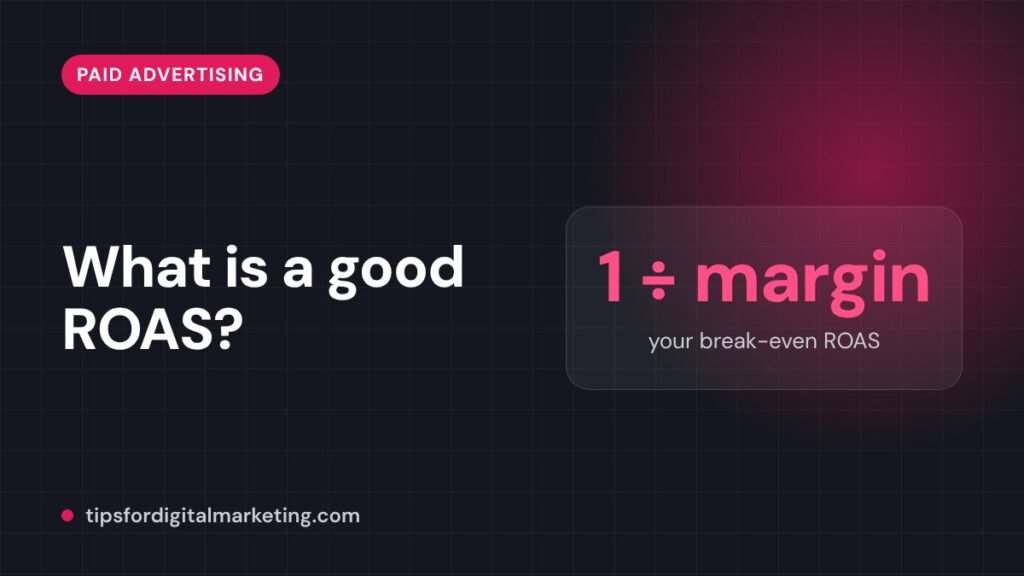

“What’s a good ROAS?” gets asked in every ads meeting, and the usual answer, “4x”, is wrong for most businesses. A good ROAS is any ROAS comfortably above your break-even point, and that point depends on your margin, not on an industry average.
This guide shows you how to work out your own number, then puts the published benchmarks in context so you know what they can and can’t tell you.
The short answer
- ROAS (return on ad spend) = revenue from ads ÷ ad spend.
- Break-even ROAS = 1 ÷ your gross margin.
- A good ROAS is your break-even ROAS plus the profit you want to keep.
If you keep 40% of each sale after product costs, your break-even ROAS is 1 ÷ 0.40 = 2.5x. At 2.5x the ads pay for themselves and nothing more. At 4x you are making money. A business with a 20% margin needs 5x just to break even, so the same 4x loses money.
You can run your own numbers in our free ROAS and break-even calculator.
Break-even ROAS by margin
| Gross margin | Break-even ROAS | ROAS for 10% profit after ads |
|---|---|---|
| 15% | 6.67x | 20x |
| 20% | 5x | 10x |
| 30% | 3.33x | 5x |
| 40% | 2.5x | 3.33x |
| 50% | 2x | 2.5x |
| 60% | 1.67x | 2x |
| 75% | 1.33x | 1.54x |
The last column uses target ROAS = 1 ÷ (margin − target profit). With a 30% margin and a 10% profit target, that is 1 ÷ 0.20 = 5x.
Notice how quickly the bar drops as margin rises. Software, courses and services with high margins can be very profitable at 2x. Resellers and travel agencies on thin margins need far higher numbers.
What the benchmarks say
Published ROAS benchmarks come almost entirely from e-commerce brands, because they track revenue per order. Treat them as a sense check, not a target.
Triple Whale (e-commerce brands). From October 1, 2025, to September 30, 2026, the median ROAS for brands advertising on Triple Whale was 2.22. By channel, the median ROAS across Triple Whale brands was 3.18 on Google Ads, 1.88 on Meta Ads, and 1.47 on TikTok Ads.
What this tells you:
- Google usually reports a higher ROAS than Meta or TikTok. Search ads catch people who are already looking, so more of them buy. Social ads find people earlier, and some of the sales they start get credited elsewhere.
- The typical brand is not at 4x. If your Meta ROAS is 2x and your margin is 60%, you are doing fine.
- Industry matters. Triple Whale’s table shows a wide spread by industry and platform, so compare yourself with your own category where you can.
Why your platforms disagree with your bank account
Each ad platform counts the sales it was involved in, using its own attribution window. The same sale can be claimed by Google, Meta and TikTok at once, so adding up platform ROAS figures overstates what the ads earned.
Two habits keep you honest:
- Track blended ROAS. Total revenue ÷ total ad spend, from your store, CRM or accounts. It can’t be double-counted.
- Use platform ROAS to compare campaigns within that platform. It’s good for deciding which Meta campaign to scale, and poor for deciding whether Meta as a whole is worth it.
If you haven’t set up conversion tracking yet, fix that first. Our guide to Google Ads conversion tracking walks through it.
ROAS for lead generation businesses
If you sell services, you don’t see revenue in the ad platform. You see leads. Work backwards:
- Find your close rate: out of 10 leads, how many pay?
- Find your average gross profit per customer.
- Break-even cost per lead = close rate × gross profit per customer.
Example: a travel agency closes 1 in 5 enquiries, and each booking earns AED 1,500 in commission. Break-even cost per lead is 0.2 × 1,500 = AED 300. Any campaign below AED 300 per enquiry is making money, and one at AED 450 is losing it, whatever its “ROAS” says.
Our ad budget calculator does this sum for you when you add a close rate and customer value.
When a low ROAS is fine
When customers buy again. A first order at break-even can be a great deal if the average customer buys three times. Judge those campaigns on customer lifetime value, not the first sale. Our guide to measuring marketing ROI across channels covers this.
When the campaign feeds others. Prospecting campaigns on Meta or TikTok often show a lower ROAS because they fill the remarketing and search campaigns that close the sale. Cut them and watch whether the other campaigns drop too before you decide.
When you are testing. The first two to four weeks of a new campaign are expensive. Set a test budget you can afford to lose, then judge.
When a high ROAS is a warning sign
Brand campaigns. People who search your company name were probably going to buy anyway. A 15x ROAS on brand search says little about the value of your ads. Report brand and non-brand campaigns separately.
Retargeting only. If every campaign targets people who already visited, ROAS looks great while the pool of new customers dries up.
A tiny budget. 8x on $200 a month often falls apart at $2,000. Raise the budget in steps of 20 to 30% and watch what happens.
How to raise ROAS
- Cut wasted spend first. On Google, check the search terms report weekly and add negative keywords. On Meta, turn off placements that spend without results.
- Fix the landing page. A page that converts 4% instead of 2% doubles ROAS without touching the ads. See our landing page examples.
- Raise order value. Bundles, upgrades and minimum spends for free delivery all increase revenue per click.
- Bid for value, not volume. Once you have enough conversion data, value-based bidding (Target ROAS on Google) tells the platform which sales matter most. Our guide to bidding strategies explains when to switch.
- Refresh creative. On Meta and TikTok, results drop as the same people see the same ad again and again. Plan new ads every few weeks.
FAQ
Is 4x a good ROAS?
It is good if your gross margin is above 25%, because your break-even ROAS is then below 4x. With a 20% margin, 4x loses money. Always compare ROAS with 1 ÷ margin.
What is a good ROAS for Google Ads?
Triple Whale’s e-commerce data puts the median at 3.18 for Google Ads. Search campaigns targeting people ready to buy can do much better, and brand campaigns better still. Judge each against your break-even ROAS.
What is a good ROAS for Facebook and Instagram ads?
The median across Triple Whale brands was 1.88 for Meta Ads. Meta finds people earlier in the buying journey, so its reported ROAS is usually lower than Google’s even when it is driving sales.
What’s the difference between ROAS and ROI?
ROAS compares revenue with ad spend. ROI compares profit with your total investment, including product costs, fees and time. A campaign can have a 3x ROAS and a negative ROI.
How do I calculate break-even ROAS?
Divide 1 by your gross margin as a decimal. A 35% margin gives 1 ÷ 0.35 = 2.86x. The ROAS calculator does it for you and shows profit after ad costs.