
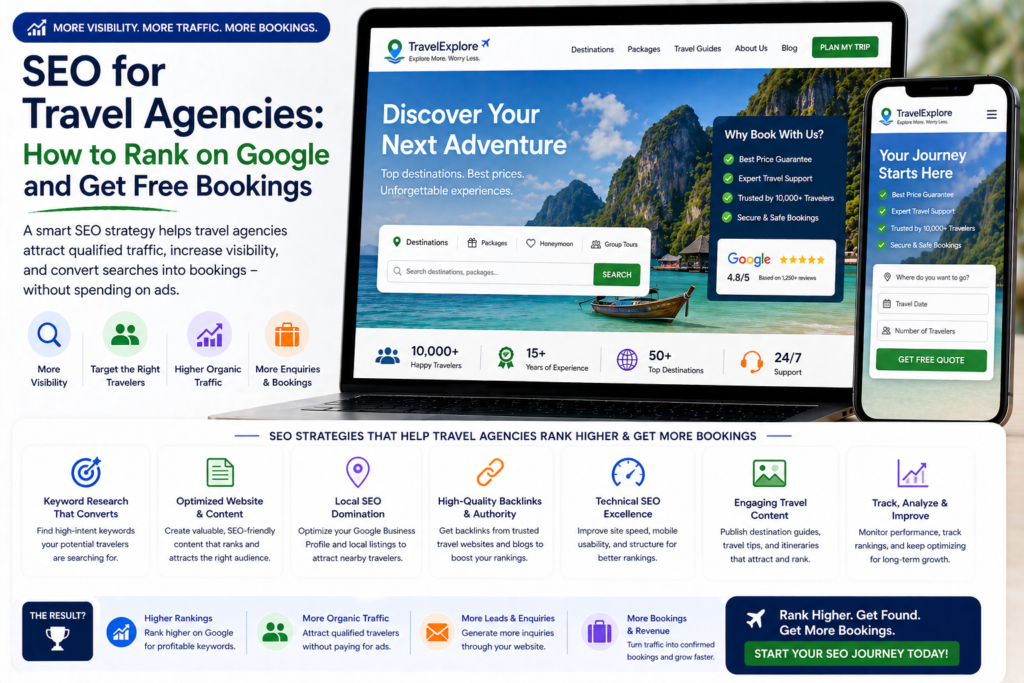
SEO for Travel Agencies: How to Rank on Google and Get Free Bookings 🔍
💡 Summary SEO is the one digital marketing channel that keeps paying back long after the work is done. A well-optimised travel agency website can generate qualified enquiries from Google 24 hours a day — for free. In this guide, I’ll show you exactly how to build an SEO strategy for your travel agency: from keyword research and content structure to technical SEO fundamentals and link building tactics that actually work in the travel industry.
Imagine waking up every morning to find new enquiries in your inbox — from people who found your travel agency on Google, read your content, decided you were the right specialist for their trip, and reached out without you spending a penny on advertising.
That’s what a well-executed SEO strategy for travel agencies looks like at full maturity.
SEO — Search Engine Optimisation — is the practice of making your website appear in Google’s organic (non-paid) search results for the terms your ideal customers are searching. Unlike Google Ads, which generates traffic only as long as you’re paying, SEO generates traffic indefinitely. A blog post or destination page that ranks on page one today can bring in enquiries for years.
The challenge is that SEO takes time — typically 3–6 months before meaningful results, and 12+ months to build genuine authority. But for travel agencies willing to invest consistently, the long-term payoff is unlike any other marketing channel.
This guide shows you exactly how to build that foundation. 👇
Why SEO Is Uniquely Powerful for Travel Agencies
You Can Win Where OTAs Can’t
Booking.com and Expedia dominate generic travel keywords — “hotels in Maldives,” “flights to Tokyo.” You will never outrank them for those terms organically.
But you can absolutely outrank them for specific, long-tail, expertise-driven searches:
- “best Maldives resort for snorkelling couples”
- “Kenya safari vs Tanzania safari comparison”
- “is the Maldives worth the money for a honeymoon”
- “tailor made Japan itinerary 2 weeks cherry blossom”
These searches require genuine knowledge to answer well. OTAs have databases, not opinions. Your agency has expertise — and Google rewards depth of knowledge and specificity.
Organic Traffic Compounds Over Time
Paid ads generate traffic in direct proportion to your spend. SEO generates traffic that compounds — each piece of content you create adds to a growing library of pages that collectively attract more and more visitors over time.
A travel agency with 50 well-optimised destination and blog pages typically generates significantly more organic traffic than one with 10 pages — and that gap widens every month.
Search Intent in Travel Is High Quality
People searching for specific travel queries on Google are in active planning mode. A person searching “best time to visit Japan for cherry blossom” isn’t just bored — they’re planning a trip. If your content answers that question brilliantly and ends with a natural CTA to enquire about Japan holidays, you’ve positioned yourself perfectly to convert a researcher into a lead.
Understanding How Google Ranks Travel Content
Before building your SEO strategy, it helps to understand what Google is actually trying to do — because your entire strategy flows from this.
Google’s goal is to return the most useful, trustworthy, and relevant result for every search query. In travel, this means Google favours:
Expertise: Content written by someone who genuinely knows the destination — not generic information scraped from other sources. First-person experience, specific recommendations, honest assessments.
Authority: Pages on websites that have built trust through backlinks (other reputable websites linking to them) and a track record of quality content.
Relevance: Pages that match exactly what the searcher is looking for — the right destination, the right trip type, the right level of detail.
User Experience: Pages that load quickly, are easy to navigate on mobile, and keep visitors engaged (low bounce rate, longer time on page).
Your SEO strategy needs to address all four of these — content quality, authority building, keyword relevance, and technical performance.
Step 1: Build Your SEO Keyword Strategy for Travel
SEO keyword research for travel agencies follows the same principles as paid search keyword research — but with a crucial difference: for SEO, you should target the full spectrum of search intent, including informational keywords that are too expensive to bid on in Google Ads.
The 3 Tiers of SEO Keywords for Travel Agencies
Tier 1: High-Intent Commercial Keywords (Destination Pages)
These are the keywords your main destination and service pages should target — searches from people who are close to booking.
Examples:
- “luxury Maldives holiday specialist”
- “tailor made Kenya safari”
- “Japan honeymoon travel agent”
- “Caribbean cruise travel agency”
These pages need to be optimised, conversion-focused, and supported by your wider content strategy.
Tier 2: Research & Comparison Keywords (Blog / Guide Content)
These are the informational searches your ideal customers make while planning — often weeks or months before they’re ready to book. They have high volume, lower competition than commercial terms, and attract exactly the right audience.
Examples:
- “best time to visit the Maldives”
- “Maldives vs Seychelles for honeymoon”
- “what to expect on a Kenya safari”
- “how much does a Japan holiday cost”
- “overwater villa vs beach villa Maldives”
These keywords are too informational for Google Ads but perfect for blog and guide content that attracts researchers and converts them over time through email nurture.
Tier 3: Long-Tail Niche Keywords (Specialist Content)
These are highly specific searches with lower volume but very high intent and minimal competition. Often the easiest wins for specialist travel agencies.
Examples:
- “best Maldives resort for snorkelling beginners”
- “Kenya safari with young children tips”
- “Japan in November cherry blossom forecast”
- “Maldives honeymoon under £5000”
A page that ranks #1 for a keyword searched 50 times per month, where every visitor is an ideal customer, is often more valuable than a page ranking #5 for a keyword with 5,000 monthly searches.
Using Google Keyword Planner and Search Console
For Tier 1 keywords, use Google Keyword Planner to validate search volume and assess competition as covered in our keywords for travel agency Google Ads guide — the same research process applies to SEO.
For Tier 2 and 3 keywords, Google Search itself is your best tool. Use autocomplete, People Also Ask, and Related Searches to find the exact questions your customers are asking.
Once your site has been live for a few months, Google Search Console (free) shows you exactly which queries are generating impressions and clicks — often revealing keyword opportunities you hadn’t considered. Install it immediately if you haven’t already.
Step 2: Build Your Site Architecture Around Content Hubs
One of the most powerful SEO strategies for travel agencies is the content hub (also called a pillar and cluster) approach.
A content hub consists of:
- One pillar page — a comprehensive, authoritative overview of a destination or topic
- Multiple cluster pages — deeper dives into specific aspects of that destination or topic
- Internal links — connecting all cluster pages back to the pillar and to each other
This structure signals to Google that your website has deep, authoritative coverage of a particular topic — which boosts the ranking potential of every page in the hub.
Example: Maldives Content Hub
Pillar Page:
- “The Complete Guide to a Maldives Holiday” (target keyword: “Maldives holiday”)
Cluster Pages (each targeting a specific long-tail keyword):
- “Best Time to Visit the Maldives” (target: “best time to visit Maldives”)
- “Maldives Overwater Villa vs Beach Villa” (target: “overwater villa vs beach villa Maldives”)
- “Maldives Honeymoon Guide” (target: “Maldives honeymoon”)
- “Best Maldives Resorts for Snorkelling” (target: “best Maldives snorkelling resorts”)
- “How Much Does a Maldives Holiday Cost?” (target: “Maldives holiday cost”)
- “North Malé Atoll vs South Malé Atoll” (target: “which Maldives atoll is best”)
- “Maldives Holiday Packing List” (target: “what to pack for Maldives”)
Each cluster page links back to the pillar page. The pillar page links out to all cluster pages. Together they form a dense, interlinked hub of Maldives content that Google recognises as authoritative.
Build one hub at a time. Start with your most important destination and build it out completely before starting the next. Depth in one destination beats shallow coverage across many.
Step 3: Write Content That Outranks Everyone Else
Having the right keyword strategy means nothing if your content isn’t genuinely better than what’s already ranking. Here’s what “better” means in travel SEO:
The E-E-A-T Framework
Google evaluates content against four criteria: Experience, Expertise, Authoritativeness, and Trustworthiness (E-E-A-T). For travel agencies, this translates directly:
Experience: Have you actually been to the destination you’re writing about? First-person accounts, your own photography, specific observations that only someone who’s been there would know — these signal genuine experience to Google and to your readers.
Expertise: Do you know more about this topic than a casual traveller? Your years of specialist knowledge, client experiences, industry relationships, and insider access should be visible in your content.
Authoritativeness: Is your website recognised as an authority in travel? This comes from other reputable websites linking to you — a signal we’ll cover in the link building section.
Trustworthiness: Does your website inspire confidence? Clear business information, customer reviews, ATOL/ABTA accreditation display, professional design, and an active social presence all contribute.
What Great Travel SEO Content Looks Like
Length: Long-form content (1,500–3,000 words) consistently outperforms short content for competitive travel keywords. Google’s top-ranking travel pages are typically comprehensive guides, not brief overviews.
Structure: Use H1, H2, and H3 headings to create a clear, scannable structure. Include a table of contents for longer guides. Break up text with bullet points, comparison tables, and images.
Specificity: Generic statements like “the Maldives is a beautiful destination” add no value. Specific statements like “The house reef at Conrad Rangali is one of the best for turtle sightings in the North Atoll — particularly at dusk” demonstrate genuine knowledge.
Honest opinions: Travel agencies often write bland, universally positive content about every destination. Google (and readers) respond better to balanced, honest assessments — what’s great, what’s overrated, who this destination is and isn’t right for.
Updated regularly: Travel information changes — resort renovations, entry requirements, seasonal patterns. Returning to existing content and updating it signals to Google that it’s current and maintained.
On-Page SEO Essentials
For every page you publish, check these on-page SEO elements:
- Title tag: Include your target keyword. Keep it under 60 characters. Make it compelling — it appears in search results.
- Meta description: 150–160 characters. Include the keyword. Write for the click, not just the crawler. (Rank Math makes this easy to manage.)
- H1: One per page, contains the target keyword.
- H2s: Cover the main sections. Include keyword variants naturally.
- URL slug: Short, keyword-rich, hyphenated. e.g.
/maldives-honeymoon-guidenot/page?id=4521 - Image alt text: Describe every image with relevant, natural language. Include keywords where genuinely relevant.
- Internal links: Link to related pages on your site using descriptive anchor text.
- Word count: Match or exceed the length of current top-ranking pages for your target keyword.
Step 4: Technical SEO — The Foundation That Supports Everything
Technical SEO isn’t glamorous, but without it, your content won’t rank regardless of its quality. These are the technical fundamentals every travel agency website needs.
Site Speed
Page speed is a direct Google ranking factor — and it’s especially important for travel, where image-heavy pages are the norm.
Key fixes for travel agency websites:
- Compress all images before uploading (use TinyPNG or ShortPixel)
- Use a content delivery network (CDN) — many hosting providers include this
- Enable browser caching and GZIP compression
- Minimise plugins (WordPress sites often accumulate dozens of unused plugins that slow load time)
Test your current speed at PageSpeed Insights (pagespeed.web.dev). Aim for a score above 80 on mobile — the majority of travel searches happen on mobile devices.
Mobile Optimisation
Google uses mobile-first indexing — it crawls and ranks your mobile site, not your desktop site. If your travel agency website doesn’t render perfectly on mobile, your rankings will suffer.
Test your mobile experience honestly: try using your own website on your phone. Can you navigate easily? Does the enquiry form work? Are images cropped correctly? Is text readable without zooming?
SSL Certificate (HTTPS)
Your website must use HTTPS (the padlock in the browser bar). Most modern hosting providers include SSL certificates free of charge. If your site still shows HTTP, fix this immediately — it’s a ranking signal and a significant trust issue for potential customers.
XML Sitemap and Robots.txt
Your XML sitemap tells Google which pages to crawl and index. Ensure it’s submitted to Google Search Console and kept up to date. Your robots.txt file should not accidentally be blocking important pages from being crawled — a common WordPress mistake.
Fixing Crawl Errors
Google Search Console’s Coverage report shows you which pages have indexing errors. Broken links, redirect chains, and duplicate content issues can all suppress your rankings. Review this monthly and fix issues as they arise.
Step 5: Local SEO — Essential for Agencies with Physical Locations
If your travel agency has a physical office or primarily serves customers in a specific city or region, local SEO is a significant opportunity.
Google Business Profile
Your Google Business Profile (formerly Google My Business) is the single most important local SEO asset you have. It controls how your agency appears in Google Maps and the local pack (the box of business listings that appears at the top of local search results).
Optimise your Google Business Profile:
- Complete every section — business description, categories, services, hours
- Add high-quality photos of your office, team, and destination imagery
- Collect reviews consistently (ask every satisfied customer — include a direct review link in your post-booking email sequence)
- Post updates regularly (Google rewards active profiles)
- Respond to every review — positive and negative
A well-optimised Google Business Profile with strong reviews can rank your agency at the top of local results for “travel agent [city]” searches — often above organic results.
Local Citation Building
Local citations are mentions of your business name, address, and phone number (NAP) on other websites — directories, industry listings, local business associations.
Key citation sources for travel agencies:
- ATOL/ABTA member directory
- AITO (Association of Independent Tour Operators) if applicable
- Local business directory (your chamber of commerce website)
- Industry directories (Travel Weekly, TTG, etc.)
- Google Maps, Apple Maps, Bing Places
Consistency matters — your NAP information must be identical across every listing.
Step 6: Link Building for Travel Agencies
Backlinks — links from other websites pointing to yours — are one of Google’s strongest ranking signals. A travel agency with authoritative, relevant backlinks will consistently outrank one with similar content but no backlinks.
The travel industry has natural link-building opportunities that many agencies fail to exploit.
PR and Media Coverage
Travel journalists, editors, and bloggers regularly write about specialist agencies, unique itineraries, and insider destination knowledge. Getting featured in a travel publication — even once — can generate multiple high-authority backlinks and significant referral traffic.
How to get travel media coverage:
- Create a list of travel journalists and editors at publications your customers read
- Pitch a specific, newsworthy angle — not “we’re a great travel agency” but “here’s why the shoulder season in [destination] is actually the best time to go, and almost nobody knows it”
- Offer exclusive access to your expertise, customer stories, or destination knowledge
- Build relationships with travel bloggers who have genuine audiences (not just follower counts)
Tourism Board Partnerships
National and regional tourism boards are excellent link-building partners. Many have “specialist agent” directories or partner pages that link back to agencies specialising in their destination.
Reach out to the UK or UAE representatives of your key destination tourism boards (e.g. Maldives Tourism, Kenya Tourism Board, Japan National Tourism Organization). Ask about partner listings, FAM trip opportunities, and co-marketing collaborations.
Guest Posting on Travel and Lifestyle Blogs
Writing genuinely useful guest posts for established travel blogs puts your expertise in front of new audiences and earns backlinks to your site.
What makes a guest post pitch successful:
- Pitch specific, expert content — not general travel advice
- Target blogs whose audience matches your ideal customer (honeymooners, adventure travellers, luxury travel)
- Offer something genuinely valuable — a real itinerary, an honest destination comparison, insider tips with specific details
Earning Links Through Exceptional Content
The most sustainable link-building strategy is creating content so good that other websites naturally link to it.
Content that earns natural travel backlinks:
- Original research (e.g. “The Most Expensive Holiday Destinations in the World — 2025 Data”)
- Comprehensive destination guides that become the definitive resource for that topic
- Interactive tools (e.g. a holiday budget calculator or trip planner quiz)
- Honest, detailed resort or destination reviews that journalists reference
Your Travel Agency SEO Priority Checklist
If you’re starting from scratch, here’s the order in which to tackle SEO:
Month 1 — Foundations
- Install Google Search Console and Google Analytics
- Ensure HTTPS is active across your entire site
- Submit your XML sitemap to Search Console
- Set up and fully optimise your Google Business Profile
- Run a PageSpeed Insights test and fix the biggest speed issues
Month 2–3 — On-Page Optimisation
- Audit your existing destination pages — optimise title tags, meta descriptions, H1s, and content quality
- Identify your most important destination and begin building a content hub
- Write and publish the pillar page for your first content hub
- Begin publishing cluster content (2–3 pieces per month)
Month 4–6 — Content and Authority Building
- Continue publishing cluster content consistently
- Begin local citation building (Google Business Profile, ATOL/ABTA, local directories)
- Identify and pitch 2–3 link-building opportunities (tourism boards, travel media, guest posts)
- Set up a monthly Search Console review to track keyword rankings and fix errors
Month 6+ — Scaling
- Begin a second content hub for your next most important destination
- Expand link-building outreach
- Update and improve existing content based on Search Console performance data
- Consider investing in a dedicated SEO tool (Ahrefs, SEMrush) to track rankings and identify new opportunities
Common Travel Agency SEO Mistakes ❌
1. Trying to rank for OTA-dominated keywords “Maldives holidays” is owned by Booking.com. Stop trying to rank for it organically and focus on the specific, expert keywords where you can genuinely compete.
2. Thin destination pages with no real content A destination page with 200 words of generic copy and a contact form will never rank. Every destination page needs comprehensive, expert content of at least 800–1,200 words.
3. No internal linking strategy Your website’s pages should link to each other meaningfully. A Maldives destination page should link to your Maldives blog posts. Your blog posts should link to relevant destination pages. This creates the content hub structure Google rewards.
4. Ignoring Google Search Console Search Console is free and shows you exactly which queries you’re appearing for, which pages have errors, and which keywords are close to ranking (page 2 keywords with impressions but low clicks are your biggest quick-win opportunity). Check it monthly at minimum.
5. Publishing content and never updating it Travel information changes constantly. Outdated content performs worse over time. Set a quarterly reminder to review and update your top-performing pages.
6. Expecting results in 30 days SEO is a 6–12 month commitment before significant results. Agencies that give up after 8 weeks miss out on the compounding benefits that come from consistent, long-term investment.
Final Thoughts
SEO for travel agencies is one of the most powerful long-term investments you can make in your business. The agencies that start building their SEO foundation today will be generating consistent organic enquiries while their competitors are still entirely dependent on paid advertising.
The strategy is clear: build expertise-driven content hubs around your specialist destinations, optimise the technical foundations of your website, build authority through genuine link building and tourism board partnerships, and measure your progress consistently through Search Console.
It won’t deliver results overnight. But 12 months from now, you’ll have a growing library of content working for your agency around the clock — bringing in qualified traffic, building trust, and generating enquiries from people who found you through Google and chose you because of the depth of your knowledge.
One post left in our travel agency marketing series — read our guide on travel landing pages that convert to make sure every visitor your SEO efforts bring to your site has the best possible chance of becoming an enquiry. And for the complete picture, head back to our Complete Digital Marketing Guide for Travel Agencies. 🌍
What is SEO for travel agencies?
SEO for travel agencies is the process of optimising a travel agency website to rank higher on Google without paying for ads. It involves targeting the right keywords, creating helpful content, improving website speed, and building backlinks so that travellers searching for holidays or travel services find your agency first.
How long does SEO take to work for a travel agency?
SEO for travel agencies typically takes 3 to 6 months to show meaningful results. New websites may take longer while established sites with existing content can see improvements within 6 to 8 weeks of making optimisations. SEO is a long-term strategy but delivers compounding results over time unlike paid advertising.
What are the best SEO keywords for a travel agency?
The best SEO keywords for travel agencies combine destination with service, such as luxury holidays to Maldives, honeymoon travel packages, or affordable Europe tours. Long-tail keywords with clear booking intent perform best because they attract travellers who are ready to enquire rather than just browsing for inspiration.
Do travel agencies need SEO or Google Ads?
Travel agencies benefit from both SEO and Google Ads but they serve different purposes. Google Ads delivers immediate leads and works well for promotions and new agencies. SEO builds long-term organic traffic that does not require ongoing ad spend. The ideal strategy combines both, using Google Ads for quick wins while SEO builds sustainable visibility over time.
How do I get my travel agency to rank on Google?
To get your travel agency to rank on Google, start by targeting specific destination and service keywords on dedicated pages. Publish helpful guides that answer questions travellers are searching for. Optimise your Google Business Profile for local searches. Build backlinks from travel directories and industry websites. Ensure your website loads fast on mobile devices.