
🎯 TL;DR
Pinterest is one of the most underused marketing channels for travel agencies — yet it is the only major social platform where content has a lifespan measured in months and years rather than hours. Travel is the second most searched category on Pinterest, and unlike Instagram or TikTok, a Pin published today can drive traffic to your website for the next two to three years. The most effective Pinterest strategy for travel agencies combines keyword-optimised destination Pins, linking directly to package pages and blog posts, published consistently at a rate of 5–10 Pins per week.
💡 Summary
Most travel agencies overlook Pinterest entirely because they associate it with recipes and home decor. This is a significant missed opportunity. Pinterest has over 550 million monthly active users in 2026, travel is one of its top search categories, and its users are in planning mode — actively searching for destination inspiration, itineraries, and travel tips — which makes them high-intent prospects, not passive scrollers.
This guide covers everything a travel agency needs to start generating website traffic and enquiries from Pinterest: setting up a business account, creating Pins that rank in Pinterest search, building boards that attract your ideal client, and using Pinterest SEO to drive long-term organic traffic.
Why Pinterest Is Different From Every Other Social Platform
The short answer: Pinterest is a visual search engine, not a social media platform. People use it the way they use Google — to search for ideas and plan purchases — which makes it uniquely valuable for travel agencies.
When someone posts on Instagram, the content gets 24–48 hours of visibility before the algorithm buries it. A TikTok video might go viral for a week, then disappear. A Pinterest Pin, however, can continue appearing in search results for months or years after it was published because Pinterest’s algorithm surfaces relevant content based on search queries, not recency.
For travel agencies, this is transformational. A Pin you create today about “10 Days in Japan Itinerary for Families” can rank in Pinterest search for “Japan family itinerary” and drive traffic to your blog post or package page for the next three years — with zero additional effort.
Pinterest’s demographics also align well with travel agency target clients. The platform’s users skew toward women aged 25–54 with above-average household incomes who are actively planning purchases. This is precisely the audience planning honeymoons, family holidays, and luxury escapes.
Travel agencies in the UAE and Middle East are particularly underrepresented on Pinterest — which means the competition for relevant search terms is lower than on Google, making it easier to rank.
Setting Up Your Pinterest Business Account
The short answer: A Pinterest Business account is free, gives you access to analytics and keyword research tools, and allows you to add clickable links to all your Pins — essential for driving website traffic.
Step 1 — Create or convert your account Go to business.pinterest.com and create a new business account or convert your existing personal account. Use your agency name as your display name.
Step 2 — Complete your profile
– Profile photo: your agency logo or a professional headshot
– Display name: your agency name + one keyword (e.g., “TravelAgencyName | Maldives & Luxury Holidays”)
– Bio: 160 characters — include your specialisation, location, and a CTA (“DM us to start planning your dream holiday”)
– Website: link to your homepage or enquiry page
– Location: UAE / Dubai
Step 3 — Claim your website
In Pinterest Business settings, claim your website by adding a meta tag to your WordPress site. This verifies your account and allows analytics to track which Pins drive traffic to your site.
Step 4 — Enable Rich Pins
Rich Pins automatically pull metadata (title, description) from your website pages when someone saves a Pin linking to your site. Enable them in your Pinterest Business settings. Article Rich Pins are particularly useful for blog posts.
How to Create Pinterest Boards That Attract Your Ideal Client
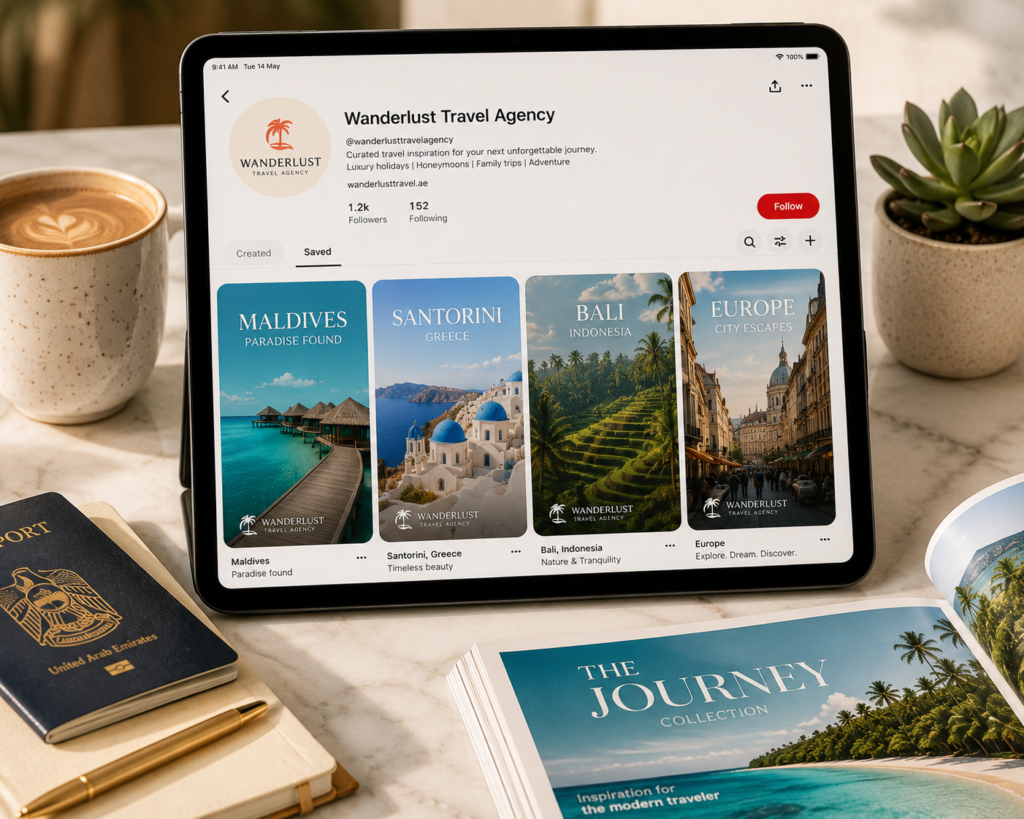
The short answer: Pinterest boards are the containers for your Pins and the primary way Pinterest’s algorithm understands what your account is about. Create one board per destination or travel topic, with keyword-rich board names and descriptions.
Create a board for each of your key specialisations and destinations:
| Board Name | Description (with keywords) | Example Pins |
|---|---|---|
| Maldives Honeymoon Ideas | Romantic Maldives overwater villa packages, honeymoon resorts, and Maldives travel tips for couples | Overwater villa photos, itineraries, packing guides |
| Bali Family Holiday | Family-friendly Bali travel guides, best resorts for families, Bali itineraries for kids | Family resort photos, day trip ideas, kids activities |
| Luxury Travel UAE | Luxury holiday packages from Dubai, premium travel destinations and tips for UAE travellers | Luxury destination photos, travel inspiration |
| Europe Holiday Packages | European holiday ideas, city breaks and coastal escapes for UAE residents | Santorini, Paris, Amalfi, Iceland photos |
| Travel Tips | General travel advice, packing tips, visa guides, and travel hacks | Infographics, checklist graphics, tip carousels |
Write a keyword-rich description for each board (500 characters) — this is what Pinterest uses to understand the board’s topic and serve it in search results.
Pinterest SEO: How to Get Your Pins Found in Search
The short answer: Pinterest SEO works like Google SEO — you need to include the keywords your ideal clients are searching for in your Pin titles, descriptions, and board names. Find these keywords using Pinterest’s own search autocomplete.
Finding Keywords for Pinterest
Type a destination or travel topic into the Pinterest search bar and note the autocomplete suggestions. These are the most searched phrases on Pinterest for that topic:
- “Maldives honeymoon” → autocompletes to “Maldives honeymoon resorts,” “Maldives honeymoon overwater bungalow,” “Maldives honeymoon on a budget”
- “Bali family holiday” → autocompletes to “Bali family holiday resort,” “Bali family holiday itinerary,” “Bali with toddlers”
- “Dubai travel” → autocompletes to “Dubai travel tips,” “Dubai travel guide,” “Dubai travel outfit”
These autocomplete phrases are your target keywords. Use them in your Pin titles and descriptions.
Writing a Pin Title That Ranks
Pin titles appear in Pinterest search results. They should be clear, keyword-rich, and immediately communicate what the Pin is about.
Weak: “Beautiful Maldives” Strong: “7-Night Maldives Honeymoon Itinerary — Overwater Villa Package from Dubai”
The strong title includes the destination (Maldives), the trip type (honeymoon), a specific detail (7 nights, overwater villa), and the departure point (from Dubai) — matching exactly how a UAE-based couple would search.
Writing a Pin Description That Drives Traffic
Pin descriptions can be up to 500 characters. Include your primary keyword naturally in the first sentence, add 2–3 related keywords throughout, and end with a call to action:
“Planning your Maldives honeymoon? Our 7-night Maldives overwater villa package from Dubai includes return flights, 5-star resort accommodation, daily breakfast, airport transfers, and personalised service from start to finish. The perfect romantic escape for couples. Click to see full itinerary details and pricing — or contact us on WhatsApp to start planning your bespoke honeymoon package.”
What Types of Pins Work Best for Travel Agencies
The short answer: The four Pin formats that consistently drive the most traffic for travel agencies are destination inspiration Pins, itinerary infographic Pins, travel tip Pins, and blog post Pins.
1. Destination Inspiration Pins
A stunning destination photo (overwater villa, beach, European cobbled street) with a keyword-rich title and a link to your relevant package page or blog post. These are the easiest to create and have the longest lifespan on Pinterest.
Tools: Use Canva to add your agency logo and a text overlay (“7 Nights in Santorini from AED 5,200”) to a high-quality destination photo from Unsplash or Pexels.
2. Itinerary Infographic Pins
A visually designed day-by-day itinerary for a specific destination. “10 Days in Japan: The Perfect Family Itinerary” presented as a clean graphic with each day listed. These are highly shareable and drive significant saves — which Pinterest rewards with increased distribution.
3. Travel Tip Pins
“5 Things to Pack for a Maldives Holiday” or “Visa Requirements for UAE Residents Visiting Bali” presented as a clean list graphic. These attract high-intent searchers who are actively planning a trip to that destination.
4. Blog Post Pins
Every blog post you publish on tipsfordigitalmarketing.com should have a corresponding Pinterest Pin linking back to it. Create a vertical (2:3 ratio) graphic with an attention-grabbing headline, your agency branding, and link it directly to the blog post URL. This drives Pinterest traffic to your existing blog content.
Internal link: For ideas on what blog content to create that performs well on both Google and Pinterest, read our guide on content marketing for travel agencies.
Pinterest Posting Strategy for Travel Agencies
The short answer: Publish 5–10 Pins per week consistently. Batch-create Pins monthly and schedule them using Tailwind or Pinterest’s native scheduler. Consistency and volume matter more than perfection on Pinterest.
Pinterest rewards accounts that publish consistently over time. Five Pins per week for six months outperforms fifty Pins in one week followed by silence.
Weekly Pin schedule for a travel agency:
- Monday: Destination inspiration Pin (link to package page)
- Tuesday: Travel tip or packing guide Pin (link to blog post)
- Wednesday: Itinerary infographic Pin (link to blog post or package page)
- Thursday: Client trip inspiration Pin (beautiful destination photo)
- Friday: Promotional Pin (seasonal offer or featured package)
Use Tailwind (a Pinterest-approved scheduling tool) to batch-schedule your Pins in advance. Create one month’s worth of Pins in a single two-hour session and schedule them to post automatically throughout the month.
Internal link: Combine your Pinterest posting with your broader content calendar. Read our guide on how to create a content calendar for your travel agency to integrate Pinterest into your weekly content workflow.
Final Thoughts — Pinterest Is the Long Game That Pays Off
Pinterest is not a channel that generates enquiries in week one. It is a channel that builds organic, compound traffic over 6–12 months and then keeps delivering that traffic for years — without ongoing ad spend.
For travel agencies willing to invest 2–3 hours per month in creating and scheduling Pins, the long-term return on that time investment is one of the highest of any free marketing channel available.
Your action step: Set up your Pinterest Business account this week. Create five boards for your top destinations. Publish one Pin linking to your most popular blog post. That is your Pinterest presence started.
FAQ — Pinterest Marketing for Travel Agencies
1. Is Pinterest worth it for a travel agency in 2026?
Yes — particularly for agencies willing to play the long game. Pinterest’s travel content has a search lifespan of months to years, making it one of the few free marketing channels that compounds over time. It is most valuable for agencies that already have good blog content (destination guides, itineraries, travel tips) that can be promoted as Pins linking back to their website.
2. How many followers do I need on Pinterest to get results?
Unlike Instagram or TikTok, Pinterest reach is not primarily follower-based — it is search-based. A Pin from an account with 50 followers can rank for a high-volume keyword and drive thousands of visits if it is properly optimised. Focus on keyword-rich Pin titles and descriptions rather than follower growth. Followers matter less on Pinterest than on any other social platform.
3. What size should Pinterest images be for travel agencies?
The optimal Pin image size is 1000 × 1500 pixels (2:3 ratio) for standard Pins. This vertical format takes up more space in the Pinterest feed and performs better than square or horizontal images. For Idea Pins (Pinterest’s story format), use 1080 × 1920 pixels. Always use high-quality, visually striking images — destination photography and clean infographic graphics perform best.
4. How long does it take for Pinterest to start driving traffic?
Most Pinterest accounts see meaningful traffic growth after 3–6 months of consistent publishing. Pinterest’s algorithm takes time to understand your account’s niche and surface your Pins in relevant searches. The first three months are investment time — publish consistently, optimise your keywords, and be patient. Accounts that abandon Pinterest after six weeks because “nothing happened” never see the results.
5. Should I use Pinterest Ads for my travel agency?
Pinterest Ads (Promoted Pins) are worth testing once your organic strategy is established and you have a library of well-performing Pins to promote. They work well for seasonal campaigns — promoting a summer Europe package in March or a Maldives honeymoon offer in January. However, organic Pinterest is sufficient for most small travel agencies and should be the starting point before investing in paid Pins.
6. How do I repurpose my existing content for Pinterest?
Every blog post becomes a Pin (create a vertical graphic with the headline and link to the post). Every destination photo becomes a Pin (add a text overlay with keyword-rich title and link to relevant package page). Every Instagram graphic becomes a Pin (resize to 1000×1500 in Canva). You already have dozens of pieces of content that can be published on Pinterest this week — you just need to resize and link them.
7. Can I automate Pinterest posting for my travel agency?
Yes. Tailwind is the most popular Pinterest scheduling tool and is approved by Pinterest. It allows you to schedule months of Pins in advance, suggests optimal posting times, and includes a SmartLoop feature that automatically re-pins evergreen content. A monthly two-hour batch session in Tailwind can handle your entire Pinterest posting for the month. The free Tailwind plan is sufficient for most small agencies starting out.
8. Which Pinterest board should I create first for my travel agency?
Start with a board for your most popular destination or specialisation — the one you sell most frequently and know best. If you specialise in Maldives honeymoons, create a “Maldives Honeymoon Ideas” board first, publish 10–15 Pins linking to your Maldives content, and optimise the board description with relevant keywords. This establishes your account’s niche for Pinterest’s algorithm and gives you the fastest route to appearing in relevant searches.