
🎯 TL;DR
User-generated content (UGC) for travel agencies is any photo, video, review, or social media post created by your clients about their trip — and it is the most trusted, most cost-effective marketing content you can publish. Research shows that 92% of consumers trust peer recommendations over brand advertising, and UGC consistently outperforms professionally produced brand content in engagement and conversion rates. The most effective travel agency UGC strategy involves three steps: actively collecting client content with permission, repurposing it across all channels, and creating a systematic ask that makes sharing easy and natural.
💡 Summary
Your clients are already creating content about their holidays — photos on Instagram, videos on TikTok, voice notes to friends, and WhatsApp messages to family. Most travel agencies are not using any of it. The ones that are outperforming competitors with a fraction of the content creation budget.
This guide covers everything a travel agency needs to build a UGC system: how to ask for content, how to use it legally, where to publish it, and how to make it a consistent marketing channel rather than a one-off lucky repost.
Why UGC Outperforms Branded Content for Travel Agencies
The short answer: Potential clients trust a real photo from a real traveller far more than a polished agency graphic — because they know it hasn’t been edited to look better than reality.
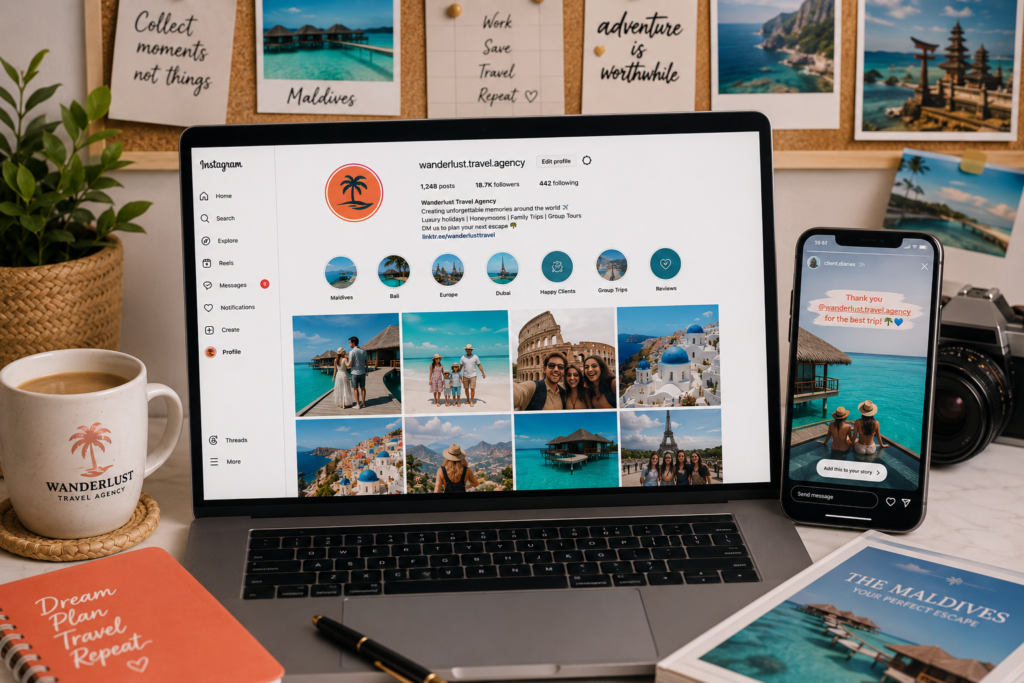
Consider the psychology of a potential client browsing your Instagram. They see two posts side by side: your professionally designed graphic showing an overwater villa, and an authentic photo posted by a past client standing on that same villa deck with a huge smile. Which builds more trust?
The client photo wins every time. It proves the experience is real, deliverable, and as good as advertised. The agency graphic, however beautiful, is expected to present the best possible version of reality.
Research confirms this. Content featuring real customers generates 6.9 times more engagement than brand-generated content. UGC converts 29% better than campaigns without it. And 92% of consumers globally say they trust earned media (peer recommendations) over paid advertising.
For travel agencies, these numbers translate directly into enquiries. A potential honeymoon couple who sees 12 posts from real clients who travelled to the Maldives through your agency is far more likely to enquire than one who has only seen your own promotional content.
How to Ask Clients for UGC — The 3-Touch Collection System
The short answer: Most clients are happy to share photos and give permission for their content to be reused — they just need to be asked at the right moment, in the right way.
Touch 1 — Before the Trip (Planting the Seed)
In your pre-departure communication, mention UGC casually: “We’d love to see your photos when you’re there — feel free to tag us @[agencyhandle] on Instagram or send us your favourites on WhatsApp. We might feature them on our page!”
This sets the expectation without pressure and gives clients the idea to document their trip with sharing in mind.
Touch 2 — During the Trip (The Tag Reminder)
If you have an active Instagram or WhatsApp presence during client trips, a mid-trip check-in message is a natural opportunity: “Hope you’re having an incredible time! If you’re posting any photos, don’t forget to tag us 😊”
Touch 3 — After the Trip (The Direct Ask)
This is the highest-converting moment. Three to five days after return, as part of your post-trip WhatsApp follow-up: “Hi [Name]! So glad to hear you had an amazing time. Would you be happy to share a couple of your favourite photos with us? We’d love to feature them on our Instagram with your permission — and credit you of course 😊”
Most clients respond positively to this direct ask. The key word is “permission” — always ask explicitly before using any client content.
Internal link: Combine your UGC ask with your review request and referral programme for a complete post-trip system. Read our guide on how to build a referral programme for your travel agency.
How to Use UGC Legally — Permissions You Need
The short answer: Always get explicit written permission before using any client photo or video in your marketing. A WhatsApp “yes, go ahead!” message is sufficient — but it must be in writing.
Before using any piece of client content:
- Ask explicitly: “Would you be happy for us to share this on our Instagram/website/marketing?” — not assumed from a tag or mention
- Get written confirmation: A WhatsApp message, DM reply, or email saying “yes, you can use it” is legally sufficient. Screenshot or save this confirmation.
- Credit the creator: Tag the client in the post or mention their first name (“Photo thanks to Sarah & James, Maldives 2026”)
- Honour opt-outs: If a client who previously gave permission later asks you to remove content, do so immediately
Do not use photos found in a client’s public Instagram without asking — even if they tagged you. A tag is not the same as permission to repost in your marketing materials.
Where to Publish UGC for Maximum Impact
The short answer: UGC works on every channel — social media, your website, email newsletters, and even in paid ads — but the context needs to match the platform’s tone and format.
| Channel | How to Use UGC | Best Format |
|---|---|---|
| Instagram feed | Client trip photos as dedicated posts | High-quality photos with caption telling their story |
| Instagram Stories | Quick reposts with client permission | Screenshot of their post with agency tag |
| Client photos + trip summary | Photo albums or single posts with detailed captions | |
| Website testimonials page | Photos alongside written reviews | Photo + name + destination + short quote |
| Homepage | 3–4 rotating client photos in hero section | High-resolution horizontal images |
| Email newsletter | “Client spotlight” monthly feature | Photo + 2-3 sentence trip summary |
| Google Business Profile | Upload client photos (with permission) | Destination photos attributed to clients |
| Paid ads | Client photos + testimonial quote overlay | Single image or carousel format |
UGC used in paid ads (Facebook and Instagram) consistently outperforms branded creative — because audiences recognise authentic user photos and engage more freely with them.
Creating a UGC Library for Your Travel Agency
The short answer: Build a folder — Google Drive or Dropbox — where you save every approved piece of client content. Organised by destination. This becomes your content bank that you draw from continuously.
Set up your UGC library with these folders:
- By destination: Maldives, Bali, Santorini, Kenya, etc.
- By trip type: Honeymoon, family, adventure, group
- By format: Photos, short videos, reviews/quotes
Every time a client sends you a photo or video and gives permission to use it, save it to the relevant folders immediately. A well-organised UGC library of 100 pieces of content provides months of social media material and keeps your content creation time minimal.
Internal link: Combine your UGC library with your content calendar for a fully planned posting schedule. Read our guide on how to create a content calendar for your travel agency.
How to Encourage More UGC From Your Clients
The short answer: The more remarkable the experience and the easier you make it to share, the more UGC you receive. Incentives help, but the quality of the trip is the most powerful driver.
Create shareable moments: Brief your supplier contacts (hotels, resorts) to create photo opportunities — a floating breakfast setup, a personalised welcome sign, a sunset dhoni trip. These moments are designed to be photographed and shared.
Send a pre-trip photography guide: A simple one-page PDF or WhatsApp message: “Here are the 5 most Instagrammable spots at your resort — and the best times to visit each one.” This increases the quality of client photos and their inclination to share.
Run a client photo competition: Once or twice a year, ask past clients to submit their favourite photo from a trip booked through you. The winner receives a travel credit. Announce it via email and Instagram. This generates a flood of UGC, reviews, and engagement in a short window.
Feature clients prominently: When you post client UGC, make it genuinely celebratory — tag them, name them, tell their story. Clients who see their photos celebrated on your page tell their friends, and those friends remember which agency to contact.
Final Thoughts — Your Best Marketing Is Already Being Created
Every trip your agency books is generating potential marketing content. Your clients are photographing overwater villas at sunrise, filming their children playing on Bali beaches, and capturing the moment they arrived at a Santorini cliffside restaurant you recommended.
All of that content exists. The only question is whether you have a system to collect it, use it legally, and publish it consistently.
Your action step: Message your last five clients right now and ask if they have any trip photos they’d be happy for you to share on Instagram. That is your UGC library started — in the next 24 hours.
FAQ — User Generated Content for Travel Agencies
1. What is user-generated content for a travel agency?
UGC is any content created by your clients about their travel experience — photos from their trip, videos on Instagram or TikTok, Google reviews, testimonials, WhatsApp messages, or social media posts. For travel agencies, the most valuable UGC is authentic destination photography and video from real client trips, which can be repurposed across social media, your website, email newsletters, and paid advertising with the client’s permission.
2. Do I need to pay clients for their UGC?
No — most clients are happy to share their photos and give permission for free, particularly if you ask warmly, credit them publicly, and make sharing easy. Some agencies offer a small incentive (travel credit, entry into a competition) to increase participation, but this is not required. The most important factor is asking at the right moment — 3–5 days after the client returns from their trip, when they are still enthusiastic about the experience.
3. Can I repost a client’s Instagram photo if they tagged me?
A tag is not the same as permission. Always ask explicitly before reposting any client content, even if they tagged your agency. Send a direct message: “Love this photo! Would you be happy for us to share it on our Instagram with credit to you?” A yes response (in writing) is sufficient permission. Using content without asking, even if tagged, can damage client relationships and create legal complications.
4. How do I get clients to take good photos during their trip?
Brief them before they travel. Send a pre-departure WhatsApp message listing the top 3–5 photo spots at their destination and the best times of day for each. This increases both the quality of their photos and their motivation to capture and share them. Partner hotels and resorts also play a role — brief your contacts to create photogenic moments (floating breakfasts, personalised touches, sunset experiences) that naturally inspire photography.
5. Can I use UGC in Facebook and Instagram ads?
Yes — and you should. UGC consistently outperforms professionally produced brand creative in paid social ads because audiences engage more naturally with authentic user photos than with polished branded graphics. Ensure you have written permission from the client before using their content in paid advertising (this is a higher bar than organic social use). Overlay a short testimonial quote on the client’s photo for a high-converting ad format.
Aim for at least one UGC post per week on Instagram. This could be a full dedicated post (client photo + their story in the caption) or a Story repost from a client’s original post. More frequent UGC is better — some of the most effective travel agency Instagram accounts post UGC as the majority of their content, supplemented by their own destination graphics and promotional posts.
7. What should I write in the caption when I post client UGC?
Tell their story. Name the clients (first names), mention their destination and trip type, share one specific detail about their experience (“Sarah and James stayed in an overwater villa for their honeymoon — this photo was taken during their private sunset dhoni trip”), and end with a soft CTA (“We’d love to help you plan your Maldives honeymoon — DM us to start”). This format is personal, specific, and converting.
8. Is there a way to automatically collect UGC from clients?
Not fully automatically, but you can streamline the process. Set up a WhatsApp Business auto-response for clients who message after their trip, prompting them to share photos. Use Instagram’s tag notifications to identify clients who have posted trip photos. Create a dedicated email address or WhatsApp group for client photo submissions. Build the collection ask into your post-trip email sequence (automated through your CRM or email tool). These systems reduce manual effort while maintaining a consistent flow of new UGC.