
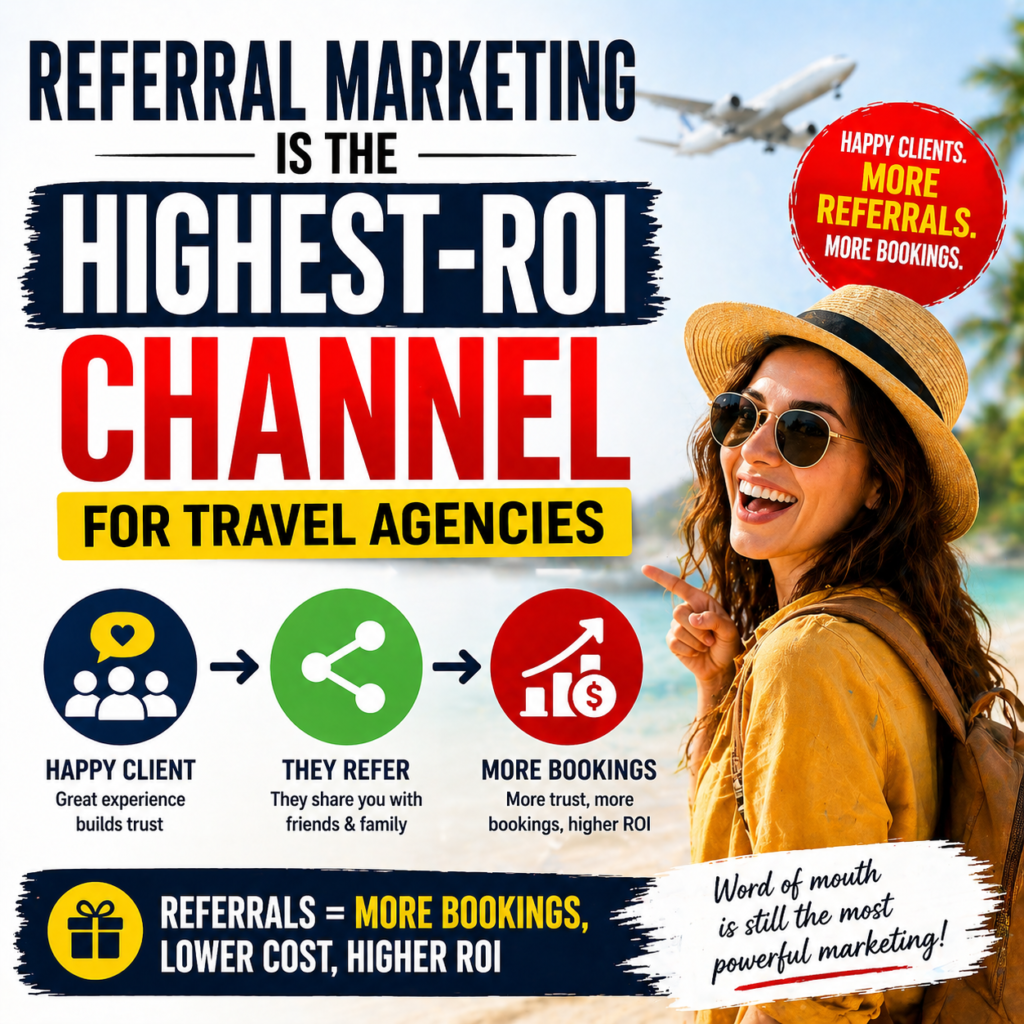

🎯 TL;DR
A referral programme for travel agencies is a structured system that rewards existing clients for introducing friends and family to your agency — turning your happiest customers into your most cost-effective marketing channel. Word-of-mouth referrals convert at 3–5x the rate of cold leads because trust is already established before the first conversation. The most effective travel agency referral programmes use the 3-Step Referral Engine: the right reward, the right ask, and the right timing — all of which you can set up in under a day with zero budget.
💡 Summary
Most travel agencies get referrals occasionally — but almost none have a system for generating them consistently. The difference between the two is enormous. An occasional referral is luck. A referral programme is a marketing channel.
This guide walks you through building a referral programme from scratch: choosing the right rewards, identifying your best referrers, crafting a WhatsApp and email ask that doesn’t feel awkward, and creating a simple tracking system that keeps everything organised. Whether you’re a solo travel agent or running a small team, this system can be running by the end of the week.
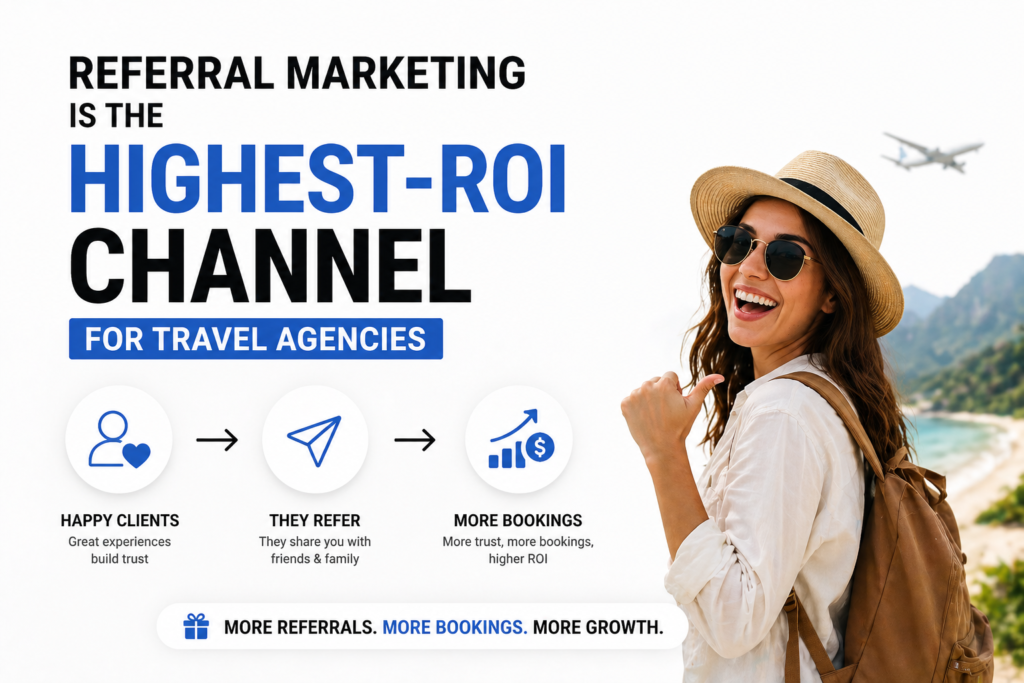
Why Referral Marketing Is the Highest-ROI Channel for Travel Agencies
The short answer: Referred clients already trust you before they’ve spoken to you. That trust — transferred from a friend or family member — converts faster, complains less, and refers others more often than any other type of lead.
Think about how most people book a holiday. They don’t open Google and click the first agency they find. They ask someone they trust: a colleague who just came back from Bali, a friend who planned a perfect honeymoon, a neighbour whose family holiday ran flawlessly. That personal recommendation carries more weight than any advertisement you could run.
Word-of-mouth referrals convert at 3–5 times the rate of cold leads generated through paid advertising or organic search. Referred clients have a shorter decision cycle, are less likely to price-compare aggressively, and have a significantly higher lifetime value — because they came in already trusting you, they’re far more likely to book again and refer others in turn.
For small travel agencies, this is transformational. Every AED you spend acquiring a client through Google Ads or Facebook needs to justify itself with a booking. A referral costs you a thank-you gift or a small incentive — and generates a client who stays loyal.
The problem isn’t that travel agency clients don’t want to refer. Most happy clients would happily recommend their agent to friends — they just don’t because nobody made it easy or gave them a reason to act right now. A referral programme solves exactly that.
Step 1 — Identify Your Best Potential Referrers
The short answer: Not every client is equally likely to refer. Start with your warmest advocates — the ones who already send you WhatsApp messages after their trip, leave five-star reviews, and tag you in their holiday photos.
Before building the programme itself, spend 20 minutes going through your client list and identifying your top referrer candidates. Look for three signals:
- Post-trip enthusiasm: Clients who messaged you unprompted after returning (“It was incredible, thank you so much!”) are already in advocacy mode. They want to share — they just need a nudge and an easy mechanism.
- Repeat bookers: A client who has booked with you two or more times is signalling deep trust. They’re your most credible advocates because they can speak to consistent quality, not just a single good trip.
- Social sharers: Clients who have tagged your agency in Instagram or Facebook posts, or shared photos from their trip publicly, have already started the referral process. They just haven’t sent anyone your way yet with a specific recommendation.
Build a simple list of 10–20 of these clients. These are the founding members of your referral programme — the first people you contact when you launch it, and the ones most likely to generate your first referred bookings within weeks.
Internal link: Your post-trip WhatsApp follow-up is the best moment to identify these advocates. For a complete post-trip communication system, read our guide on WhatsApp marketing for travel agencies.
Step 2 — Choose the Right Referral Reward
The short answer: The best referral reward is meaningful enough to motivate action but doesn’t cheapen the relationship. Travel credits, gift vouchers, and exclusive upgrades consistently outperform cash for building loyalty in travel agencies.
The reward is what transforms a passive advocate into an active one. Get it right and your programme runs itself. Get it wrong — by offering something too small, too complicated, or too transactional — and participation rates stay low.
Here are the reward options that work best for travel agencies:
| Reward Type | Example | Best For |
|---|---|---|
| Travel credit | AED 200 off your next booking | Repeat bookers — drives loyalty and future revenue |
| Gift voucher | AED 150 Noon or Amazon voucher | Clients who may not book again soon — immediate value |
| Upgrade or add-on | Free airport transfer or travel insurance | Premium clients — feels exclusive, not transactional |
| Tiered rewards | 1 referral = AED 100 / 3 = AED 400 / 5 = free add-on | High-volume referrers — creates momentum |
| Dual reward | Referrer gets AED 150 credit; new client gets AED 100 off | Highest conversion — both parties are incentivised |
The dual reward — where both the referrer and the new client receive something — consistently produces the highest conversion rates. The referrer is motivated to share, and the new client has an immediate reason to act on the recommendation rather than filing it away for later.
For UAE-based agencies, travel credits and Noon/Amazon gift vouchers resonate particularly well. Keep the reward proportional to the booking value — a AED 50 credit on a AED 10,000 luxury package feels token; a AED 300 credit feels genuinely appreciated.
Step 3 — Build the 3-Step Referral Engine
The short answer: The 3-Step Referral Engine turns a one-off ask into a repeatable system. Set it up once and it generates referrals automatically every time a client returns from a trip.
Most agencies that try referral marketing do it once — mention it at booking, hear nothing back, and give up. The reason it fails isn’t the idea. It’s the timing and the mechanism.
Step A — The Post-Trip WhatsApp Ask (Day 3–5 After Return)
This is the highest-converting moment to ask for a referral. The client is home, still buzzing from the trip, scrolling through photos, and naturally inclined to share. Send this message via WhatsApp — personalised with their name and destination:
“Hi [Name] 😊 So happy to hear you had an amazing time in [destination]! If you know any friends or family thinking about a holiday, we’d love to help them too. We have a referral programme where you get AED [amount] credit off your next trip for every booking they make. Just send them our way and mention your name. Here’s our WhatsApp link: [link]. Thank you so much — you’re one of our favourite clients!”
Keep it warm, brief, and personal. Include your WhatsApp link or a direct contact method. One tap is the maximum friction you should ask for.
Step B — The Email Reminder (7 Days Later)
If no referral has come through, send a brief email follow-up. Subject line: “Your [destination] trip — share the love 🌍”
Keep the email body short — two paragraphs maximum. Reiterate the reward, make the action crystal clear (forward this email / share this link / tag us in a post), and include a single CTA linking to your WhatsApp or a simple enquiry form.
Step C — The Ongoing Reminder (Every Future Touchpoint)
Add a referral mention to every post-trip communication going forward:
- Email signature: “Loved your trip? Refer a friend and earn AED [X] off your next holiday.”
- Invoice footer: Brief referral programme mention with contact link
- Booking confirmation email: One line at the bottom of every confirmation
- Social media bio: “Refer a friend — earn travel credits. DM us to find out how.”
These passive touchpoints require zero ongoing effort once set up — and they ensure every client interaction includes a gentle reminder that referrals are welcomed and rewarded.
Step 4 — Make It Easy to Refer
The short answer: The number one reason clients don’t refer — even when they’re happy — is friction. The fewer steps between “I want to recommend my agent” and “my friend has contacted them,” the more referrals you receive.
Reduce friction at every point:
- Give them a direct WhatsApp link — wa.me/[your number] generates a one-tap link that opens a WhatsApp conversation with your agency. This is the lowest-friction referral mechanism for a UAE audience.
- Create a shareable message template — write the recommendation for them. “I use [Agency Name] for all my holidays — they’re brilliant. Here’s their contact: [link].” When clients can copy and paste a ready-made recommendation into a WhatsApp group, conversion rates climb significantly.
- Build a simple referral landing page — a single page on your WordPress site explaining the programme, the reward, and how to refer. Link to it from every communication. A heading, three bullet points, and a WhatsApp CTA is enough.
- Use name-based referrals, not codes — asking clients to “mention your name when they contact us” is far simpler than managing referral codes for a small agency. Track it manually in a spreadsheet.
Internal link: Your referral landing page works best when it’s built for conversion. Read our guide on travel landing pages that convert to see how to structure it.
Step 5 — Track, Reward and Follow Up
The short answer: A referral programme that doesn’t track its referrals breaks trust fast. Nothing kills word-of-mouth momentum like a client’s friend booking a trip and the referrer never receiving their credit.
A simple Google Sheet with these columns is enough for most small agencies:
| Column | What to Record |
|---|---|
| Referrer name | The client who made the recommendation |
| Referred client name | The new client who was referred |
| Date of enquiry | When the new client first contacted you |
| Booking confirmed? | Yes / No / In progress |
| Reward issued | Date the credit or gift was sent to the referrer |
| Notes | Any relevant context |
Issue the reward promptly — within 48 hours of the referred client’s booking being confirmed. A quick WhatsApp message to the referrer closes the loop, reinforces their goodwill, and makes them want to refer again:
“Great news — [friend’s name] has confirmed their booking! Your AED [X] travel credit has been added to your account. Thank you so much for the recommendation 🙏”
Review your referral tracker monthly. Which clients are your top referrers? The agencies with the strongest referral cultures are the ones where top referrers feel genuinely valued — a handwritten card, an unexpected upgrade, or a personalised thank-you goes a long way.
How to Promote Your Referral Programme
The short answer: A referral programme nobody knows about generates zero referrals. Promote it consistently across every client touchpoint — not as a sales pitch, but as a genuine benefit you’re offering your best clients.
Once your programme is set up, work it into these touchpoints:
- Social media posts: One dedicated post explaining the programme (destination photo + caption explaining the reward and how to refer). Pin it to your Instagram profile and repost it quarterly.
- Email newsletter: Include a referral programme section in your regular newsletter — a brief mention with a CTA. One mention per newsletter is enough; more feels pushy.
- Booking confirmation: Add a single paragraph to the bottom of every confirmation email explaining the programme and reward.
- Post-trip review request: Combine your review request with a referral mention in the same WhatsApp message — but keep them separate asks. Ask for the review first; mention the referral programme as a lighter, second ask.
- Google Business Profile post: Publish a monthly GBP update about your referral programme — this surfaces it to people who find your listing in search and Maps.
Internal link: Your email newsletter is one of the most effective channels for promoting an ongoing referral programme. Read our complete guide on email marketing for travel agencies for a full newsletter strategy.
Final Thoughts — Your Happiest Clients Are Your Best Marketers
A referral programme for your travel agency doesn’t require software, a big budget, or a complicated system. It requires one thing: a decision to stop leaving your existing client relationships underutilised as a growth channel.
Your happiest clients are already talking about their holidays. They’re showing photos to colleagues at work, telling family members about the overwater villa, recommending you in WhatsApp groups. A referral programme simply puts a structure around that existing behaviour — making it easier to refer, giving clients a reason to do it now, and making sure every referral is acknowledged and rewarded.
Your action step this week: Write your post-trip WhatsApp referral script, choose your reward, and send it to the last five clients who returned from a trip. That’s your referral programme launched — before the end of the week.
How much should a travel agency offer as a referral reward?
For most small travel agencies, AED 100–300 in travel credit per successful referral is the right range. If your average booking value is AED 8,000–15,000, a AED 200 credit is a small cost per acquisition compared to what the same client would cost through Google Ads. Dual rewards — where both the referrer and the new client receive something — produce the highest participation rates.
When is the best time to ask a client for a referral?
The best moment is 3–5 days after they return from their trip, when the experience is fresh and their enthusiasm is at its peak. This is when they’re naturally sharing photos and talking about their holiday. Asking at checkout (before the trip) or months later (when the experience has faded) produces significantly lower response rates.
Do I need special software to run a referral programme?
No. A simple Google Sheet to track referrers, referred clients, and reward status is more than sufficient for most small travel agencies. Start with a spreadsheet — complexity is the enemy of actually launching. As your programme scales to 10+ referrals per month, you can consider simple referral software like ReferralRock.
What if a client refers someone but that person doesn’t book?
Issue the reward only when the referred client confirms and pays a booking — not at the enquiry stage. Make this condition clear in your programme description. If the referred client enquires but doesn’t book, follow up with them as you would any lead. The referrer should still be thanked for the introduction to keep goodwill intact.
Is a referral programme worth it for a one-person travel agency?
Absolutely — arguably more so than for larger agencies. As a solo agent, every new client acquired through cold advertising costs you time and money. A referred client arrives already trusting you, shortening the sales process dramatically. Even two to three referred bookings per month adds meaningful revenue with minimal ongoing effort.
Can I combine a referral programme with my review request strategy?
Yes — but keep them as separate asks in the same communication. Your post-trip WhatsApp message should first ask for a Google review (primary ask), then mention the referral programme in a second paragraph (secondary ask). Combining both into one request dilutes both. For the full review strategy, read our guide on online reputation management for travel agencies.
Social media referrals — where someone shares your Instagram post and a friend contacts you as a result — are still referrals. Ask every new enquiry “How did you hear about us?” and record the answer. If someone says “my friend sent me your Instagram,” reach out to thank the person who shared — it builds loyalty and signals that you notice and appreciate it.
How do I make sure clients remember to mention their referral when the new person contacts me?
Include a simple instruction in your referral ask: “Just ask them to mention your name when they WhatsApp us.” Keep it as simple as possible. In your first message to new enquiries, also ask: “Were you referred by anyone? We’d love to know so we can say thank you.” This catches referrals that weren’t explicitly mentioned and ensures referrers receive their credit.