

🎯 TL;DR
Online reputation management for travel agencies is the process of actively generating, monitoring, and responding to reviews across Google, TripAdvisor, Facebook, and other platforms — so that when a potential client searches for your agency, they find a business they trust. Studies show 94% of consumers avoid businesses with negative reputations, and responding to 75% or more of your Google reviews can significantly improve your local search rankings. The most effective system is the 3-Touch Review Request — asking at the right moment, in the right way, on the right channel.
💡 Summary
Most travel agencies treat reviews as something that just happens — clients either leave them or they don’t. The agencies ranking at the top of Google for their local area treat reviews as an active, managed channel. They ask for them at the perfect moment, respond to every single one, and display them strategically across their website and social media.
This guide covers the complete online reputation management system for travel agencies: where reviews matter most, how to generate a steady stream of them without awkward requests, how to respond to both positive and negative feedback, and how to turn your best reviews into marketing assets that convert website visitors into enquiries.
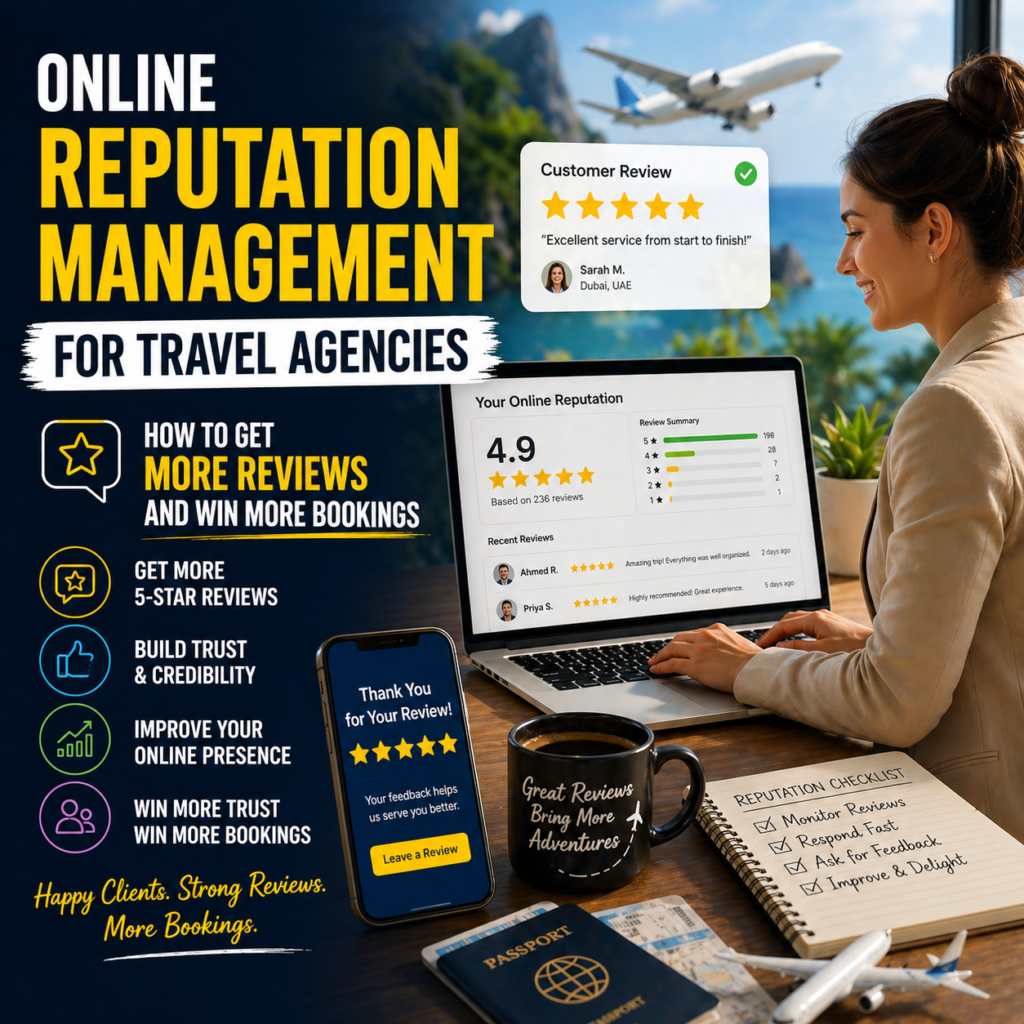
Why Your Online Reputation Is Your #1 Sales Tool
The short answer: Before a potential client ever contacts your agency, they’ve already formed an opinion based on your reviews. A weak or absent review profile is costing you bookings every single week.
Travel is a high-value, high-trust purchase. A family booking a two-week holiday to Japan is handing over thousands of pounds and trusting you with their most precious annual leave. A couple booking a honeymoon needs absolute confidence that everything will go perfectly.
That trust is formed — or broken — before the first conversation even happens.
Research consistently shows that 94% of consumers avoid brands with negative online reputations. A single unaddressed negative review sitting on your Google Business Profile is actively steering potential clients toward your competitors. Equally, a profile with 4.8 stars and 60 detailed reviews is doing your selling for you — before you’ve said a word.
For travel agencies specifically, reviews do two things simultaneously. They influence booking decisions directly (social proof) and they influence your visibility in Google Search (local SEO). More reviews, responded to promptly, means Google’s algorithm shows your profile more often when people search for travel agencies in your area.
Your reputation is not a nice-to-have. It’s your most powerful sales and marketing asset — and most agencies are leaving it entirely to chance.
Where Travellers Leave (and Read) Reviews
The short answer: Google Business Profile is the most important review platform for travel agencies. Everything else is secondary — but still worth monitoring.
Not all review platforms carry equal weight. Here’s where to focus your energy:
Google Business Profile
This is non-negotiable. Google reviews appear directly in search results, in Google Maps, and in the local pack (the three businesses that appear at the top of location-based searches). A strong Google review profile improves your click-through rate from search results and directly influences your local search ranking.
Businesses that respond to 75% or more of their Google reviews tend to rank meaningfully higher in local search results. Response speed matters too — replying within 24 hours correlates with better Local Pack placement. Review freshness is also a ranking signal — a steady stream of new reviews over time outperforms a one-time spike.
Internal link: For a deeper look at how to optimise your Google presence for local search, read our guide on SEO for travel agencies.
TripAdvisor
Particularly important for agencies specialising in international or luxury travel. Travellers still use TripAdvisor heavily for destination research and to validate supplier choices. If your agency has a TripAdvisor listing, it needs to be actively managed.
Facebook Reviews
Facebook recommendations appear in your Page’s review section and can surface in Facebook searches. For agencies running Facebook Ads, a strong review profile on the platform adds credibility to your paid content and reduces friction for cold audiences.
WhatsApp and Local Directories (UAE-Specific)
For Dubai and UAE-based travel agencies, word-of-mouth through WhatsApp groups is a significant source of referrals. Client recommendations shared in WhatsApp groups, community forums, and local Facebook groups (particularly expat communities) influence bookings just as much as formal review platforms. While you can’t manage these directly, encouraging clients to share their experiences in their networks is worth including in your post-trip follow-up.
How to Get More Google Reviews Without Begging
The short answer: The secret is timing, not persistence. Ask once, at the perfect moment, in the format your client already uses to communicate with you.
Most agencies either never ask for reviews or ask in the wrong way at the wrong time. Asking for a review at checkout — before the client has even travelled — produces very few responses. Sending a generic “please leave us a review” email three weeks later produces even fewer.
The moment to ask is immediately after the trip, when the client is back home, still glowing from the experience, and naturally inclined to share how it went.
The 3-Touch Review Request System
This framework generates a consistent flow of Google reviews without requiring manual follow-up every time.
Touch 1 — WhatsApp Message (3–5 days after return)
Send a personal WhatsApp message while the trip is still fresh. Keep it warm and brief:
“Hi [Name] 😊 So glad to hear you had an amazing time in [destination]! Would you mind leaving us a quick Google review? It genuinely helps other families find us. Here’s the direct link: [Google review link]. Thank you so much!”
The key elements: it’s personal (their name, their destination), it explains the benefit honestly, and it includes a direct link. No friction. One tap and they’re on the review page.
Touch 2 — Email Follow-Up (7 days later if no review yet)
If the WhatsApp message didn’t result in a review, send a brief follow-up email:
Subject: Your [destination] trip — a quick favour
“Hi [Name], I hope you’re settling back in after your [destination] trip! I wanted to reach out one more time to ask if you’d be willing to leave us a short Google review. It takes less than 2 minutes and makes a real difference for our small agency. [Direct link]. Thank you — and I can’t wait to help you plan your next adventure!”
Touch 3 — In Person or Final Call (for high-value bookings)
For clients who booked premium packages (honeymoons, luxury itineraries, group travel), a personal phone call or meeting creates the right moment to ask verbally. “If you’ve been happy with how everything went, a Google review would mean the world to us.” Clients who have invested significantly in a trip and had a great experience are your warmest potential reviewers — but they often just need to be asked directly.
Getting Your Direct Google Review Link
In Google Business Profile, go to your profile, click “Get more reviews” and copy the direct review link. Shorten it with Bitly or a similar tool. This link goes directly to the review box — no searching required. Use it in every review request.
Internal link: Your post-trip WhatsApp message is also the perfect moment to introduce your referral programme. Read our guide on WhatsApp marketing for travel agencies for a complete post-trip follow-up system.
How to Respond to Positive Reviews (Most Agencies Get This Wrong)
The short answer: A generic “Thank you for your kind words!” response is a missed opportunity — both for client relationships and for local SEO. Every positive review response should be personalised, keyword-aware, and warm.
Most agencies that do respond to reviews send the same template to every reviewer. “Thank you so much for your wonderful review! We hope to welcome you back soon.” This looks automated, adds no value, and misses a significant SEO opportunity.
Here’s what a good positive review response looks like:
“Thank you so much, [Name]! We’re absolutely delighted that your Maldives honeymoon exceeded expectations — hearing that the overwater villa was everything you’d dreamed of genuinely makes our day. We’ll pass your kind words on to the team. Whenever you’re ready to start planning your next adventure, we’d love to help!”
Notice what this response does:
- Uses the client’s name — personal, not templated
- References the specific trip — shows you’re paying attention
- Includes a natural keyword (Maldives, honeymoon) — signals relevance to Google
- Ends with a soft CTA — invites repeat business
Spend 3–4 minutes on each positive review response. It’s one of the highest-ROI activities in your entire marketing operation.
How to Handle Negative Reviews Without Making Things Worse
The short answer: A well-handled negative review can actually increase trust more than a positive one. Potential clients aren’t looking for perfection — they’re looking for how you respond when things go wrong.
Every travel agency will receive a negative review at some point. A missed transfer, a hotel that didn’t match expectations, a flight delay that caused a cascade of problems — travel is complex, and things occasionally go wrong despite your best efforts.
How you respond publicly is watched by every potential client who finds that review.
The HEARD Framework for Negative Review Responses
Use this five-step framework for every negative review response:
H — Hear: Acknowledge that you’ve read and understood the complaint. Don’t be defensive. “Thank you for taking the time to share your experience, [Name]. I’m really sorry to hear that your [destination] trip didn’t meet the standard you deserved.”
E — Empathise: Show that you understand the impact. “I completely understand how disappointing it must have been, especially for what was supposed to be a special family holiday.”
A — Apologise: Offer a genuine apology for the experience — even if the issue was outside your direct control. “I apologise that your experience fell short, and I take that seriously.”
R — Resolve: Move the conversation offline and offer a specific next step. “I’d really like to discuss this further and understand what happened. Please call us directly on [phone number] or email [address] and we’ll make this right.”
D — Diagnose: In your internal process (not in the public response), investigate what went wrong and whether a system change is needed.
What Never To Do
- Never argue publicly. Even if the review is unfair, a defensive or argumentative response damages your reputation far more than the original review.
- Never ignore a negative review. Unanswered negative reviews are the most damaging — they suggest you don’t care.
- Never offer compensation publicly. If a refund or gesture of goodwill is appropriate, do it privately — not in a visible public response.
- Never have someone else respond using their name. All responses should come from the agency consistently.
A negative review that receives a calm, empathetic, solution-focused response often ends up as a trust signal. Potential clients see that you handle problems professionally — which is exactly what they need to know before handing over thousands of pounds for a holiday.
How to Display Your Reviews to Convert Website Visitors
The short answer: Your reviews shouldn’t just live on Google. Every positive review is a piece of content — pull it onto your website, your social media, and your email campaigns to maximise its impact.
Generating reviews is only half the equation. The other half is making sure those reviews are seen by the right people at the right moment in their booking journey.
Google Review Widget on Your WordPress Site
Install a free Google review widget plugin on your WordPress site (options include Elfsight, WP Google Review Slider, or Trustmary). This pulls your live Google reviews directly onto your website — typically on your homepage, contact page, or a dedicated testimonials page.
A visible review widget on your homepage reduces the trust barrier for first-time visitors immediately. They don’t need to leave your site to check your reviews — the social proof is right there.
Review Screenshots for Social Media
Take screenshots of your best Google and Facebook reviews and post them as social media content. A five-star review with a detailed, heartfelt description of a honeymoon is compelling content — more persuasive than most promotional posts you’ll ever write.
Pair the review screenshot with a relevant destination image in Canva, add your agency branding, and post it as a weekly “Client Story” or “Client Love” feature. This turns your review-generation effort into ongoing content marketing.
Reviews on Landing Pages and Email Campaigns
Your highest-performing landing pages — honeymoon packages, family holiday packages, group travel — should each feature 2–3 relevant reviews from clients who booked similar trips. A potential honeymoon couple reading a five-star review from another couple who booked the same Maldives package is far more likely to submit an enquiry.
In email campaigns, including a brief client testimonial in the email body — alongside your featured destination or offer — consistently improves click-through rates.
Internal link: For more on building landing pages that convert enquiries into bookings, read our guide on travel landing pages that convert.
Final Thoughts — Reviews Are Not Passive, They Are a System
The agencies with the strongest online reputations are not the ones who got lucky with great clients. They’re the ones who built a repeatable system for asking, responding, and displaying reviews consistently.
Start this week: set up your direct Google review link, write your 3-Touch WhatsApp message template, and send it to the last three clients who returned from a trip. That’s your reputation management system started.
Your action step: Open your Google Business Profile today, copy your review link, and send it to your most recent client with the WhatsApp script above. One message, sent today, could become your next five-star review by the weekend.
How many Google reviews does a travel agency need to rank well locally?
There’s no magic number, but agencies with 20+ reviews consistently outperform those with fewer in local search results. More important than the total count is consistency — a steady flow of new reviews over time signals relevance to Google. Aim to collect at least 2–4 new reviews per month. Quality matters too: detailed, keyword-rich reviews carry more weight than single-line ratings.
Can I ask clients to change or remove a negative review?
ou can politely ask a client to update a review if you’ve resolved their issue to their satisfaction — particularly if the response to your offline conversation was positive. However, you cannot pressure, incentivise, or threaten clients into removing reviews. Google and TripAdvisor explicitly prohibit offering rewards in exchange for review changes. The best approach is to resolve the issue genuinely — satisfied clients often voluntarily update their reviews.
Should I respond to every Google review, even the positive ones?
Yes. Responding to all reviews — positive and negative — shows Google that your profile is actively managed, which is a positive ranking signal. It also demonstrates to potential clients that you engage with your customers. Keep positive responses personal and specific (reference the destination, the trip type) rather than using the same template every time.
What’s the best way to get Google reviews from UAE clients specifically?
WhatsApp is by far the most effective channel for UAE-based clients — it’s the primary communication platform for most residents. Send your review request via WhatsApp 3–5 days after their return, include the direct Google review link, and keep the message short and personal. Email is a useful backup but typically generates lower response rates in the UAE market. For VIP clients, a personal call works extremely well.
What should I do if I receive a fake or unfair negative review?
If a review is genuinely fake — left by someone who was never a client — you can report it to Google for removal via Google Business Profile. Go to your review, click “Flag as inappropriate,” and select the relevant reason. Google does investigate and remove reviews that violate its policies. While waiting for a resolution, post a calm, professional response noting that you have no record of this client’s booking and inviting them to contact you directly to clarify.
How do reviews affect my travel agency’s Google search ranking?
Google uses four review signals in its local ranking algorithm: volume (total number of reviews), rating (average star score), freshness (how recently reviews were left), and response activity (whether and how quickly you respond). Businesses that respond to 75% or more of reviews and maintain a consistent flow of new reviews tend to rank higher in the local pack — the three-business result that appears at the top of location-based searches.
Is TripAdvisor still relevant for small travel agencies in 2026?
TripAdvisor remains relevant, particularly for agencies specialising in leisure, luxury, or adventure travel. Travellers still use it to validate agencies and destinations during the research phase. If you have a TripAdvisor listing, it should be actively managed — respond to reviews, keep your profile updated, and encourage clients who are active TripAdvisor users to leave reviews there as well as Google.
How do I handle a negative review that’s actually justified?
Acknowledge it honestly and address it head-on. Potential clients reading your reviews are not expecting perfection — they’re evaluating your professionalism and integrity. A response that says “You’re right that this fell short of our standard, here’s what we’ve done to address it, and we’d love the opportunity to restore your confidence” is far more reassuring than a defensive response or silence. The agencies with the strongest reputations are often the ones who have handled a few difficult situations transparently and well.