
🎯 TL;DR
Retargeting ads for travel agencies show your packages to people who have already visited your website, watched your videos, or engaged with your social media — but didn’t enquire. These warm audiences convert at 3–5x the rate of cold traffic because they already know your agency exists. In 2026, the most effective retargeting channels for travel agencies are Facebook and Instagram retargeting (through the Meta Pixel), Google Display retargeting, and YouTube retargeting — all of which can be set up with a starting budget of AED 500–1,000 per month.
💡 Summary
Most travel agencies spend their entire advertising budget trying to find new people who have never heard of them. They overlook the most valuable audience of all: the people who already visited their website, read about their Maldives package, and then left without enquiring.
These are not lost leads — they are warm prospects. And retargeting ads are how you bring them back.
This guide covers the complete retargeting system for travel agencies: how to set up the tracking pixels, which audiences to target, what ads to show them, how much to spend, and when to stop showing ads to someone who clearly isn’t going to convert.
Why Retargeting Is the Highest-Converting Ad Type for Travel Agencies
The short answer: A person who visited your Maldives package page and spent three minutes reading it is far more likely to enquire than someone who has never heard of you. Retargeting finds that person and brings them back.
Think about the typical travel research journey. A couple planning their honeymoon might visit your website three or four times across two to three weeks before they enquire. They browse your Maldives package on Tuesday, come back on Thursday to check the inclusions, and then get distracted by life. By the following Monday, they’ve forgotten your agency name — but they’re still thinking about the Maldives.
A retargeting ad finds them on Facebook on Friday evening, shows them the exact package they were reading about, and puts your agency back at the front of their mind at exactly the right moment.
Retargeting audiences convert at 3–5x the rate of cold audiences because the awareness and trust barrier has already been partially overcome. These people chose to visit your website — they showed interest. Retargeting capitalises on that interest before it fades.
The average travel customer visits 20+ websites before booking. Retargeting ensures that when they do make a decision, your agency is the one they remember.
Setting Up the Meta Pixel for Travel Agency Retargeting
The short answer: The Meta Pixel is a small piece of code that installs on your WordPress website and tracks every visitor — building your retargeting audience automatically before you’ve spent a single dirham on ads.
Step 1 — Create your Meta Pixel In Facebook Ads Manager, go to Events Manager → Connect Data Sources → Web → Meta Pixel. Name your pixel after your agency and click “Create Pixel.”
Step 2 — Install on WordPress
The easiest method is using a free plugin — search “PixelYourSite” or “Meta Pixel” in the WordPress plugin directory. Install, activate, enter your Pixel ID (found in Events Manager), and save. The pixel is now installed and tracking visitors.
Step 3 — Verify installation
Install the Meta Pixel Helper Chrome extension and visit your website. The extension should show a green tick confirming the pixel is firing correctly.
Step 4 — Set up standard events
Configure events for key actions on your website: PageView (automatic), ViewContent (when someone views a specific package page), Lead (when someone submits your enquiry form), and Contact (when someone clicks your WhatsApp button). These events allow you to retarget based on specific actions, not just any website visit.
Critical step: Install your pixel now, even if you are not ready to run ads yet. Your pixel builds your retargeting audience over time — a pixel that has been tracking for 60 days before you launch your first retargeting campaign gives you a warm audience of hundreds or thousands of visitors to target immediately.
The Travel Agency Retargeting Audience Stack
The short answer: Build your retargeting audiences in layers — from hottest to coldest — and show different ads to each layer based on how far they progressed through your website.
| Audience | Warm Level | What They Did | Ad Strategy |
|---|---|---|---|
| Enquiry form visitors (didn’t submit) | 🔥🔥🔥 | Reached your enquiry page but left | Urgency — “Still planning your Maldives trip? We have availability this June.” |
| Package page visitors (3+ minutes) | 🔥🔥🔥 | Read a specific package in detail | Show that exact package with a testimonial and a soft CTA |
| Blog post readers | 🔥🔥 | Read destination content | Destination-specific ad matching the blog topic |
| General website visitors | 🔥 | Visited any page, bounced quickly | Brand awareness — agency overview with review rating |
| Video viewers (75%+ watch time) | 🔥🔥 | Watched most of a destination video | Follow-up ad with more detail about that destination |
| Instagram/Facebook page engagers | 🔥 | Liked, commented, or saved a post | Agency awareness ad with strong social proof |
Prioritise your hottest audiences — enquiry page visitors and package page visitors — with the most specific, conversion-focused ads. Colder audiences (general website visitors, social engagers) receive brand-building ads that warm them up for future retargeting.
Internal link: To build a retargeting audience quickly, you need a steady flow of website traffic. Read our guide on SEO for travel agencies for the organic traffic strategy that feeds your retargeting funnel.
What Ads to Show Retargeted Travel Agency Audiences
The short answer: Retargeting ads for warm travel audiences work best when they reference the specific destination or package the person viewed — combined with a trust signal and a low-friction call to action.
Ad Type 1 — The Reminder Ad (For Package Page Visitors)
Show the specific package they viewed. Include the package name, key inclusions, price range, and a review quote from a past client who booked the same package.
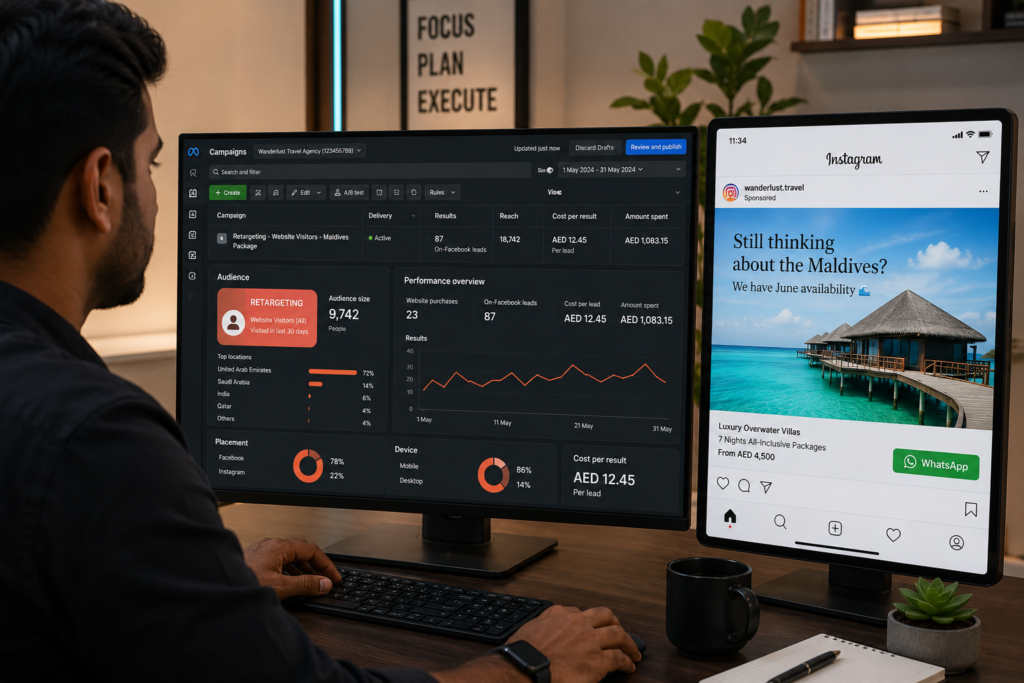
Ad copy example: “Still thinking about the Maldives? 🌊 Our 7-night overwater villa package from AED 4,500 per person includes return flights, daily breakfast, and airport transfers — fully managed so you don’t have to organise a thing. 4.9★ from 130+ Google reviews. WhatsApp us to check availability for your dates.”
Ad Type 2 — The Social Proof Ad (For Blog Readers and Video Viewers)
Lead with a real client story or testimonial related to the destination they showed interest in. This builds trust through peer validation rather than direct promotion.
Ad copy example:
“‘We honestly couldn’t have planned this without [Agency Name] — every detail was perfect.’ — Sarah & James, Maldives honeymoon clients. If you’re planning a Maldives trip, we’d love to help. DM us to start.”
Ad Type 3 — The Urgency Ad (For Enquiry Page Visitors Who Didn’t Convert)
These are your hottest prospects — they reached the enquiry page and left. A time-sensitive angle reactivates them.
Ad copy example: “We still have June Maldives availability — but it’s going fast. Our 7-night packages from AED 4,500 are booking up. Send us a WhatsApp and we’ll hold availability while we put your itinerary together.”
Ad Type 4 — The Value Ad (For Cold Retargeting Audiences)
For people who visited briefly and showed minimal engagement, a value-led ad that educates rather than sells is more appropriate.
Ad copy example:
“Planning a Maldives honeymoon from the UAE? Here’s what most couples don’t know before they book — [link to blog post].” This drives them back to your content, deepens their engagement, and moves them into a warmer retargeting tier.
Budget Allocation for Travel Agency Retargeting
The short answer: Retargeting should receive 35–40% of your total Facebook and Google advertising budget — more than most agencies currently allocate — because it consistently delivers the lowest cost per enquiry of any campaign type.
For a travel agency spending AED 3,000/month on paid advertising:
| Campaign Type | Budget | Rationale |
|---|---|---|
| Prospecting (cold audiences) | AED 1,500 | Builds your retargeting pool |
| Retargeting (warm audiences) | AED 1,050 | Converts existing interest |
| Lead generation | AED 450 | Captures direct enquiries |
Your retargeting budget does not need to be large to be effective — warm audiences are small but high-converting. AED 500–700/month in retargeting can generate 10–20 qualified enquiries from people already familiar with your agency.
Internal link: For the complete Facebook Ads strategy that works alongside your retargeting campaigns, read our guide on Facebook ads for travel agencies.
Google Display Retargeting for Travel Agencies
The short answer: Google Display retargeting shows your ads to past website visitors as they browse other websites across Google’s Display Network — keeping your agency visible throughout the decision-making process.
While Meta retargeting reaches warm audiences on Facebook and Instagram, Google Display retargeting reaches them everywhere else — news websites, blogs, Gmail, YouTube, and thousands of other sites.
Set up Google Display retargeting in Google Ads: 1. Link your Google Ads account to Google Analytics (or use the global site tag on your WordPress site)
2. Create a Remarketing audience in Google Ads for “all website visitors” (last 30 days)
3. Create a Display campaign with remarketing targeting
4. Use visual banner ads (300×250, 728×90, 160×600) featuring your destination photography and a simple CTA
Google Display retargeting is particularly effective for the 60–90 day travel research window — keeping your agency name visible throughout the entire consideration period.
When to Stop Retargeting — Frequency Caps and Audience Exclusions
The short answer: Showing the same ad to the same person 20 times is not persistence — it is harassment. Set frequency caps and exclude audiences who have already converted.
Frequency caps: In Facebook Ads Manager, set a maximum of 2–3 ad impressions per person per week for retargeting campaigns. Beyond this, ad fatigue sets in — users start ignoring or hiding your ads, which negatively affects your ad account’s quality score.
Time window: Retarget website visitors for 30 days after their visit. Beyond 30 days, move them to a lower-budget “cold retargeting” audience with less specific, more brand-awareness-focused ads.
Exclusions: Always exclude people who have already submitted an enquiry form — there is no need to retarget someone who is already in your pipeline. Set up a Custom Audience of recent enquirers and exclude them from all retargeting campaigns.
Final Thoughts — Retargeting Turns Your Traffic Into Revenue
You are already spending money (or time) to get people to your website — through SEO, social media, Google Ads, or content marketing. Retargeting ensures that investment is not wasted on visitors who leave without converting on their first visit.
Start with the Meta Pixel today. Even if you are not ready to run retargeting ads for another month, every day your pixel tracks visitors is a day you are building your future retargeting audience.
Your action step: Install the Meta Pixel on your WordPress website today using the PixelYourSite plugin. Set it up, verify it is firing, and let it build your audience for 30 days. When you are ready to run your first retargeting campaign, you will have a warm audience waiting.
FAQ — Retargeting Ads for Travel Agencies
1. What is the difference between retargeting and remarketing?
Retargeting and remarketing are often used interchangeably, but they have a slight technical distinction. Retargeting typically refers to showing ads to people based on pixel data — website visitors tracked by the Meta Pixel or Google Tag. Remarketing often refers specifically to Google’s system of reaching past website visitors through Google Ads. In practice, both mean the same thing for travel agencies: showing ads to people who have already shown interest in your agency.
2. How long should I retarget travel agency website visitors?
The optimal retargeting window for travel agencies is 30 days for hot audiences (package page visitors, enquiry page visitors) and 60–90 days for warmer but less engaged visitors (general website visitors, video viewers). Beyond 90 days, the intent signal from an initial website visit becomes too weak to justify specific retargeting spend — move these visitors to a general brand awareness audience instead.
3. How many people do I need in my retargeting audience before I can run ads?
Facebook requires a minimum of 100 people in a Custom Audience to run retargeting ads (for privacy reasons). In practice, you need at least 300–500 people for meaningful results. Install your Meta Pixel immediately — even before you are ready to run ads — and let it build your audience passively. A pixel that has been tracking for 60 days gives you an immediate audience to target from day one of your first campaign.
4. What is a good cost per lead from travel agency retargeting ads?
Retargeting campaigns for travel agencies typically deliver leads at AED 50–150 per lead — significantly lower than cold prospecting campaigns (AED 150–400 per lead). The exact cost depends on your audience size, ad creative quality, and destination. Premium luxury packages attract higher-value leads that justify a higher cost per lead; mid-range packages should aim for the lower end of the range.
5. Can I retarget people who watched my Instagram Reels?
Yes. Facebook Ads Manager allows you to create Custom Audiences based on Instagram and Facebook video views — specifically targeting people who watched 50%, 75%, or 95% of a specific video. High video completion is a strong intent signal; people who watched 75%+ of your Maldives Reel are warm prospects who deserve a retargeting ad showing them more detail about that destination or package.
6. Should I retarget people with the exact same ad they saw originally?
No — use a different creative for your retargeting audience. The person has already seen your original ad or website page. Retargeting works best when it adds new information or a new angle: a client testimonial, a specific package detail, a seasonal offer, or an urgency message. Showing the same generic ad again produces diminishing returns and increases ad fatigue faster.
7. How do I know if my retargeting campaign is working?
Track cost per lead (enquiry form submission or WhatsApp message), return on ad spend (booking value generated ÷ ad spend), and click-through rate (aim for 1.5–3% for retargeting). Compare these metrics to your cold prospecting campaigns — retargeting should consistently outperform on cost per lead. Also track which retargeting audience segment performs best (package page visitors vs. general visitors) and allocate more budget to the highest-converting segment.
8. Can I retarget past clients to encourage repeat bookings?
Yes — and this is one of the most underused retargeting strategies for travel agencies. Upload your past client email list to Facebook as a Custom Audience. This allows you to show seasonal offers and new destination ads specifically to people who have already booked with you — your warmest possible audience. A past client who had a great experience and sees your new Santorini package advertised on Instagram is far more likely to book again than a cold prospect.