
🎯 TL;DR
A travel agency newsletter is an email sent regularly to your subscriber list — past clients, enquirers, and interested travellers — featuring destination inspiration, exclusive offers, travel tips, and agency updates. Email remains the highest-ROI marketing channel in 2026, returning an average of $36–$42 for every $1 spent. The most effective travel agency newsletters follow the DISH format — Destination spotlight, Insider tip, Special offer, Human story — published once or twice per month to a segmented list, using a subject line that creates curiosity rather than announcing content.
💡 Summary
Most travel agencies that run a newsletter make the same mistake: they treat it like a promotional brochure. Every email is an offer. Every subject line screams “SALE.” And so their subscribers stop opening them.
The agencies with the highest open rates — consistently 30–45% — treat their newsletter like a trusted friend sending genuinely useful travel content, with a relevant offer included naturally. This guide covers how to build, write, and grow a travel agency newsletter that subscribers look forward to opening — and that generates enquiries every time it goes out.
Why Email Outperforms Every Other Marketing Channel
The short answer: Unlike social media, where algorithm changes can cut your reach overnight, your email list is an asset you own. No platform can take it away — and every subscriber chose to hear from you.
The comparison between email and social media marketing is stark. An Instagram post typically reaches 2–5% of your followers organically. An email reaches 100% of your list — and 30–45% of them open it if your subject lines are good.
Email marketing for travel agencies generates an average return of $36–$42 for every $1 spent — a higher ROI than Google Ads, Facebook Ads, or any organic social channel. The reason is simple: email subscribers have already raised their hand. They opted in, which means they have at least some interest in travel and some familiarity with your agency.
For past clients specifically, the email list is the most direct line to repeat bookings. A past client who loved their Maldives honeymoon, subscribed to your newsletter, and receives a perfectly timed “Maldives anniversary packages” email 11 months later is your highest-probability booking — and the email that triggers it costs you almost nothing to send.
Internal link: For a complete guide to email marketing beyond the newsletter, read our full guide on email marketing for travel agencies.
The DISH Newsletter Format for Travel Agencies
The short answer: The DISH format — Destination spotlight, Insider tip, Special offer, Human story — gives every newsletter a consistent structure that is genuinely useful, not purely promotional.
D — Destination Spotlight
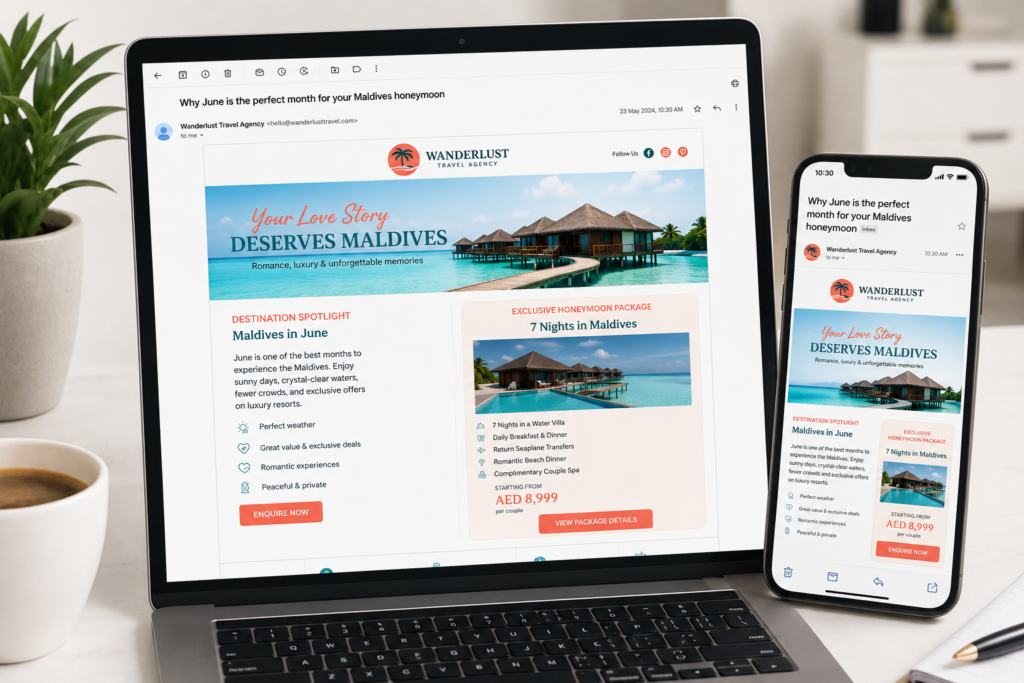
Feature one destination per newsletter. 100–150 words: why it is remarkable right now, the best time to visit, and one insider detail that demonstrates your knowledge. Link to a full blog post or package page for readers who want more.
Example: “Why June Is the Best Month to Visit Santorini (And Why Most Travellers Get It Wrong)” — a brief teaser with a “read more” link to your blog.
I — Insider Tip
A practical, specific travel tip your subscribers can use immediately. This is where you demonstrate expertise. 50–80 words, highly specific.
Example: “Getting a sunset table at Oia’s best restaurants requires booking exactly 60 days in advance — not the day before. Here is exactly which restaurants to contact and what to say.”
S — Special Offer
One featured package or seasonal offer, clearly presented. Destination, inclusions, price range, and a WhatsApp or enquiry CTA. Keep this to 80–100 words. It should feel like a helpful recommendation, not a hard sell.
H — Human Story
A brief client story — one paragraph, 60–80 words — about a real trip your agency recently organised. Name the clients (first names only), mention the destination, and include one specific detail that makes the story vivid. This is your social proof section and typically has the highest engagement of any newsletter element.
Example: “Last month, Ahmed and Fatima celebrated their anniversary in Tuscany — their first Europe trip. Ahmed called us from the hotel to say the private vineyard tour we arranged was the best evening of their lives. That is exactly why we do this.”
Building Your Travel Agency Email List
The short answer: Start with the clients you already have, then grow with a lead magnet that attracts the type of traveller you want to serve.
Your existing clients first: Import every past client email address into your email tool (Brevo, Mailchimp, or ConvertKit). These are your warmest subscribers — they have already booked with you and are most likely to open your newsletter and book again.
Lead magnets for new subscribers: Offer a free resource on your website in exchange for an email address: – “Free Maldives Honeymoon Planning Guide” (PDF download)
– “UAE Resident’s Visa Guide for Top 10 Destinations” (checklist)
– “The 7-Night Bali Itinerary for Families” (downloadable guide)
Place your lead magnet opt-in prominently on your homepage, blog posts, and any page that receives significant traffic.
Internal link: For a complete guide to creating lead magnets that attract your ideal clients, read our post on lead magnets for travel agencies.
Subject Lines That Actually Get Opened
The short answer: The best travel agency newsletter subject lines create curiosity, reference a specific destination or scenario, and avoid words that trigger spam filters. Never announce the content — tease it.
High-performing subject line formulas:
- The Question: “Is this the most underrated honeymoon destination right now?”
- The Specific Claim: “The Maldives resort we’ve sent 40 couples to (and why)”
- The Contrarian: “Why we’re telling clients to avoid Bali in August this year”
- The Personal: “We nearly missed this Santorini restaurant. Don’t make the same mistake.”
- The Time Sensitive: “3 June departures still available — Bali family package from AED 4,200”
Subject line rules:
– Under 50 characters for full display on mobile (where 60%+ of emails are opened)
– Avoid: “SALE,” “LIMITED TIME,” “FREE” in caps — these trigger spam filters
– Test two subject lines per send (A/B test via Brevo or Mailchimp) to learn what works for your audience
How Often to Send Your Travel Agency Newsletter
The short answer: Twice per month is the sweet spot for most travel agencies — frequent enough to stay top of mind through the 45–90 day booking consideration window, but not so frequent that subscribers feel bombarded.
| Frequency | Open Rate Trend | Best For |
|---|---|---|
| Weekly | Can fatigue subscribers if content isn’t consistently strong | High-volume agencies with lots of content |
| Twice monthly | Best balance of visibility and subscriber patience | Most small travel agencies ✅ |
| Monthly | Risk of being forgotten between sends | Agencies with very limited content capacity |
Publish your newsletter on a consistent day and time. Tuesday and Thursday mornings (8–10am UAE time) consistently produce the highest open rates for travel email lists. Consistency trains subscribers to expect and look for your email.
Final Thoughts — Your Email List Is Your Most Valuable Marketing Asset
Social media followers can disappear if a platform changes its algorithm. Paid ad results stop the moment you stop paying. Your email list — a direct line to people who have raised their hand and said “yes, I want to hear from you” — keeps delivering for years.
Build it, write to it consistently, and treat every subscriber like a potential repeat client or referrer. Because most of them are.
Your action step: Write your first newsletter this week using the DISH format. D: pick one destination you love. I: share one specific insider tip. S: feature one current package with a price range. H: tell one client story (with permission). That is your first newsletter — done in under an hour.
FAQ — Travel Agency Newsletter
Brevo (formerly Sendinblue) is the best option for most small travel agencies — it has a generous free plan (up to 300 emails per day), strong automation features, and excellent deliverability. Mailchimp is a well-known alternative with a good free tier (up to 500 subscribers). ConvertKit is worth considering if you plan to build a significant subscriber list and use automation extensively. All three integrate with WordPress and allow you to design professional newsletters without any coding.
2. How do I grow my travel agency email list quickly?
The fastest way is a lead magnet — a free, genuinely useful resource offered in exchange for an email address. A “Maldives Honeymoon Planning Guide” or “Bali Family Holiday Itinerary” placed prominently on your website and promoted via Instagram will attract new subscribers consistently. Additionally, ask every new client to join your newsletter as part of the booking process, and promote your newsletter to your social media followers with a specific reason to sign up.
Industry average for travel email is 20–25% open rate. A well-managed travel agency list with engaged subscribers should aim for 30–45%. If your open rate is below 20%, review your subject lines (most common issue), your sending frequency (if you send too often, subscribers disengage), and your list quality (old or purchased lists have low open rates). Clean your list every six months by removing subscribers who haven’t opened an email in 12 months.
Yes — AI writing tools like ChatGPT or Claude can draft your newsletter in minutes from a simple brief. Give the tool your DISH structure and specific details: “Write a 400-word travel newsletter with a Maldives destination spotlight, a tip about the best time to visit for budget prices, a featured 7-night package from AED 4,500, and a one-paragraph story about a couple’s anniversary trip.” Then edit the draft to match your voice before sending.
Segmentation significantly improves performance. At minimum, separate your past clients from new subscribers — past clients benefit from more personalised, relationship-focused content (“It’s been a year since your Maldives trip…”) while new subscribers need more introductory, credibility-building content. As your list grows, segment by travel preference (beach vs. city, luxury vs. mid-range, couples vs. families) to send destination-specific content that drives higher open and click rates.
Avoid: too many offers in one email (one featured offer per newsletter maximum), overly salesy language (“BOOK NOW — LIMITED TIME”), generic content that any agency could send, subject lines with spam-trigger words in capitals, emails sent without an unsubscribe link (legally required), and attachments (PDFs reduce deliverability — link to content on your website instead). The guiding principle: every newsletter should feel like something a knowledgeable friend would send — genuinely useful, not purely promotional.
Track: open rate (aim for 30%+), click-through rate (aim for 3–5% for travel links), unsubscribe rate (under 0.5% per send is healthy), and — most importantly — enquiries that mention the newsletter as the prompt. Ask every new enquiry “How did you hear about us?” and note when they mention your email. Over six months of consistent sending, you should see a measurable correlation between newsletter sends and enquiry volume in the days that follow.
Use a reputable email tool (Brevo, Mailchimp, ConvertKit) — these have established sending infrastructure and good deliverability. Only send to subscribers who explicitly opted in. Authenticate your sending domain (SPF, DKIM, DMARC records — your email tool will guide you through this). Avoid spam-trigger words in subject lines. Include your physical business address in the footer (legally required in most markets). Maintain a clean list by removing inactive subscribers regularly.