
🎯 TL;DR
Influencer marketing for travel agencies means partnering with content creators who promote your packages to their engaged social media audiences — and it works: 72% of travellers are swayed by social media when planning trips, and over half are now comfortable booking travel directly through social platforms. The most cost-effective approach for small agencies is micro-influencer marketing — partnering with creators who have 10,000 to 100,000 followers in a specific travel niche. They deliver higher engagement, stronger audience trust, and more affordable rates than celebrity influencers, often charging between $100 and $5,000 per post.
💡 Summary
Most small travel agencies assume influencer marketing is for big brands with big budgets. In 2026, that assumption is costing them bookings. Micro-influencers — creators with highly engaged, niche audiences — are now one of the most accessible and cost-effective marketing channels available to any agency, regardless of size.
This guide covers everything a travel agency needs to launch its first influencer partnership: how to find the right creators, what to offer them, how to structure the collaboration, and how to measure whether it worked. No large budget required.
Why Influencer Marketing Works for Travel Agencies
The short answer: Travel is inherently visual and social. People trust a recommendation from someone they follow online far more than they trust an advertisement — and influencers have built that trust at scale.
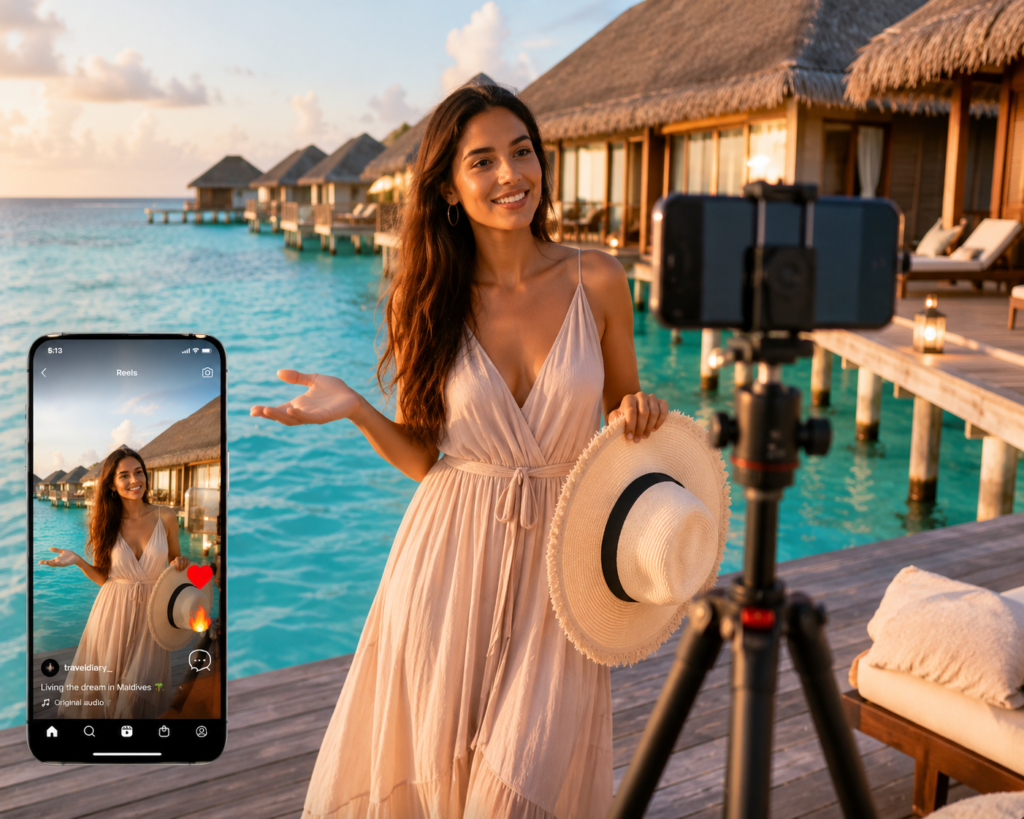
Consider how a potential client decides on their next holiday. They might search Google for destination ideas, but they’re also watching destination Reels on Instagram, scrolling TikTok for “things to do in Bali,” and saving YouTube travel vlogs for their commute. At every one of those touchpoints, the opinions of content creators they follow are shaping their destination decisions.
The numbers support this. Research shows 72% of travellers are influenced by social media when planning their trips. More significantly, over half of travellers in 2026 are now comfortable booking travel directly through social platforms — meaning the gap between inspiration and purchase has never been shorter.
For small travel agencies, this is an enormous opportunity. A well-chosen micro-influencer with 25,000 engaged followers who specialise in luxury travel content can put your Maldives honeymoon package in front of 25,000 people who are actively interested in exactly that type of holiday. No other marketing channel gives you that level of audience targeting at that price point.
Understanding Influencer Tiers — Which One Is Right for Your Agency?
The short answer: For most small travel agencies, micro-influencers (10,000–100,000 followers) deliver the strongest return on investment. They cost less, convert better, and have audiences that actually engage with their content.
| Influencer Tier | Followers | Typical Cost Per Post | Best For |
|---|---|---|---|
| Nano | Under 10,000 | $20–$100 | Hyperlocal awareness, product testing |
| Micro | 10,000–100,000 | $100–$5,000 | Targeted campaigns, high engagement, best ROI |
| Mid-tier | 100,000–500,000 | $5,000–$10,000 | Broader reach with reasonable targeting |
| Macro/Mega | 500,000+ | $10,000+ | Mass awareness — typically beyond small agency budgets |
Micro-influencers consistently outperform macro-influencers on engagement rate. A creator with 30,000 followers in the luxury travel niche will typically deliver a 3–5% engagement rate — meaning 900–1,500 people actively interact with each post. A macro-influencer with 500,000 followers might deliver 0.5–1% engagement — the same absolute number, but at 10x the cost.
HubSpot’s 2026 research found that 47% of marketers report micro-influencers as their most successful partners across all industries. In travel, where niche audience fit drives purchase decisions, that advantage is even more pronounced.
How to Find the Right Travel Influencers for Your Agency
The short answer: The best influencer for your agency is not the one with the most followers — it is the one whose audience most closely matches your ideal client.
Start by defining your ideal influencer audience before you search for creators. Ask: Who are my best clients? Where do they live? What type of travel do they book? What is their budget range? The influencer you want is one whose followers match that profile.
Where to Find Micro-Influencers
Instagram Search: Search hashtags relevant to your specialisation — #MaldivesHoneymoon, #LuxuryTravelUAE, #DubaiTravel, #FamilyTravelBali — and look at the top posts. The creators behind those posts are your starting list. Check their follower count, engagement rate, and whether they tag travel brands or agencies in their content.
TikTok Search: Search destination keywords and filter for creators rather than brands. TikTok’s algorithm surfaces content regardless of follower count, so small creators regularly produce viral destination content — these are your ideal partners.
Free Tools: Modash, Heepsy, and Later’s influencer search tools offer free tiers for finding and vetting influencers by niche, location, follower count, and engagement rate.
Your Own Comments Section: Clients who tag your agency in their holiday posts are already unpaid advocates. If their profiles have a travel-focused following, they may be ideal micro-influencer partners.
What to Check Before You Reach Out
Before contacting any influencer, verify:
- Engagement rate: Aim for 2–5% minimum (likes + comments ÷ followers × 100). Below 1% suggests an inactive or bought audience.
- Comment quality: Scroll through recent comments. Genuine comments (“I need to go here!”) are very different from spam (“Great post! Check my page”).
- Audience location: If you serve UAE clients, check that a significant portion of the influencer’s audience is based in the UAE, GCC, UK, or other markets you serve. Most influencers can share audience demographics on request.
- Content quality: Does their content look professional? Is the photography or video quality consistent with how you want your packages represented?
- Brand fit: Have they worked with travel brands before? Is their content style aligned with your agency’s positioning?
How to Approach Influencers: The Outreach Formula
The short answer: Most influencer outreach fails because it is generic, impersonal, and unclear. A three-paragraph DM or email that is specific, flattering, and actionable gets responses. A template blast does not.
Here is an outreach message structure that works:
Paragraph 1 — Genuine compliment: Reference a specific piece of their content. “Your Santorini series last month was stunning — the way you captured the caldera views at sunrise was genuinely beautiful.”
Paragraph 2 — Who you are and what you offer: “I run [Agency Name], a Dubai-based travel agency specialising in bespoke honeymoon and luxury holiday packages across the Mediterranean and Indian Ocean. I’d love to explore a collaboration — either a hosted trip to one of our partner resorts or a paid partnership to promote one of our packages to your audience.”
Paragraph 3 — Clear next step: “Would you be open to a quick call or DM to discuss? I’m happy to share more about what we have in mind and hear your thoughts.”
Keep it under 150 words. Make it clear you have actually looked at their content. Give them a reason to say yes.
Structuring the Collaboration
The short answer: The most effective travel agency influencer collaborations involve either a hosted trip or a paid promotion — or both. Set clear deliverables before agreeing to anything.
Option 1 — Hosted FAM Trip
You cover the influencer’s travel costs (flights, accommodation, transfers) in exchange for a set number of posts, Reels, TikToks, or Stories. This works well if you have supplier relationships that give you access to complimentary or discounted hotel stays.
Typical deliverables for a hosted trip: 1 Instagram Reel, 3–5 Instagram Stories, 1 TikTok video, 1 blog post or YouTube video (optional). Agree all deliverables in writing before the trip.
Option 2 — Paid Partnership
You pay the influencer a fee to create and publish content promoting a specific package. You provide the package details, key selling points, and any imagery. They produce the content in their own style.
For micro-influencers, this typically costs $200–$1,500 per post. Always ask for content usage rights so you can repurpose their posts in your own social media and paid ads.
Option 3 — Affiliate Commission
Instead of a fixed fee, offer the influencer a commission for every enquiry or booking that comes through a unique link or discount code. This reduces upfront cost and aligns incentives — the influencer earns more if they drive more bookings.
The Travel Agency Influencer Brief — always give every influencer a one-page brief covering: your agency name and positioning, the specific package or destination you want featured, three key messages to communicate, any mandatory disclosures (#ad or #gifted as required by local regulations), the posting deadline, and the deliverables agreed.
Internal link: Pair your influencer content with a strong social media presence of your own. Read our guide on video marketing for travel agencies to understand how to repurpose influencer content across your own channels.
How to Measure Whether It Worked
The short answer: Track reach, engagement, website traffic, and enquiries — not follower count. A post that reaches 10,000 people and generates 5 enquiries is infinitely more valuable than one that reaches 100,000 and generates none.
Set up tracking before the campaign goes live:
- Unique link: Create a UTM-tagged URL (use Google’s Campaign URL Builder) for the influencer to include in their bio link or Stories swipe-up. This shows exactly how much traffic came from their posts.
- Unique discount code: Give the influencer a code (e.g., SARAH200) offering AED 200 off their first booking. Every redemption is a direct attribution.
- DM tracking: Ask all new enquiries during the campaign period how they heard about you. Record the responses.
- Engagement metrics: Note the reach, likes, comments, saves, and shares on every piece of influencer content. These indicate audience interest even if no immediate booking follows.
Review performance 30 days after the campaign — not immediately. Travel has a long consideration cycle; a Reel posted in June may generate enquiries in August when the viewer starts actively planning their holiday.
Internal link: Tracking influencer traffic through your website is only useful if your website is set up to convert that traffic. Read our guide on how to build a travel agency website that gets bookings for the conversion fundamentals.
Final Thoughts — Start With One Influencer, Not Ten
The biggest mistake travel agencies make with influencer marketing is trying to do too much at once. They contact 20 influencers, negotiate 10 collaborations, and then have no budget or time left to manage any of them well.
Start with one micro-influencer whose audience is a near-perfect match for your ideal client. Negotiate one clear collaboration. Track everything. Learn from it. Then scale.
A single well-executed influencer partnership with a travel creator who has 20,000 engaged followers in your target demographic can generate more enquiries than months of sporadic social media posting.
Your action step: Search one hashtag relevant to your niche on Instagram right now — #MaldivesHoneymoon, #LuxuryTravelDubai, or a destination you specialise in. Find three creators with 10,000–50,000 followers and strong engagement. Save their profiles. That is your influencer shortlist.
FAQ — Influencer Marketing for Travel Agencies
1. How much does influencer marketing cost for a small travel agency?
Micro-influencer partnerships typically cost between $100 and $5,000 per post, depending on the creator’s follower count, engagement rate, and content format. For a small travel agency starting out, budget AED 500–2,000 per collaboration for a micro-influencer with 15,000–50,000 followers. Hosted FAM trips can replace cash fees if you have supplier relationships that give you complimentary or heavily discounted stays. Start with one or two collaborations to test what works before scaling.
2. How do I find travel influencers in the UAE or Middle East?
Search Instagram for hashtags like #UAETravel, #DubaiTravel, #MiddleEastTravel, and #LuxuryTravelUAE. Look at the creators behind the top posts. Also check TikTok for UAE-based travel creators — the platform has a rapidly growing travel content community in the region. Tools like Modash or Heepsy allow you to filter influencer searches by audience location, making it straightforward to find creators whose followers are primarily based in the UAE or GCC.
3. Do I need a formal contract for influencer collaborations?
For any paid collaboration, yes. A simple one-page agreement covering the deliverables, posting deadline, payment terms, content usage rights, and disclosure requirements is sufficient. For hosted trips, a written email exchange confirming the same details provides enough documentation. Never proceed with a paid partnership on a verbal agreement alone — misunderstandings about deliverables are the most common source of influencer collaboration disputes.
4. What should I ask an influencer to post about my travel agency?
Give them a clear brief but allow creative freedom. Specify the destination or package, the three key messages you want communicated (for example: bespoke service, seamless logistics, competitive pricing), any mandatory brand mentions or disclosure hashtags, and the call to action you want in the caption (DM for details, link in bio, use code X). Do not script the entire post — audiences can tell when content is not authentic to the creator’s voice, and it reduces effectiveness.
5. Is it better to work with one influencer or many?
For a small travel agency starting out, one well-chosen micro-influencer consistently outperforms a scatter-gun approach across many creators. Focus on finding one creator whose audience is a near-perfect match for your ideal client, negotiate a thorough collaboration, and learn from the results before expanding. As your budget and confidence grow, a portfolio of 3–5 micro-influencers across different niches (honeymoon, family, adventure) provides the broadest coverage.
6. Do influencers need to disclose that a trip or post is sponsored?
Yes, in most markets this is a legal requirement. In the UAE, the National Media Council requires influencers to disclose paid partnerships and sponsored content. Internationally, the FTC (US) and ASA (UK) have similar requirements. Ensure every piece of sponsored content includes a clear disclosure — #ad, #gifted, or #sponsored in the caption. Brief your influencers on this requirement before the collaboration begins.
7. Can influencer marketing replace paid advertising for a travel agency?
No — but it complements it effectively. Influencer marketing excels at building awareness and trust with cold audiences who haven’t heard of your agency. Paid advertising (Google Ads, Facebook/Instagram Ads) is better for capturing high-intent searchers who are actively looking to book. The strongest approach combines both: influencer content builds brand awareness, and retargeting ads then reach the people who engaged with that influencer content. Start with whichever channel fits your current budget and strategy.
8. How long does it take to see results from influencer marketing?
Immediate results (website visits, DM enquiries) typically appear within 48–72 hours of a post going live. However, the full impact often unfolds over 4–8 weeks — particularly for travel, where the consideration cycle between inspiration and booking can be months long. Track your website traffic and enquiry volume for 30 days after each influencer post and attribute any uplift to the campaign. Don’t judge a collaboration on the first weekend alone.