
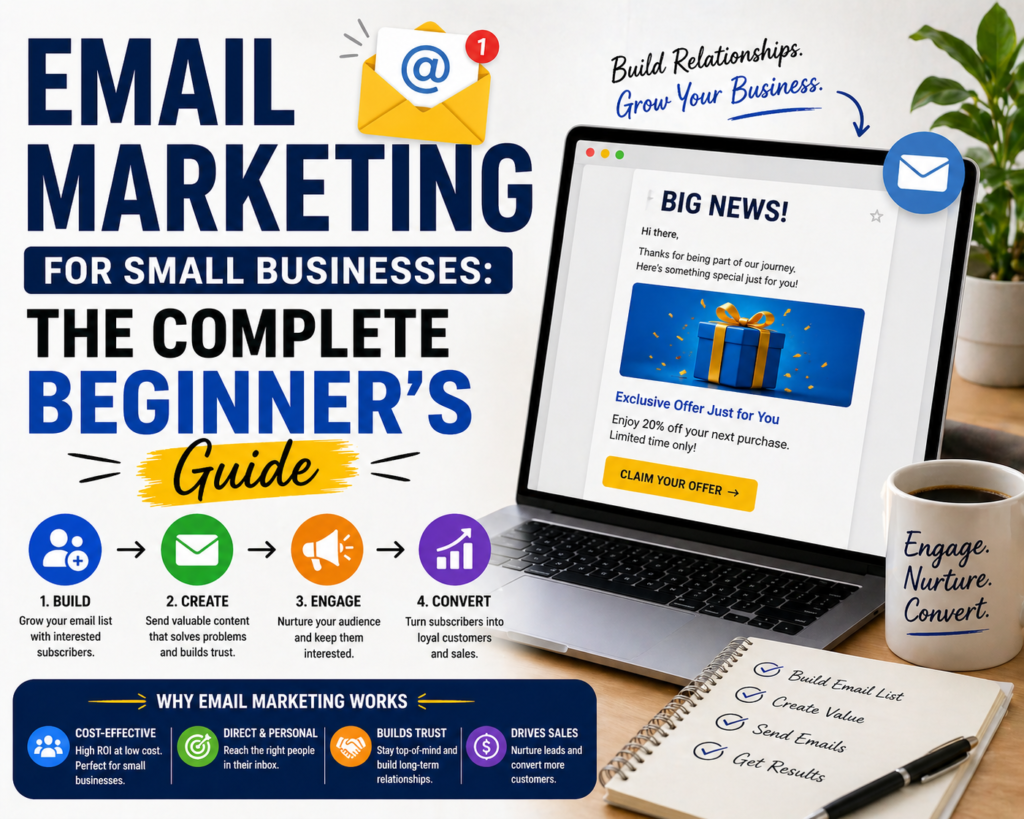
Email Marketing for Small Businesses: The Complete Beginner’s Guide 📧
🎯 TL;DR Email marketing delivers an average return of £36 for every £1 spent — making it the highest-ROI digital marketing channel available to small businesses. To get started, you need three things: an email marketing platform (Mailchimp is free up to 500 contacts), a way to capture email addresses (a sign-up form on your website with a compelling reason to subscribe), and a welcome sequence (3–5 automated emails that introduce your business and build trust with new subscribers). Once these foundations are in place, email marketing runs largely on autopilot and consistently outperforms every other marketing channel for customer retention and repeat business.
💡 Summary Most small businesses either don’t do email marketing at all or send the occasional promotional blast and wonder why nobody buys. Both approaches miss the point. Email marketing works when it delivers genuine value consistently — building trust over time until subscribers become customers. This guide covers everything a small business needs to know: choosing the right platform, building a list, writing emails people actually read, setting up automation, and measuring what’s working.
If you could send a personalised message directly to everyone who has shown interest in your business — at almost zero cost — would you?
That’s email marketing.
And with an average return of £36 for every £1 spent, it consistently outperforms every other marketing channel available to small businesses — including social media, paid advertising, and SEO.
Yet most small businesses either ignore it entirely or use it so infrequently and ineffectively that they never see those returns.
Email marketing for small businesses isn’t complicated — but it does require understanding a few fundamentals that most people get wrong from the start. This guide covers all of them. 👇
Why Email Marketing Works for Small Businesses
The short answer: Email marketing works because it reaches people who have already expressed interest in your business, in a channel they check daily, with messages that can be personalised to their specific interests — making it consistently more effective than any channel that interrupts strangers.
You’re Reaching Warm Audiences
Unlike social media ads that interrupt people who weren’t thinking about you, or Google Ads that compete for attention at the moment of search — email reaches people who have already raised their hand and said “I’m interested in what you do.”
Someone who signed up to your email list did so because they wanted to hear from you. That’s a fundamentally different starting point than cold advertising.
You Own Your Email List
Your Instagram following can disappear if your account is suspended. Your Google Ads traffic stops the moment you stop paying. Your email list belongs to you — it’s a business asset that no platform can take away.
Every email subscriber you add is a long-term asset. A list of 2,000 engaged subscribers who trust your business is worth more than 20,000 social media followers who scroll past your posts.
Email Gets Seen
Average email open rates for small businesses run at 25–35%. Average organic reach on Facebook for a business page is around 2–5%. You’re reaching dramatically more of your existing audience through email than through social media.
The Compounding Effect
Email marketing compounds over time. A subscriber who receives genuinely useful emails from you for six months and then becomes a customer is worth significantly more than one acquired through a single ad click — because the trust is already built, the consideration cycle is shorter, and they’re more likely to refer friends.
Step 1 — Choose Your Email Marketing Platform
The short answer: For most small businesses starting out, Mailchimp (free up to 500 contacts) is the best starting platform — it’s easy to use, has good templates, and includes basic automation. As your list grows or needs become more sophisticated, ActiveCampaign offers significantly more powerful automation and segmentation.
The Main Options for Small Businesses
| Platform | Free Tier | Best For | Price to Scale |
|---|---|---|---|
| Mailchimp | 500 contacts, 1,000 sends/month | Beginners, simple campaigns | From £11/month |
| MailerLite | 1,000 contacts, 12,000 sends/month | Growing businesses | From £9/month |
| ActiveCampaign | No free tier | Automation-heavy businesses | From £29/month |
| ConvertKit | 1,000 contacts | Content creators, bloggers | From £9/month |
| HubSpot | 2,000 sends/month | CRM-integrated email | From £41/month |
Which Platform Should You Choose?
Just starting out (under 500 contacts): Mailchimp free tier — zero cost, good enough for most early-stage needs
Growing business (500–5,000 contacts): MailerLite — more generous free tier, better automation than Mailchimp at the same price
Sophisticated automation needed: ActiveCampaign — the most powerful automation and segmentation, worth the cost once your list is over 1,000 contacts
Already using a CRM: HubSpot — if your business already uses HubSpot for sales, the email marketing integration is seamless
Step 2 — Build Your Email List
The short answer: The most effective way for small businesses to build an email list is to offer something genuinely valuable in exchange for an email address — a free guide, checklist, discount, or exclusive content — promoted via a sign-up form on your website and social media channels.
The Permission Principle
Never add people to your email list without their explicit permission. This isn’t just good practice — in most countries (including the UK and UAE) it’s a legal requirement under GDPR and similar regulations. Only email people who have actively opted in to receive emails from you.
How to Get Email Sign-Ups
Method 1 — Lead Magnet (Highest Volume) Offer a free resource in exchange for an email address. The more specific and useful the resource, the higher the sign-up rate.
Examples:
- Free checklist: “The 10-Point Website Audit Checklist”
- Free guide: “The Beginner’s Guide to Google Ads”
- Free template: “The Social Media Content Calendar Template”
- Free mini-course: “5-Day Email Marketing Crash Course”
A well-promoted lead magnet on a dedicated landing page typically converts at 25–40% of visitors — far higher than a generic “subscribe to our newsletter” form.
Method 2 — Newsletter Sign-Up (Lower Volume, Higher Quality) A simple “Subscribe for weekly digital marketing tips” form on your website. Lower conversion rate than a lead magnet but attracts subscribers who genuinely want your ongoing content.
Method 3 — Content Upgrades A downloadable resource specifically related to a blog post — offered within that post in exchange for an email. For example, a blog post about Google Ads could offer a downloadable “Google Ads Keyword Research Template” as a content upgrade.
Method 4 — Customer Opt-In Ask existing customers to join your email list at the point of purchase or service delivery. These subscribers already know and trust you — they convert at significantly higher rates than cold sign-ups.
Where to Put Your Sign-Up Form
- Homepage — above the fold or as a pop-up
- Blog posts — within the content and at the end
- Dedicated lead magnet landing page
- Instagram and Facebook bio link
- Email signature
What NOT to Do
- Never buy email lists — they’re low quality, legally risky, and will destroy your sender reputation
- Don’t add people from business card exchanges without explicit permission
- Don’t use pre-ticked checkboxes that automatically opt people in
Step 3 — Write Emails People Actually Read
The short answer: Emails that get read have three things in common — a subject line that earns the open, a clear single purpose per email, and copy that delivers value before making any ask. The biggest mistake small businesses make is writing emails that are all ask and no value.
Writing Subject Lines That Get Opened
Your subject line is the most important part of your email — if it doesn’t earn the open, nothing else matters.
What works:
- Curiosity: “The Google Ads mistake 90% of small businesses make”
- Specificity: “3 email marketing templates you can use today”
- Benefit: “How to cut your cost per click by 40%”
- Personalisation: “[First Name], your free checklist is inside”
- Numbers: “5 things I wish I’d known before running my first campaign”
What doesn’t work:
- Vague: “Our monthly newsletter”
- Salesy: “HUGE DISCOUNT — 50% OFF TODAY ONLY!!!”
- Boring: “Update from [Company Name]”
- Misleading: Anything that promises something the email doesn’t deliver
Subject line length: 40–50 characters is the sweet spot for mobile — shorter subjects get fully displayed on phone screens.
The Email Copy Framework
Every email should have a clear single purpose. Not three purposes. One.
Structure that works:
Opening line: Hook the reader immediately — a surprising fact, a relatable problem, or a compelling question. Never open with “I hope this email finds you well.”
Body: Deliver on the opening line’s promise. Keep it concise — most marketing emails should be 150–300 words. Long emails get skimmed. Short, focused emails get read.
CTA: One clear action. “Read the full guide”, “Book a call”, “Download the template”, “Reply to this email.” One CTA, not five.
The 80/20 Rule for Email Content
80% of your emails should deliver value — useful tips, insights, content, stories. Only 20% should be primarily promotional (sales, offers, announcements).
Subscribers who only receive promotional emails unsubscribe. Subscribers who receive genuine value stay engaged and convert when you do make an offer — because you’ve earned their trust.
Step 4 — Set Up Your Welcome Sequence
The short answer: A welcome sequence is a series of 3–5 automated emails sent to every new subscriber — it introduces your business, delivers immediate value, and builds the trust that converts subscribers into customers. It’s the highest-ROI automation any small business can set up.
Why the Welcome Sequence Matters
Welcome emails have the highest open rates of any email type — typically 50–60% compared to 25–35% for regular campaigns. New subscribers are at peak interest immediately after signing up. A well-crafted welcome sequence capitalises on that interest before it fades.
The 5-Email Welcome Sequence Template
Email 1 — Day 0 (Immediate): Welcome + Deliver Subject: “Your free [resource] is here + what to expect from me”
- Deliver the promised lead magnet (if applicable)
- Introduce yourself briefly and warmly
- Tell them what kind of emails to expect and how often
- One piece of immediate value (a quick tip or insight)
Keep it short — 100–150 words. This email is about delivering the promise and making a warm first impression.
Email 2 — Day 2: Your Best Content Subject: “The most important thing I’ve learned about [topic]”
- Share your single best piece of content or insight
- Completely value-focused — no ask whatsoever
- Establishes your expertise naturally
Email 3 — Day 5: Social Proof Subject: “How [customer/client name] achieved [result]”
- Share a customer story or case study
- Demonstrates real-world results
- Builds confidence that you can deliver
Email 4 — Day 10: Soft Invitation Subject: “When you’re ready — here’s how I can help”
- First mention of your products or services
- Frame it as an invitation, not a pitch
- Make the next step feel easy and low-risk
Email 5 — Day 15: Direct Offer Subject: “One more thing before I go quiet…”
- A specific offer or invitation to take action
- Creates gentle urgency
- Clear CTA with a specific next step
After email 5, move subscribers to your regular newsletter or campaign schedule.
Step 5 — Set Up Email Automation
The short answer: Email automation sends the right email to the right person at the right time without any manual effort — the essential automations for small businesses are the welcome sequence, an abandoned cart or follow-up sequence, and a re-engagement sequence for inactive subscribers.
Essential Automations for Small Businesses
1. Welcome Sequence (covered above) Triggered when: Someone subscribes to your list Duration: 15 days, 5 emails
2. Purchase/Enquiry Follow-Up Triggered when: Someone makes a purchase or submits an enquiry Content: Thank you, what happens next, useful resources, review request
3. Lead Magnet Delivery Triggered when: Someone downloads a specific lead magnet Content: Deliver the resource + a short follow-up sequence related to that specific topic
4. Re-Engagement Sequence Triggered when: A subscriber hasn’t opened an email in 90+ days Content: 3 emails trying to re-engage — if they don’t respond, remove them from your list
5. Birthday or Anniversary Triggered when: A subscriber’s birthday or signup anniversary (if you collect this data) Content: A personal greeting + a special offer
Setting Up Automation in Mailchimp
- Go to Automations in Mailchimp
- Click Create → Email
- Select your trigger (e.g. “Subscribes to audience”)
- Add your email sequence
- Set the timing between emails (Day 0, Day 2, Day 5 etc.)
- Activate
Step 6 — Measure What’s Working
The short answer: The four email marketing metrics that matter most for small businesses are open rate (are people reading?), click rate (are people taking action?), conversion rate (are emails generating sales or enquiries?), and unsubscribe rate (are people finding value or leaving?).
The Key Email Metrics
| Metric | What It Measures | Good Benchmark |
|---|---|---|
| Open Rate | % of recipients who open | 25–35% |
| Click Rate | % of recipients who click a link | 2–5% |
| Click-to-Open Rate | % of openers who click | 10–20% |
| Conversion Rate | % who take the desired action | 1–5% |
| Unsubscribe Rate | % who opt out per email | Under 0.5% |
| Bounce Rate | % of emails not delivered | Under 2% |
| List Growth Rate | Net new subscribers per month | Aim for consistent growth |
What to Do With the Data
Low open rate (under 20%): Your subject lines aren’t compelling enough. Test different approaches — curiosity, specificity, benefit-led. Also clean your list — removing inactive subscribers improves deliverability.
Low click rate (under 1%): Your email content isn’t driving action. Check your CTA clarity and relevance. Are you asking for the right action at the right time?
High unsubscribe rate (over 0.5% per email): You’re either emailing too frequently or your content isn’t relevant enough. Review your content mix — are you delivering enough value before asking?
Low list growth: Your lead magnet or sign-up offer needs improving. A/B test different offers or improve your sign-up form placement.
Email Marketing Best Practices for Small Businesses
The short answer: The five most impactful email marketing best practices for small businesses are sending consistently (same day/time each week), personalising beyond first name (segment by interest or behaviour), keeping emails focused on one topic per send, cleaning your list regularly, and always providing an easy unsubscribe option.
Send Consistently
Subscribers expect consistency. If you say you’ll send weekly tips, send weekly tips. Inconsistent sending trains subscribers to ignore you — and damages your sender reputation with email providers.
Recommended frequency for small businesses:
- Newsletter: Weekly or bi-weekly
- Promotional emails: Maximum 2× per month
- Automated sequences: As designed (don’t change based on impulse)
Personalise Beyond First Name
Using [First Name] in subject lines is standard — most subscribers are used to it and it barely moves the needle anymore. More powerful personalisation:
- Segment by interest and send relevant content to each group
- Reference past purchases or interactions
- Tailor content based on where the subscriber is in the customer journey
Keep Emails Mobile-Friendly
Over 60% of emails are opened on mobile devices. Every email should:
- Use a single-column layout
- Have a minimum 16px font size
- Have large, easy-to-tap CTA buttons (minimum 44px height)
- Load images quickly (or display well without images if blocked)
Clean Your List Regularly
Every 3–6 months, remove subscribers who haven’t opened an email in 6+ months. A smaller, engaged list consistently outperforms a larger, disengaged one — and improves your deliverability metrics.
Common Email Marketing Mistakes Small Businesses Make ❌
1. Only emailing when you have something to sell Subscribers who only hear from you when you want money will unsubscribe. Build the relationship first with value-led content. Save promotional emails for when you’ve earned the trust.
2. No welcome sequence The first email a new subscriber receives sets the tone for the entire relationship. A strong welcome sequence capitalises on peak engagement. No welcome sequence is a missed opportunity every single time someone subscribes.
3. Buying an email list Purchased lists are low quality, legally risky in most jurisdictions, and will get your account suspended by most email platforms. Never do it.
4. Sending the same email to everyone A subscriber who bought your premium product and a subscriber who downloaded a free guide have different needs and different relationships with your business. Basic segmentation dramatically improves relevance and performance.
5. No clear CTA Every email should have one clear thing you want the reader to do. Multiple CTAs competing for attention reduce clicks on all of them.
6. Ignoring mobile Over 60% of emails are opened on mobile. An email that looks great on desktop and is unreadable on phone is losing the majority of its potential impact.
7. Giving up too early Email marketing results compound over time. A list of 200 subscribers won’t transform your business overnight. But consistent, value-led email marketing for 12 months builds an asset that generates revenue on autopilot.
Frequently Asked Questions
What is email marketing for small businesses? Email marketing for small businesses is the practice of sending targeted, valuable emails to a list of subscribers who have opted in to receive communications from your business. It’s used to build relationships with potential customers, nurture leads toward a purchase, retain existing customers, and generate repeat business. Unlike social media or advertising, email marketing reaches an audience that has explicitly expressed interest in your business — making it consistently the highest-ROI digital marketing channel.
How much does email marketing cost for a small business? Email marketing is one of the most affordable digital marketing channels. Mailchimp is free for up to 500 contacts. MailerLite is free for up to 1,000 contacts. Most small businesses can run effective email marketing for £0–£30/month at the early stages. As your list grows beyond 5,000 contacts, costs typically run £30–£100/month. Given average returns of £36 per £1 spent, email marketing is highly cost-effective at every stage.
How often should a small business send marketing emails? Weekly is the optimal frequency for most small businesses — frequent enough to stay top of mind without overwhelming subscribers. Some businesses send bi-weekly (every two weeks) with good results. Daily emails work for some high-engagement niches but risk higher unsubscribe rates for most small businesses. The most important factor is consistency — whatever frequency you choose, stick to it.
What should a small business write about in their emails? Write about topics that are genuinely useful to your subscribers — tips, insights, how-to guides, industry news, behind-the-scenes content, customer stories, and answers to common questions. Follow the 80/20 rule: 80% value-led content, 20% promotional. The more genuinely useful your emails are, the higher your open rates, the lower your unsubscribe rates, and the more effective your occasional promotional emails will be.
How do I build an email list for my small business? Build your email list by offering something genuinely valuable in exchange for an email address — a free guide, checklist, template, discount, or exclusive content. Promote your sign-up offer on your website, social media, and in person. Never buy email lists or add people without explicit permission. Quality matters more than quantity — 500 engaged subscribers are worth more than 5,000 disengaged ones.
What is a good open rate for small business email marketing? A good open rate for small business email marketing is 25–35%. Welcome emails typically achieve 50–60%. If your open rate is below 20%, focus on improving your subject lines and cleaning your list of inactive subscribers. Open rates vary by industry — compare your rates to industry benchmarks rather than generic averages for the most meaningful assessment.
Do I need technical skills to do email marketing? No — modern email marketing platforms like Mailchimp and MailerLite are designed for non-technical users. They have drag-and-drop email editors, pre-built templates, and simple automation builders. If you can write a document and upload a photo, you have the technical skills needed to run effective email marketing campaigns.
What is email automation and do small businesses need it? Email automation sends pre-written emails automatically based on triggers — when someone subscribes, makes a purchase, downloads a resource, or goes inactive. Small businesses absolutely should use automation, starting with a welcome sequence. Automation lets your email marketing work 24/7 without manual effort — every new subscriber gets a consistent, well-crafted introduction to your business regardless of when they sign up.
Final Thoughts
Email marketing for small businesses is the channel that keeps giving. Unlike paid advertising that stops the moment you stop spending, email marketing builds an asset — a list of engaged subscribers who trust your business — that generates leads, sales, and referrals month after month.
Start simple: choose Mailchimp or MailerLite, add a sign-up form to your website with a compelling reason to subscribe, and write a 5-email welcome sequence. That’s your foundation.
From there, add a regular newsletter, set up additional automations, and segment your list as it grows. Each addition compounds on the last — and within 6–12 months you’ll have a marketing channel that consistently outperforms everything else you’re doing.
For more on using email marketing specifically for travel agencies, read our comprehensive email marketing for travel agencies guide. And for the broader digital marketing strategy, explore our complete series of guides on Tips For Digital Marketing. 🚀