
How to Write Google Ads Copy That Converts (Complete Guide) ✍️
🎯 TL;DR Great Google Ads copy does three things: matches the searcher’s intent exactly, communicates your strongest differentiator clearly, and ends with a specific zero-risk CTA. For Responsive Search Ads (RSAs), write 15 headlines across four categories — keyword match, benefit, emotional, and CTA — plus 4 descriptions covering value proposition, social proof, and next steps. Ads with high relevance between keyword, headline, and landing page consistently achieve Quality Scores of 7–10, reducing cost per click by up to 50% compared to generic ads.
💡 Summary Most Google Ads look identical — the same generic headlines, the same vague descriptions, the same “Book Now” CTAs. In a search results page full of similar ads, standing out with genuinely compelling copy is one of the most powerful advantages available to any advertiser. This guide covers everything: how Google Ads copy works, the exact formulas for writing high-performing headlines and descriptions, ad extensions that multiply your click-through rate, and how to test your way to better performance over time.
Open Google and search for almost any product or service. Look at the ads that appear.
You’ll typically see something like this:
“Best [Service] | Book Online Today” “[Service] — Great Deals Available” “[Service] | Competitive Prices”
They’re all saying the same thing. Generic headlines. Vague descriptions. Identical CTAs. If every ad looks the same, none of them stand out — and the one that does stand out wins the click.
Writing great Google Ads copy is one of the highest-leverage skills in digital marketing. The difference between a mediocre ad and a compelling one isn’t budget — it’s words. And getting those words right can double your click-through rate, improve your Quality Score, and cut your cost per click in half.
This guide shows you exactly how to do it. 👇
How Google Ads Copy Works
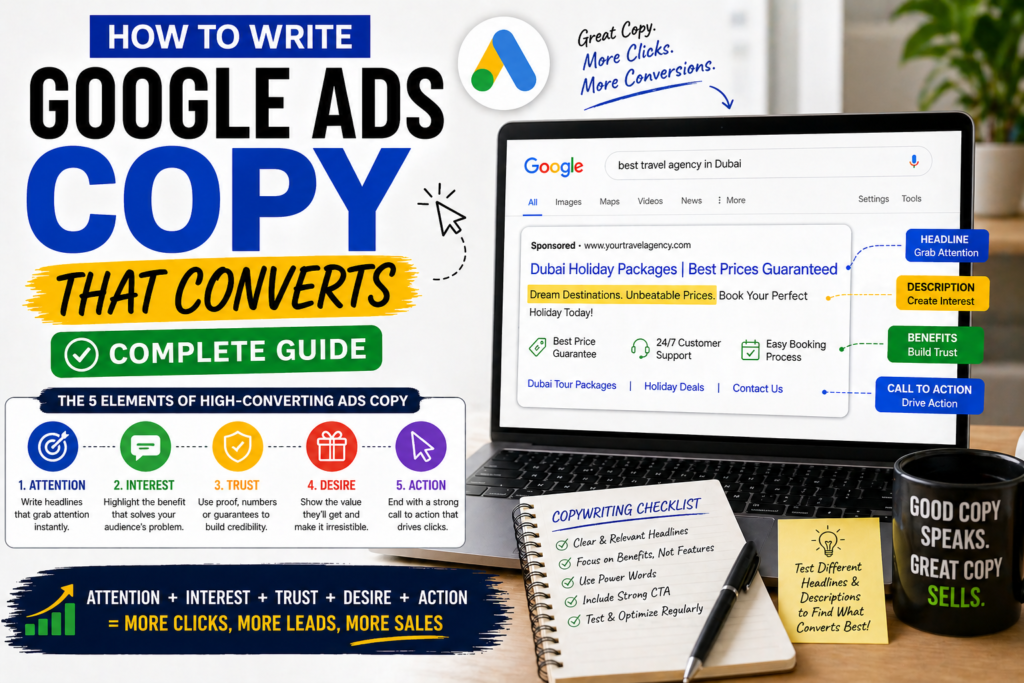
The short answer: Google Ads copy consists of headlines (up to 15, shown 2–3 at a time), descriptions (up to 4, shown 1–2 at a time), and ad extensions — all assembled dynamically by Google’s algorithm to find the highest-performing combinations for each search query and user context.
Responsive Search Ads (RSAs)
The current standard Google Ads format is the Responsive Search Ad (RSA). You provide up to:
- 15 headlines (30 characters each)
- 4 descriptions (90 characters each)
Google tests different combinations of your headlines and descriptions to find which combinations perform best for different users, search queries, devices, and contexts.
This means you’re not writing one ad — you’re writing a library of copy assets that Google assembles into thousands of potential ad combinations.
What This Means for Your Copy Strategy
Because headlines and descriptions can appear in any combination, each one must:
- Make sense independently (as a standalone statement)
- Make sense in combination with other headlines
- Not repeat the same information as other headlines
You can’t write headline 1 and then have headline 2 say the same thing in different words — they might appear together and it’ll look redundant.
Ad Rank and Quality Score
Your ad’s position in search results isn’t just determined by how much you bid. Google calculates Ad Rank using:
- Your bid amount
- Your Quality Score (1–10 rating)
- Expected impact of ad extensions
Quality Score is based on:
- Expected CTR — how likely people are to click your ad
- Ad relevance — how closely your ad matches the search intent
- Landing page experience — how relevant and useful your landing page is
Great copy directly improves your Quality Score — which means you pay less per click AND rank higher than competitors who bid more but write worse ads.
The 4 Headline Categories Every RSA Needs
The short answer: Write 15 headlines across four categories — keyword match headlines (3–4), benefit and differentiator headlines (4–5), emotional and aspirational headlines (2–3), and CTA headlines (2–3) — to give Google’s algorithm the full range of copy assets it needs to find the best performing combinations.
Category 1 — Keyword Match Headlines (Write 3–4)
These contain your target keyword or a very close variant. They’re essential for relevance signals — both to the searcher (confirming your ad is about what they searched for) and to Google (boosting Quality Score).
For the keyword “digital marketing agency”:
- Digital Marketing Agency
- Top Digital Marketing Agency
- Digital Marketing Agency Services
- Award-Winning Digital Marketing
For “Google Ads management”:
- Google Ads Management Service
- Expert Google Ads Management
- Google Ads Management Agency
- Certified Google Ads Management
Rules for keyword match headlines:
- Include the exact keyword or a very close variant in at least 2–3 headlines
- Use title case (First Letter Capitalised)
- Vary them slightly — don’t write the same headline four times
Category 2 — Benefit and Differentiator Headlines (Write 4–5)
What makes you different? Why should someone click your ad over the six others on the page? These headlines communicate your unique value.
Effective differentiator headlines:
- No Long-Term Contracts
- Certified Google Partners
- Results Within 30 Days
- Dedicated Account Manager
- Free Account Audit Included
- 500+ Successful Campaigns
- Google Ads Certified Experts
- 97% Client Retention Rate
- ROI-Focused Campaigns
- Transparent Monthly Reports
The specificity rule: “Great Results” is weak. “97% Client Retention Rate” is strong. Numbers, certifications, and specific claims outperform vague adjectives every time.
Category 3 — Emotional and Aspirational Headlines (Write 2–3)
These speak to the desired outcome — what the customer wants to achieve, feel, or experience. They work particularly well in the middle position of an ad where Google often shows a second headline.
Examples:
- Stop Wasting Money on Ads
- Ads That Actually Convert
- Grow Your Business With Google
- Get More Leads, Spend Less
- Finally — Ads That Work
- Turn Clicks Into Customers
- More Sales, Less Guesswork
Category 4 — CTA Headlines (Write 2–3)
These tell the searcher exactly what to do next. They create momentum and reduce friction.
Effective CTA headlines:
- Get Your Free Audit Today
- Start Your Free Trial Now
- Request a Free Quote
- Book a Free Consultation
- Get Started in Minutes
- See Your Results in 30 Days
- Claim Your Free Analysis
CTA headline rules:
- Be specific about what happens next (“Free Audit” not “Learn More”)
- Include “Free” where you genuinely offer something free — it significantly improves CTR
- Use action verbs: Get, Start, Book, Claim, Request, Try
Writing High-Converting Descriptions
The short answer: Google Ads descriptions should cover four jobs across your four description slots — lead with your strongest value proposition, support with social proof or specifics, address the main objection, and close with a clear CTA — each description working independently but complementing the others.
The 4-Description Framework
Description 1 — Value Proposition Lead with your strongest, most specific benefit statement. What is the single most compelling reason someone should choose you?
“We manage Google Ads campaigns for small businesses — certified experts, transparent reporting, and results you can measure. No long-term contracts.”
Description 2 — Social Proof + Specifics Numbers, credentials, and third-party validation. Make claims credible with specifics.
“Trusted by 500+ businesses across the UK and UAE. Rated 4.9/5 by our clients. Google Partner certified. Average client sees 3x return on ad spend within 90 days.”
Description 3 — Objection Handling Address the most common reason someone might hesitate. What’s the biggest concern your ideal customer has?
“Worried about wasting budget? We start with a free account audit to identify exactly what’s costing you money — before you spend a penny with us.”
Description 4 — CTA + Next Step Tell them exactly what to do and what to expect.
“Get your free Google Ads audit today — we’ll review your account, identify wasted spend, and show you exactly how to improve performance. No obligation.”
Description Writing Rules
Stay under 90 characters. Google truncates at 90 — if your description gets cut mid-sentence it looks unprofessional and loses meaning.
Don’t repeat your headlines. Headlines and descriptions should cover different ground. If your headline says “Certified Google Ads Experts” your description shouldn’t repeat “We are certified Google Ads experts.”
End with a period. Unlike headlines (which shouldn’t end with punctuation), descriptions look better with a period at the end.
Write for the benefit, not the feature. “Transparent monthly reports” is a feature. “Always know exactly what you’re getting for your money” is the benefit.
The Search Intent Matching Framework
The short answer: Different keywords represent different stages of the buying journey and different searcher needs — your ad copy must match the specific intent behind each keyword, not just contain the keyword.
Mapping Keywords to Intent
| Keyword Type | Searcher Intent | Ad Copy Approach |
|---|---|---|
| “What is Google Ads” | Learning/research | Educate — not the right keyword to bid on |
| “Google Ads agency” | Comparing options | Lead with credibility and differentiation |
| “Best Google Ads agency” | Evaluating top options | Lead with social proof and awards |
| “Google Ads agency near me” | Ready to act locally | Lead with location and immediate availability |
| “Hire Google Ads expert” | Ready to buy | Lead with specific offer and CTA |
| “Google Ads management pricing” | Price comparing | Lead with transparency and value |
The same agency bidding on all these keywords should have different ad copy for each — because the searcher’s mindset and need is different at each stage.
Writing for Transactional vs Informational Intent
Transactional keywords (hire, book, get, buy, price, cost) indicate the person is ready to take action. Your copy should:
- Lead with the specific action they can take
- Remove barriers and risk (“Free”, “No obligation”, “Cancel anytime”)
- Create mild urgency where genuine (“Limited availability”, “Get started today”)
Commercial investigation keywords (best, top, compare, review) indicate the person is evaluating options. Your copy should:
- Lead with your strongest differentiator
- Include social proof prominently
- Demonstrate expertise and credibility
Ad Extensions — The Copy That Multiplies Your Click-Through Rate
The short answer: Ad extensions add additional information to your ad, make it physically larger on the search results page, and improve both click-through rate and Quality Score — and they’re completely free to add. Never run an ad without at least 4 extension types active.
The Essential Ad Extensions
Sitelink Extensions Add 4–8 links below your main ad pointing to specific pages on your site.
Format: Short headline (25 chars) + 2 description lines (35 chars each)
Examples for a digital marketing agency:
- “Google Ads Management” — Expert Google Ads campaigns for your business
- “Free Account Audit” — Identify wasted spend in your current campaigns
- “Our Results” — See case studies from 500+ successful campaigns
- “Pricing” — Transparent pricing with no hidden fees
Callout Extensions Short phrases (25 characters) that highlight key selling points. These appear as additional text beneath your ad.
Effective callouts:
- No Long-Term Contracts
- Google Partner Certified
- Free Account Audit
- 24/7 Support Available
- UK & UAE Specialists
- 500+ Happy Clients
- Transparent Reporting
- ROI Guaranteed
Structured Snippet Extensions Lists of specific items under a header. For a digital marketing agency:
Services: Google Ads, Facebook Ads, SEO, Email Marketing, Analytics
Call Extension Your phone number displayed in the ad. Essential for any business where customers prefer to call before purchasing.
Lead Form Extension A form that opens directly in the search results — no website visit required. Customers submit their details right from Google. Particularly effective for service businesses where the first step is a consultation.
Image Extensions Add relevant images to your search ads — makes them significantly more visually prominent in search results.
Writing Ad Copy for Different Business Types
The short answer: The fundamentals of great ad copy are universal, but the specific emphasis changes by business type — service businesses should lead with expertise and trust, eCommerce should lead with price and availability, and local businesses should lead with proximity and immediate availability.
Service Businesses (Agencies, Consultants, Professionals)
Lead with: Expertise, credentials, results Differentiate with: Specific experience, certifications, client results CTA: Free consultation, free audit, free quote
Example headline set:
- “Digital Marketing Experts”
- “500+ Campaigns Managed”
- “Google & Meta Certified”
- “Free Strategy Session”
- “No Setup Fees — Start Today”
Local Service Businesses (Plumbers, Dentists, Tradespeople)
Lead with: Location, immediate availability, trust Differentiate with: Response time, local credentials, reviews CTA: Call now, book online, emergency availability
Example headline set:
- “Emergency Plumber Dubai”
- “Available 24/7 — Call Now”
- “Licensed & Insured Plumbers”
- “Same Day Service Available”
- “Rated 4.9★ by 200+ Customers”
eCommerce
Lead with: Product, price, availability, offer Differentiate with: Free shipping, returns policy, exclusive range CTA: Shop now, buy today, get it fast
Example headline set:
- “Premium Running Shoes”
- “Free UK Delivery Over £50”
- “New 2026 Collection Now Live”
- “30-Day Free Returns”
- “Shop 500+ Styles Online”
Testing Your Ad Copy — The Ongoing Improvement Cycle
The short answer: Ad copy testing in Google Ads should be systematic and continuous — pin your most critical headlines to fixed positions (position 1 and 2) to control what Google always shows, then let Google test the remaining headlines, reviewing performance monthly and replacing underperformers.
Using Pinning to Control Key Headlines
In RSAs you can “pin” specific headlines to specific positions:
- Position 1: Always shown first — pin your keyword match headline here
- Position 2: Always shown second — pin your strongest differentiator here
- Position 3: Rotated — let Google test from your remaining headlines
Example pinning strategy:
- Position 1 (pinned): “Google Ads Management Agency”
- Position 2 (pinned): “Certified Google Partners — 500+ Campaigns”
- Position 3 (rotating): Test between emotional, CTA, and additional benefit headlines
Monitoring Ad Performance
In Google Ads go to Ads & Assets → Assets to see performance data for each headline and description:
- Best — this asset performs above average
- Good — this asset performs as expected
- Low — this asset underperforms
Replace “Low” rated assets with new variants monthly. Over time, your ad copy gets progressively stronger as you remove what doesn’t work and double down on what does.
What to Test
- Headline angles: Expertise-led vs social proof-led vs benefit-led
- CTA variations: “Get Free Quote” vs “Start Free Trial” vs “Book Consultation”
- Specificity: “Great Results” vs “3x ROI in 90 Days”
- Emotional vs rational: “Finally — Ads That Work” vs “Google Ads Management Service”
Common Google Ads Copy Mistakes ❌
1. Writing the same headline 15 times “Digital Marketing Agency”, “Digital Marketing Experts”, “Digital Marketing Services” — these are essentially the same headline repeated. Use all 15 slots to cover genuinely different angles.
2. Ignoring character limits Headlines truncate at 30 characters. Descriptions truncate at 90. Write within the limits so your copy is never cut off mid-sentence.
3. Vague CTAs “Learn More” is the weakest possible CTA. “Get Your Free Audit Today” is specific, low-risk, and actionable. Always be specific about what happens when they click.
4. No social proof In a competitive market, social proof (review count, rating, years in business, client count) is often the deciding factor between your ad and a competitor’s. Include it.
5. Not matching landing page copy Your ad promises “Free Google Ads Audit” — your landing page says “Contact Us”. The disconnect kills conversions and damages Quality Score. Ad and landing page must match.
6. Never reviewing asset performance Google tells you which headlines are performing well and which are underperforming. Most advertisers never check this. Monthly asset reviews are one of the fastest ways to improve campaign performance.
7. Using the same copy for all campaigns A campaign targeting “Google Ads for small businesses” needs completely different copy from one targeting “enterprise Google Ads management.” Tailor copy to each audience.
Frequently Asked Questions
What makes good Google Ads copy? Good Google Ads copy does three things: matches the searcher’s specific intent (the headline reflects exactly what they searched for), communicates a clear and specific differentiator (why you over competitors), and ends with a specific, low-risk CTA. The most impactful single improvement most advertisers can make is adding specificity — replacing vague claims like “great results” with specific ones like “97% client retention” or “average 3x ROAS in 90 days.”
How many characters can a Google Ads headline be? Google Ads headlines are limited to 30 characters each. Descriptions are limited to 90 characters each. Google shows 2–3 headlines and 1–2 descriptions at a time in a Responsive Search Ad. Always write within these limits — copy that exceeds them gets truncated and looks unprofessional in search results.
How do I write a Google Ads headline? Write Google Ads headlines in Title Case (First Letter of Each Word Capitalised). Include your target keyword in at least 2–3 headlines. Cover four categories across your 15 headline slots: keyword match, benefit/differentiator, emotional/aspirational, and CTA. Keep each headline independent — it may appear with any of your other headlines.
What is ad strength in Google Ads and how do I improve it? Ad strength is Google’s rating of how well your RSA is likely to perform based on the variety, relevance, and quantity of your headlines and descriptions. To improve it: use all 15 headline slots, use all 4 description slots, include your keyword in multiple headlines, avoid repetition across headlines, and make headlines genuinely distinct from each other. “Excellent” ad strength correlates with better performance but isn’t a guarantee.
Should I use dynamic keyword insertion in Google Ads? Dynamic Keyword Insertion (DKI) automatically inserts the search term into your headline — e.g. “Buy {KeyWord:Running Shoes}” becomes “Buy Blue Running Shoes” when someone searches that. It can improve CTR by increasing relevance but can also produce awkward or irrelevant headlines if your keyword list is too broad. Use DKI carefully, only in specific headline positions, and with a sensible default text for when the keyword doesn’t fit.
How do I know if my Google Ads copy is working? Monitor three metrics: CTR (click-through rate — is your ad getting clicked?), conversion rate (are those clicks turning into leads or sales?), and Quality Score (is Google rating your ad as relevant?). In Google Ads, go to Ads & Assets → Assets to see which individual headlines and descriptions are rated Best, Good, or Low. Replace Low-rated assets monthly with new variants.
What is a good CTR for Google Ads? Average CTR for Google Search Ads varies significantly by industry, keyword type, and position. Generally, 3–5% CTR is considered good for most industries. Top-performing ads in competitive industries can achieve 10–15%+ CTR. If your CTR is below 2%, your headlines likely aren’t matching search intent closely enough or your ad isn’t standing out from competitors.
How is Google Ads copy different from other advertising copy? Google Ads copy is fundamentally different because it responds to expressed intent — the person is actively searching for something. Unlike social media ads (which interrupt), Google Ads answers a specific query. This means relevance is more important than creativity. Your headline should confirm to the searcher that they’ve found what they were looking for — before it tries to persuade them of anything else.
Final Thoughts
Writing great Google Ads copy is one of those marketing skills that keeps paying dividends. Better copy means higher Quality Scores, lower cost per click, better click-through rates, and ultimately more conversions from the same budget.
The framework is consistent: match the keyword intent, communicate a specific differentiator, include social proof, and close with a clear CTA. Write across the four headline categories, use all your extension slots, and review asset performance monthly.
Start with your single most important campaign. Apply the framework. Monitor the results. Replace underperforming headlines. Within 60–90 days your ads will be significantly more effective than when you started — and they’ll keep improving every month you continue testing.
For travel agency-specific Google Ads copy, read our dedicated guide on how to write Google Ads copy that drives travel bookings. And for the complete Google Ads foundation, start with our guide on Google Ads keyword match types. 🚀
What makes good Google Ads copy?
Good Google Ads copy does three things: matches the searcher’s specific intent, communicates a clear differentiator over competitors, and ends with a specific low-risk call to action. The most impactful improvement most advertisers can make is adding specificity — replacing vague claims like “great results” with specific ones like “97% client retention” or “average 3x ROAS in 90 days.”
How many characters can a Google Ads headline be?
Google Ads headlines are limited to 30 characters each. Descriptions are limited to 90 characters each. Google shows 2 to 3 headlines and 1 to 2 descriptions at a time in a Responsive Search Ad. Always write within these limits as copy that exceeds them gets truncated and looks unprofessional in search results.
How do I write a Google Ads headline?
Write Google Ads headlines in Title Case with the first letter of each word capitalised. Include your target keyword in at least 2 to 3 headlines. Cover four categories across your 15 headline slots: keyword match, benefit or differentiator, emotional or aspirational, and call to action. Keep each headline independent as it may appear alongside any of your other headlines.
What is ad strength in Google Ads and how do I improve it?
Ad strength is Google’s rating of how well your Responsive Search Ad is likely to perform based on variety, relevance, and quantity of headlines and descriptions. To improve it: use all 15 headline slots, use all 4 description slots, include your keyword in multiple headlines, avoid repetition, and make each headline genuinely distinct. Excellent ad strength correlates with better performance.
Should I use dynamic keyword insertion in Google Ads?
Dynamic Keyword Insertion automatically inserts the search term into your headline to improve relevance and CTR. However it can produce awkward headlines if your keyword list is too broad. Use it carefully in specific headline positions only, and always set a sensible default text for when the keyword does not fit within the character limit.
How do I know if my Google Ads copy is working?
Monitor three metrics to evaluate your Google Ads copy. CTR shows whether your ad is getting clicked. Conversion rate shows whether those clicks turn into leads or sales. Quality Score shows whether Google rates your ad as relevant. In Google Ads go to Ads and Assets to see which headlines are rated Best, Good, or Low, and replace Low-rated assets monthly.
What is a good CTR for Google Ads?
A CTR of 3 to 5 percent is considered good for most Google Search Ad campaigns. Top-performing ads in competitive industries can achieve 10 to 15 percent CTR or higher. If your CTR is below 2 percent your headlines are likely not matching search intent closely enough or your ad is not standing out sufficiently from competitors.
How is Google Ads copy different from other advertising copy?
Google Ads copy is fundamentally different because it responds to expressed intent — the person is actively searching for something specific. Unlike social media ads which interrupt, Google Ads answers a direct query. This means relevance is more important than creativity. Your headline should confirm to the searcher that they found what they were looking for before it tries to persuade them.