
How to Build a Lead Funnel for Travel Agency (Step-by-Step Guide) 🔄
🎯 TL;DR A travel agency lead funnel is a structured system that moves potential customers from first discovery through to confirmed booking across four stages: Awareness (social media, SEO, ads), Capture (lead magnets, landing pages, forms), Nurture (email sequences, remarketing, WhatsApp), and Convert (direct consultation, proposals, booking confirmation). The most effective travel agency funnels combine Google Ads or Instagram for awareness, a destination-specific landing page for capture, an automated email sequence for nurture, and a personalised itinerary proposal for conversion.
💡 Summary Most travel agencies generate leads inconsistently because they have channels but no funnel — they attract visitors, but have no structured system to move them from interest to enquiry to booking. This guide shows you how to build a complete lead funnel for your travel agency: every stage, every tool, every automation, and the metrics that tell you whether each stage is working.
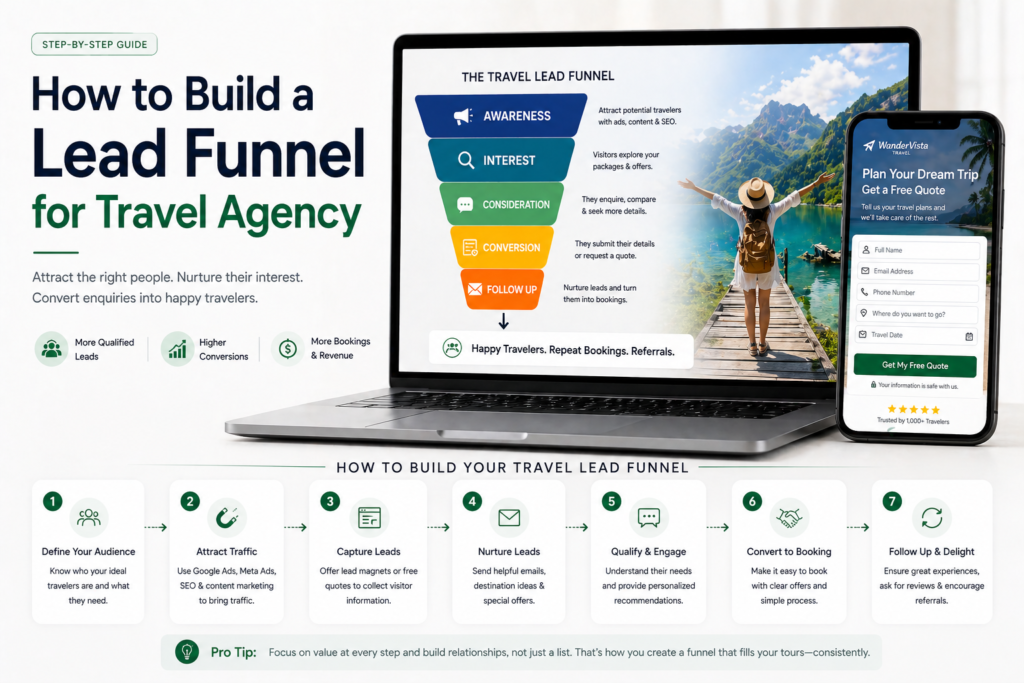
Here’s the difference between a travel agency that generates leads inconsistently and one that generates them predictably every month.
The inconsistent agency has channels. They post on Instagram. They run occasional Google Ads. They have a contact form on their website. But these things don’t connect. A visitor who finds them on Instagram and doesn’t enquire immediately is lost. A Google Ads click that doesn’t convert goes nowhere. A lead that enquires but doesn’t book gets no follow-up after day three.
The predictable agency has a funnel. Every channel feeds into a structured system. Every visitor who doesn’t convert immediately enters a nurture sequence. Every enquiry gets followed up automatically and persistently. Every past customer is reactivated at the right moment.
Building a lead funnel for a travel agency is the difference between hoping for enquiries and engineering them. This guide shows you exactly how to do it. 👇
What Is a Lead Funnel and Why Does It Matter for Travel Agencies
The short answer: A lead funnel is a structured system that guides potential customers through every stage of their journey — from first discovering your agency to confirming a booking — with a defined action, tool, and message at each stage.
The term “funnel” reflects the shape of the customer journey: many people enter at the top (awareness), fewer progress to the middle (enquiry), and fewer still reach the bottom (booking). Your job as a travel agency marketer is to make each stage as efficient as possible — maximising the percentage of people who move from one stage to the next.
Why Travel Agencies Need a Funnel More Than Most Businesses
The travel booking journey is uniquely long and non-linear. A customer might:
- Discover your Instagram in January
- Download your Maldives guide in February
- Enquire in March
- Go quiet for six weeks
- Book in May for a trip the following January
Without a structured funnel — specifically an automated nurture system that keeps your agency present and valuable across that entire journey — you lose that customer somewhere between February and May. They book with a competitor who stayed in touch.
The funnel doesn’t just generate leads. It captures and retains them across the consideration period until they’re ready to book.
The 4-Stage Travel Agency Lead Funnel
The short answer: Every travel agency lead funnel consists of four stages — Awareness, Capture, Nurture, and Convert — each with a specific goal, primary channel, and success metric.
Stage 1: Awareness — Getting Found by the Right People
Goal: Put your agency in front of your ideal customer at the moment they’re thinking about travel.
What happens here: Potential customers discover your agency for the first time — through a Google search, an Instagram Reel, a Facebook Ad, a Google Business Profile, or a referral from a past customer.
Primary channels:
- Google Ads (captures existing demand — people actively searching)
- Instagram organic (inspires and attracts travel dreamers)
- Facebook and Instagram Ads (creates demand — reaches people before they start searching)
- SEO and content marketing (long-term organic discovery)
- Google Business Profile (local search visibility)
- Referrals from past customers
The goal of awareness is not conversion — it’s qualified reach. You want to put your agency in front of people who match your ideal customer profile. Not everyone. The right people.
Success metrics:
- Impressions and reach (paid and organic)
- Landing page sessions from each channel
- New followers gained (Instagram, Facebook)
- Google Business Profile views and actions
The most common awareness mistake: Treating awareness as the end goal. Getting 10,000 Instagram impressions on a post means nothing if those impressions don’t move people into your funnel. Awareness only has value if it connects to a capture mechanism.
Stage 2: Capture — Converting Attention into a Lead
Goal: Convert an aware visitor into a named contact in your system — someone you have permission to follow up with.
What happens here: A visitor who discovered your agency in Stage 1 takes a defined action that puts them into your lead database — submitting an enquiry form, downloading a lead magnet, messaging you on WhatsApp, or calling your agency.
Primary capture mechanisms:
High-intent capture (ready to enquire):
- Destination-specific landing page with enquiry form
- Facebook/Instagram Lead Ad with native form
- Google Ads call-only ad (clicks connect directly to a phone call)
- WhatsApp direct message
Low-intent capture (not ready to enquire yet):
- Lead magnet landing page (free destination guide, itinerary template, budget breakdown)
- Instagram DM sequence triggered by a keyword CTA (“DM me MALDIVES for the free guide”)
- Email newsletter sign-up with a compelling incentive
The distinction matters: high-intent capture moves leads directly toward conversion. Low-intent capture puts early-stage researchers into a nurture system that moves them toward enquiry over time.
As covered in our lead generation landing pages for travel agencies guide, every capture mechanism needs a dedicated, message-matched page — not a homepage.
Success metrics:
- Conversion rate per landing page (target: 4–8% for paid traffic)
- Cost per lead by channel
- Lead magnet download rate (target: 25–40% of landing page visitors)
- Form abandonment rate
The most common capture mistake: Having only one capture mechanism — the enquiry form. Visitors who aren’t ready to enquire leave with no way for your agency to stay in touch. A lead magnet captures them at the research stage instead of losing them entirely.
Stage 3: Nurture — Staying Present Until They’re Ready to Book
Goal: Build trust, demonstrate expertise, and maintain top-of-mind presence across the weeks or months between a lead’s first contact and their booking decision.
What happens here: This is the stage most travel agencies skip entirely — and it’s where the most leads are lost.
A lead who enquires in January and doesn’t book immediately isn’t a failed conversion. They’re a future booking waiting for the right follow-up. The agency that stays in touch consistently, delivers genuine value, and maintains a presence in their inbox and social feed will win that booking when the customer is finally ready.
The Nurture System: 3 Parallel Tracks
Track 1: Email Nurture Sequence
The core of your nurture system. As covered in detail in our email marketing for travel agencies guide, every lead should enter an automated email sequence that delivers value across a defined period.
The 5-stage travel agency nurture sequence:
- Email 1 (Day 0): Immediate confirmation + deliver the promised resource
- Email 2 (Day 3): Genuine destination insight — something they can’t easily Google
- Email 3 (Day 7): Customer story from a similar trip
- Email 4 (Day 14): Soft invitation to take the next step (free consultation)
- Email 5 (Day 21): Direct CTA — “Are you ready to start planning?”
After Day 21, move the lead to your monthly newsletter list for ongoing nurture until they’re ready to book.
Track 2: Remarketing Ads
Not all leads engage with emails. Remarketing ads on Facebook, Instagram, and Google Display keep your agency visible to leads who’ve visited your landing pages or downloaded your guides — even if they haven’t opened your emails.
Remarketing sequence:
- Days 1–7: Show destination inspiration content (soft, non-salesy)
- Days 8–30: Show social proof (customer testimonials, trip photos)
- Days 31–60: Show a specific offer or urgency message (“Limited availability for [Season]”)
- Days 61–90: Final remarketing push before removing from the audience
This parallel remarketing track ensures that even leads who don’t engage with email stay aware of your agency throughout their consideration period.
Track 3: WhatsApp Follow-Up
For leads who’ve provided a phone number or contacted you via WhatsApp, a personal WhatsApp message at the right moment is the highest-converting nurture touchpoint available.
WhatsApp nurture cadence:
- Day 1: Send personalised initial response with brief recommendation
- Day 4 (if no reply): “Just checking in — did my message reach you? Happy to answer any questions 😊”
- Day 14 (if still no reply): “Thinking of you — [relevant news about destination, e.g. ‘I just heard the new Conrad resort opens this autumn if you’re considering the Maldives’]”
The personal, conversational nature of WhatsApp makes it feel very different from email — it often re-engages leads that have gone cold on email entirely.
Success metrics:
- Email open rate (target: 30–40% for travel)
- Email click rate (target: 4–8%)
- Remarketing CTR and CPL
- Lead-to-enquiry rate from nurture (target: 10–20% of nurtured leads eventually enquire)
Stage 4: Convert — Turning Enquiries into Confirmed Bookings
Goal: Convert a warm, nurtured enquiry into a confirmed booking through a personalised, consultative sales process.
What happens here: A lead who has been through your nurture system (or arrived directly with high intent) is ready to book. The conversion stage is where your travel expertise and personal service make the final difference.
The 5-Step Conversion Process
Step 1: The Personalised Itinerary Proposal When a lead enquires, respond within 24 hours with a personalised itinerary proposal — not a generic brochure or a list of options, but a specific recommendation based on what they’ve told you.
This proposal should:
- Address their specific requirements (dates, budget, occasion, preferences)
- Include 1–3 specific resort or itinerary recommendations with reasons why you’ve chosen them
- Be presented in a format that demonstrates your expertise (a well-designed PDF, a detailed email, or a shared document)
- Include pricing — clearly broken down, with ATOL/ABTA protection highlighted
Step 2: The Follow-Up Call or Meeting Within 48 hours of sending the proposal, follow up with a personal call or WhatsApp message. Most bookings are won in conversations, not emails.
“Hi [Name], just checking you received the itinerary I sent for your Maldives honeymoon. Would it be helpful to jump on a quick call to talk through the options?”
Step 3: Objection Handling Common objections at this stage:
- “It’s more than we expected to spend” → Offer a restructured itinerary at a lower budget, or explain what the additional cost delivers
- “We’re still comparing options” → Acknowledge their research and offer to answer any specific questions
- “We’re not sure of the dates yet” → Place a provisional hold on the preferred resort and give a response deadline
Step 4: The Booking Confirmation Make the booking process as frictionless as possible:
- Clear payment schedule and deposit amount
- ATOL certificate issued promptly
- Booking confirmation summary sent immediately
Step 5: Post-Booking Engagement The booking isn’t the end of the funnel — it’s the beginning of the next one.
After confirmation:
- Send the post-booking email sequence (excitement, preparation, final tips — covered in our email marketing guide)
- After the trip, request a review and a referral
- Add the customer to your “past customer” segment for future remarketing and re-engagement
Success metrics:
- Enquiry-to-booking rate (target: 20–35% for specialist travel agencies)
- Average time from first enquiry to booking
- Average booking value
- Post-trip review rate
- Referral rate from past customers
The Complete Travel Agency Funnel Architecture
Here’s how all four stages connect into a single, coherent system:
AWARENESS
├── Google Ads (search intent)
├── Instagram organic (inspiration)
├── Facebook/Instagram Ads (demand creation)
├── SEO content (long-term discovery)
└── Referrals (word of mouth)
         ↓
CAPTURE
├── High-intent: Destination landing page → Enquiry form
├── Low-intent: Lead magnet page → Email opt-in
└── Direct: WhatsApp / phone call / Instagram DM
         ↓
NURTURE
├── Email sequence (Days 1–21)
├── Remarketing ads (Days 1–90)
└── WhatsApp follow-up (personal touchpoints)
         ↓
CONVERT
├── Personalised itinerary proposal
├── Follow-up call / WhatsApp
├── Objection handling
└── Booking confirmation
         ↓
POST-BOOKING
├── Pre-departure email sequence
├── Post-trip review request
└── Referral programme → back to AWARENESS
This is the Travel Agency Lead Funnel Framework — a closed-loop system where every stage feeds the next, and the post-booking stage feeds back into awareness through reviews and referrals.
Building Your Funnel Stage by Stage: The 90-Day Plan
The short answer: Build your funnel in order of impact — start with capture and nurture (which fix the biggest lead loss points), then expand awareness, then optimise conversion.
Days 1–30: Foundation
Week 1: Set up tracking
- Install Google Analytics 4 and set up form submission conversion events
- Install Microsoft Clarity (free heatmaps and session recordings)
- Set up HubSpot CRM (free) and create a simple 4-stage pipeline
Week 2: Build your capture mechanism
- Create one destination-specific landing page for your most important destination
- Set up a lead magnet (repurpose existing destination knowledge into a PDF guide using Canva)
- Create a lead magnet landing page (simple 2-field form)
Week 3: Build your nurture sequence
- Set up Mailchimp or ActiveCampaign
- Write the 5-email nurture sequence for your primary destination
- Connect your landing page form to the email sequence
Week 4: Connect the pieces
- Connect your CRM to your email platform
- Test the complete funnel end-to-end (submit a test lead and verify every step fires correctly)
- Set up WhatsApp Business with automated greeting and away messages
Days 31–60: Traffic
Week 5–6: Paid awareness
- Launch a Google Ads campaign targeting high-intent keywords for your primary destination
- Launch a Facebook Lead Ad campaign targeting your ideal audience
- Install the Meta Pixel on your landing pages
Week 7–8: Organic awareness
- Optimise your Instagram bio and link-in-bio
- Publish 3 Reels promoting your lead magnet
- Optimise your Google Business Profile and request reviews from past customers
Days 61–90: Optimise and Scale
Week 9–10: Analyse and fix
- Review GA4: which channels generate the most leads at the lowest cost?
- Review Clarity: where are visitors dropping off on your landing page?
- Fix the biggest conversion leak (usually the landing page headline or form)
Week 11–12: Add remarketing
- Set up Google Display remarketing to past landing page visitors
- Set up Facebook/Instagram remarketing to website visitors and lead form openers
- Build a lookalike audience from your existing customer email list
Funnel Metrics: What to Measure at Each Stage
The short answer: Each stage of the funnel has its own primary metric. Tracking all four gives you a complete picture of where leads are entering, progressing, stalling, and dropping out.
| Funnel Stage | Primary Metric | Target (Travel Agency) |
|---|---|---|
| Awareness | Cost Per Landing Page Session | £0.30–£2.00 (paid) |
| Capture | Landing Page Conversion Rate | 4–8% (paid), 2–4% (organic) |
| Nurture | Lead-to-Enquiry Rate | 10–20% over 90 days |
| Convert | Enquiry-to-Booking Rate | 20–35% |
| Overall | Cost Per Booking | Varies by destination — track vs. average booking value |
Review these metrics monthly. When a metric falls below target, diagnose which stage is underperforming before adding more budget to awareness. Throwing more traffic at a broken funnel doesn’t fix it — it just makes the leak more expensive.
The 3 Most Common Travel Agency Funnel Failures
The short answer: Most travel agency funnels fail at Stage 3 (Nurture) because there is no nurture system — leads either enquire immediately or are never heard from again.
Failure 1: No Nurture System
This is by far the most common funnel failure. A travel agency runs Google Ads, generates clicks, captures some enquiries — but has nothing in place for the 95% of visitors who don’t enquire immediately.
Without a nurture system, every visitor who doesn’t convert on the first visit is permanently lost. Adding even a basic lead magnet and 5-email sequence typically increases overall funnel conversion by 30–50%.
Fix: Build the nurture stage first — before adding more awareness spend.
Failure 2: Too Many Channels, No Depth
Many travel agencies spread themselves across Google Ads, Instagram, Facebook, TikTok, LinkedIn, Pinterest, email, and SEO simultaneously — doing all of them superficially and none of them well.
One channel executed brilliantly — a well-optimised Google Ads campaign feeding into a strong landing page and a thorough email nurture sequence — consistently outperforms five channels executed poorly.
Fix: Master one awareness channel completely before adding the second. Build depth before breadth.
Failure 3: Awareness Without Capture
The third most common failure: travel agencies invest heavily in awareness (beautiful Instagram content, blog posts, social media ads) but have no effective capture mechanism at the end. Visitors arrive, consume the content, feel inspired — and leave without any mechanism to stay in touch.
Every piece of awareness content should point toward a capture mechanism: an Instagram post ends with “DM me MALDIVES for the free guide”, a blog post includes a lead magnet CTA, a Facebook Ad uses a Lead form rather than sending cold traffic to a homepage.
Fix: Audit every awareness touchpoint and ensure every one has a clear path into your capture stage.
Frequently Asked Questions
What is a lead funnel for a travel agency? A lead funnel for a travel agency is a structured, stage-by-stage system that guides potential customers from first discovering your agency through to confirming a booking. It consists of four stages: Awareness (getting found), Capture (collecting contact details), Nurture (building trust over time), and Convert (turning enquiries into bookings). Without a funnel, marketing channels generate inconsistent results because there’s no system connecting them.
How long does it take to build a travel agency lead funnel? A basic travel agency lead funnel — one landing page, one lead magnet, one email sequence, and one paid traffic channel — can be built in 30 days. A complete funnel with multiple destination pages, full nurture sequences, remarketing ads, and CRM integration typically takes 60–90 days to build and another 60–90 days to optimise based on data.
What is the most important stage of a travel agency lead funnel? The nurture stage is the most important and most neglected. Most travel agencies have some form of awareness (ads or social media) and some form of capture (an enquiry form). But without a structured nurture system — automated email sequences, remarketing ads, WhatsApp follow-up — the majority of leads go cold and are lost to competitors who stay in touch more persistently.
How many emails should be in a travel agency nurture sequence? A minimum effective travel agency nurture sequence has 5 emails delivered over 21 days. The sequence should deliver value first (destination insight, customer story) before making a sales ask. After 21 days, leads that haven’t converted should move to a monthly newsletter for ongoing nurture until they’re ready to book — which could be months later.
What tools do I need to build a travel agency lead funnel? The minimum tool stack for a basic travel agency lead funnel is: a landing page builder (Elementor for WordPress or Leadpages), an email marketing platform (Mailchimp for beginners, ActiveCampaign for more sophisticated automation), a CRM (HubSpot free tier), and WhatsApp Business (free). As covered in our best lead generation tools for travel agencies guide, you can build a functional funnel for under £50/month.
What is a good conversion rate for a travel agency lead funnel? Healthy travel agency funnel benchmarks are: 4–8% landing page conversion rate (paid traffic), 10–20% lead-to-enquiry rate from nurture over 90 days, and 20–35% enquiry-to-booking rate. The overall funnel conversion (from first landing page visit to confirmed booking) typically runs at 1–3% for paid traffic — meaning 1–3 bookings per 100 paid visitors when the funnel is well-optimised.
How do I measure the ROI of my travel agency lead funnel? Track the cost per landing page session (from your ad platform), the landing page conversion rate (from GA4), the lead-to-enquiry rate (from your email platform and CRM), and the enquiry-to-booking rate (from your CRM). Multiply through to get cost per booking, then compare against your average booking value and margin. A well-built travel agency funnel typically generates £10–£30 in booking revenue for every £1 spent across all channels combined.
Should a travel agency build separate funnels for different destinations? Yes — at least for your top 2–3 destinations or trip types. A Maldives honeymoon funnel with a Maldives-specific landing page, Maldives lead magnet, and Maldives email sequence will significantly outperform a generic funnel that tries to serve all destinations simultaneously. Start with your most profitable destination and build a complete funnel for it before expanding to the next.
Common Lead Funnel Mistakes Travel Agencies Make ❌
1. Building awareness before building nurture Adding more traffic to a funnel with no nurture system just means more leads going cold. Fix nurture first, then scale awareness.
2. Using a homepage as the funnel entry point Sending paid traffic to a homepage is the most expensive funnel mistake a travel agency makes. Dedicated, message-matched landing pages convert 2–5x better than homepages for paid traffic.
3. Treating the funnel as a one-time build A funnel is never finished — it’s continuously tested and improved. Agencies that build a funnel and never change it miss the compounding gains that come from monthly optimisation.
4. Measuring awareness metrics instead of conversion metrics Impressions, followers, and reach are awareness metrics. The only metrics that matter for funnel performance are conversion rate, cost per lead, lead-to-enquiry rate, and cost per booking. Don’t confuse visibility with results.
5. No post-booking funnel stage The post-booking stage — pre-departure emails, post-trip review requests, referral asks — is where your most cost-effective new leads come from. Past customers who had excellent experiences are your highest-converting, lowest-cost acquisition channel. Most agencies have no system for activating them.
6. Giving up too early A new funnel takes 60–90 days to generate meaningful data and 90–180 days to reach peak performance. Agencies that judge a funnel after 3 weeks and shut it down miss the compounding returns that come from a mature, well-optimised system.
Final Thoughts
Building a lead funnel for your travel agency is the difference between a marketing strategy that occasionally generates enquiries and one that produces a predictable, growing pipeline every single month.
The framework is clear: build awareness through the right channels, capture leads with dedicated landing pages and lead magnets, nurture them across the consideration period with automated email sequences and remarketing, and convert them with personalised proposals and persistent, human follow-up.
Start with nurture — it’s the stage most agencies are missing and it delivers the fastest improvement in overall funnel performance. Then build capture. Then scale awareness. Then optimise conversion. Then start again.
The travel agencies generating consistent bookings in 2026 are not the ones spending the most on advertising. They’re the ones who’ve built the most connected, well-measured funnel — where every stage feeds the next and no lead is ever truly lost.
This guide is the final post in our complete travel agency digital marketing series. For the full strategy across every channel, head back to our Complete Digital Marketing Guide for Travel Agencies and work through the series from the beginning. Everything you need to build a thriving travel agency marketing machine is there. 🌍✈️