
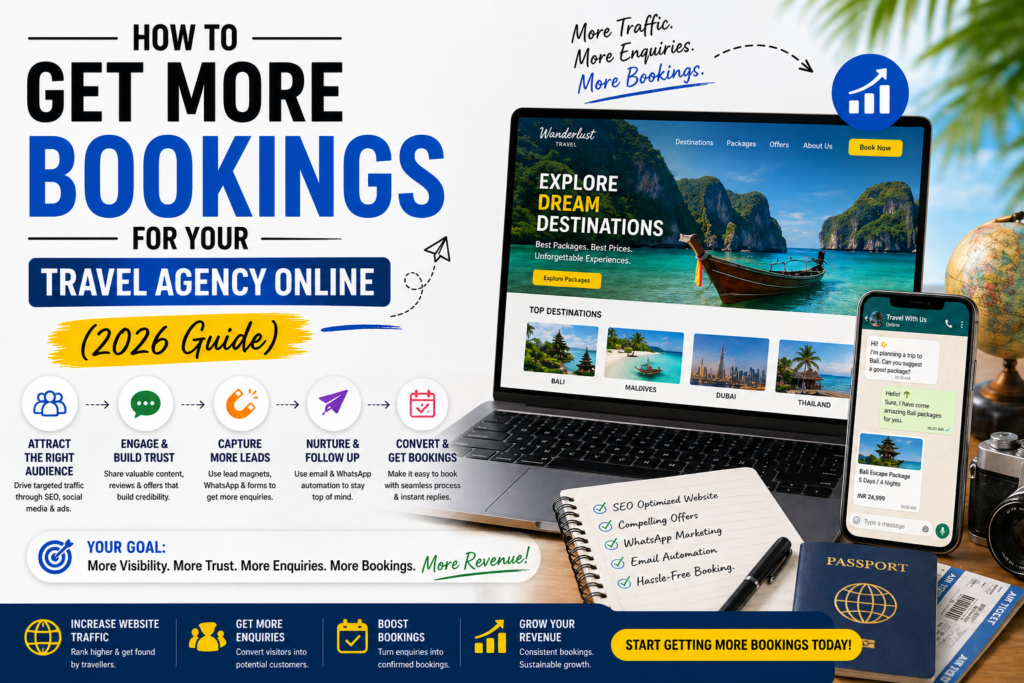
How to Get More Bookings for Your Travel Agency Online (2026 Guide) 🌍
🎯 TL;DR To get more bookings, travel agencies need three things working together: consistent traffic from the right sources (Google Ads for high-intent leads, SEO for long-term organic, social media for awareness), conversion-optimised landing pages that turn visitors into enquiries (dedicated destination pages, short forms, strong social proof), and a structured follow-up system that nurtures leads until they’re ready to book (automated email sequences, WhatsApp follow-up, remarketing ads). Agencies that have all three consistently generate more bookings without increasing ad spend.
💡 Summary Most travel agencies that struggle to get bookings online don’t have a traffic problem — they have a conversion and follow-up problem. Visitors arrive, browse, and leave. Enquiries come in but go cold without systematic follow-up. This guide covers the complete system for getting more bookings: from attracting the right traffic to converting it efficiently to nurturing every lead until it becomes a confirmed booking.
Getting more bookings is the single goal behind everything a travel agency does online.
Not more website visitors. Not more Instagram followers. Not more Google Ads impressions.
Bookings.
And yet most travel agencies focus their energy on the top of the funnel — running ads, posting content, building a social following — without building the systems that actually convert that activity into confirmed bookings.
The result is spending money on marketing that generates traffic and enquiries but doesn’t consistently convert them into revenue.
This guide covers the complete system for getting more bookings for your travel agency online — every stage from attracting the right visitors to confirming the booking. 👇
Why Most Travel Agencies Don’t Get Enough Bookings Online
The short answer: Most travel agencies underperform on bookings not because of insufficient traffic but because of three specific gaps — message mismatch (wrong traffic reaching wrong pages), weak conversion (visitors don’t enquire), and poor follow-up (enquiries go cold before booking).
Before focusing on getting more traffic, it’s worth understanding where bookings are actually being lost — because fixing a leak is more valuable than pouring more water into a leaky bucket.
Gap 1 — Wrong Traffic
If you’re running Google Ads on broad keywords like “holidays” or “travel deals”, you’re attracting price shoppers and holiday browsers — not the high-intent customers who are looking for a specialist agent to plan their trip.
Wrong traffic generates clicks but not enquiries. And clicks without enquiries are just wasted budget.
Gap 2 — Weak Conversion
Most travel agency websites convert paid traffic at 1–2%. A well-optimised destination landing page converts at 4–8%. That 3–6% difference represents 3–4× more enquiries from exactly the same traffic.
If your website is sending all paid traffic to the homepage, missing dedicated destination pages, or using a 10-field enquiry form — you’re leaving the majority of your potential enquiries uncaptured.
Gap 3 — Poor Follow-Up
Travel agencies typically respond to enquiries within 24–48 hours with an initial proposal — and then follow up once or twice before moving on. But travel bookings have a 4–12 week consideration cycle. A lead that doesn’t book in the first week isn’t a lost lead — it’s a lead that needs consistent, value-led nurturing.
Agencies with structured follow-up systems — automated email sequences, remarketing ads, periodic WhatsApp touchpoints — consistently convert significantly more enquiries into bookings than those relying on manual follow-up alone.
The 5-Part System for Getting More Travel Bookings
The short answer: Getting more travel bookings online requires five elements working together — targeted traffic generation, conversion-optimised landing pages, a frictionless enquiry process, a structured nurture system, and a streamlined booking confirmation process.
Part 1 — Attract the Right Traffic
The short answer: The highest-quality traffic for travel booking generation comes from Google Ads (immediate, high-intent), organic search (long-term, compounding), and social media (awareness and remarketing) — with each channel targeting a different stage of the customer journey.
Google Ads — Your Fastest Booking Generator
Google Ads puts your agency in front of people actively searching for exactly what you offer. When someone types “luxury Maldives honeymoon specialist” into Google, they’re already at peak buying intent — they want to book, they just need to find the right agency.
The keywords that generate bookings:
- Destination + specialist/agent: “Maldives honeymoon specialist”, “Kenya safari travel agent”
- Destination + trip type: “luxury Maldives holiday package”, “tailor made Japan holiday”
- Occasion keywords: “honeymoon travel agent”, “anniversary holiday specialist”
- Comparison keywords: “best travel agent for Maldives”
For a complete Google Ads keyword strategy, see our guide on keywords for travel agency Google Ads.
The most common Google Ads mistake that costs bookings: sending all paid traffic to the homepage. A Maldives ad going to a Maldives landing page converts at 4–8%. The same ad going to your homepage converts at 1–2%. That difference directly impacts your number of bookings.
SEO — Your Long-Term Booking Engine
SEO generates free, compounding traffic over time. A well-ranked blog post about “best Maldives resorts for honeymooners” can generate qualified visitors for years without ongoing ad spend.
The content that generates bookings from SEO:
- Destination guides: “Complete Guide to a Maldives Honeymoon”
- Comparison posts: “Maldives vs Seychelles — Which Is Right for You?”
- Budget breakdowns: “What Does a Kenya Safari Actually Cost?”
- Best time to visit posts: “Best Time to Visit Japan for Cherry Blossom”
Each piece of content attracts visitors in the research phase — people who are planning a trip but haven’t yet chosen an agency. A well-placed CTA (“Get a free personalised itinerary from our specialists”) converts a percentage of those researchers into enquiries.
For the complete SEO strategy, see our SEO for travel agencies guide.
Social Media — Awareness and Remarketing
Instagram, TikTok, and Facebook don’t generate immediate bookings at the same rate as Google Ads — but they play a crucial role in the booking journey:
- Awareness: Potential customers discover your agency before they start searching
- Trust building: Regular content demonstrates expertise and builds familiarity over weeks and months
- Remarketing: Ads targeting people who’ve visited your website keep your agency visible during the consideration period
A customer who has followed your Instagram for three months, seen your Maldives expertise, and then searches Google for a Maldives specialist is far more likely to click your ad and book than a complete stranger.
Part 2 — Convert Traffic Into Enquiries
The short answer: Converting website visitors into enquiries requires destination-specific landing pages (not homepages), short enquiry forms (4–6 fields), compelling social proof adjacent to the form, and a clear statement of what happens after submission.
Create Dedicated Destination Landing Pages
This is the single highest-impact change most travel agencies can make to increase bookings.
Every major destination or trip type you advertise needs its own dedicated landing page:
/maldives-honeymoon— for Maldives honeymoon campaigns/kenya-safari— for Kenya safari campaigns/japan-holidays— for Japan holiday campaigns/luxury-holidays— for general luxury campaigns
Each page:
- Has a headline matching the specific ad or search term
- Features destination-specific photography
- Includes testimonials from customers who’ve visited that destination
- Has a short, focused enquiry form
Optimise Your Enquiry Form
Long forms kill conversions. Every additional field reduces form completion rates by 10–15%.
Optimal first-touch form:
- First name
- Email address
- Phone (optional)
- Destination of interest
- Approximate travel dates
That’s it. Get the contact details. Everything else is gathered in the follow-up conversation.
Form copy that increases completions:
- Form headline: “Get Your Free [Destination] Itinerary”
- Submit button: “Start Planning My Trip” (not “Submit”)
- Below form: “We respond within 24 hours — free, no obligation”
Add Social Proof Next to Your Form
Position your strongest testimonial immediately adjacent to your enquiry form — either directly above it or beside it on desktop. This is the moment of maximum hesitation and the moment trust signals have the biggest impact.
What converts: “We had no idea where to start with our Maldives honeymoon. [Agency] planned every detail — the resort, flights, transfers, and a surprise anniversary dinner. It was the holiday of our lives.” — Sarah & James, October 2024
What doesn’t convert: “Great service, would recommend!” — Anonymous
For everything about optimising your landing pages, see our complete guide on travel landing pages that convert.
Part 3 — Make Enquiring Frictionless
The short answer: Every barrier between a potential customer’s interest and their enquiry submission costs you bookings — reducing friction means multiple contact options (form, phone, WhatsApp), fast response times, and a clear confirmation of what happens next.
Offer Multiple Contact Mechanisms
Different customers prefer different ways of making first contact:
- Some want to fill in a form (structured, at their own pace)
- Some want to call and speak to someone immediately
- Some want to WhatsApp and have a casual conversation first
- Some want to email directly
Make all four easy:
- Prominent enquiry form on every landing page
- Phone number visible in the header (click-to-call on mobile)
- WhatsApp button on every page and in the site header
- Email address in the footer
WhatsApp is particularly important for travel agencies serving Middle Eastern and Asian markets where WhatsApp is the dominant communication channel. A prominent WhatsApp button can be one of your highest-converting CTAs.
Response Speed Matters More Than You Think
Research shows that leads contacted within 5 minutes convert at 9× the rate of leads contacted after 30 minutes. For travel enquiries, a response within a few hours is the minimum — same day is good, within 2 hours is excellent.
Automation helps:
- Immediate auto-response email confirming receipt and setting response time expectations
- WhatsApp automated greeting message when someone initiates contact outside business hours
- Instant indexing through Rank Math triggers Google to crawl new content immediately
Set Clear Expectations After Submission
One of the simplest conversion improvements: tell visitors exactly what happens after they submit their enquiry.
“Once you submit, you’ll receive an immediate confirmation email. One of our [Destination] specialists will review your enquiry and send you a personalised itinerary within 24 hours — completely free, no obligation to book.”
Uncertainty is a conversion killer. Clarity builds confidence.
Part 4 — Nurture Leads Until They Book
The short answer: The majority of travel enquiries don’t convert in the first week — they need consistent, value-led follow-up across 4–12 weeks before booking. Agencies with automated email sequences, remarketing ads, and periodic WhatsApp touchpoints convert significantly more enquiries into bookings.
The Travel Booking Consideration Cycle
A customer planning a Maldives honeymoon might:
- Start researching 6 months before their trip
- Enquire with 3–4 agencies
- Take 4–8 weeks to decide
- Book 3–6 months before departure
An agency that sends one proposal and follows up once will lose this customer to the agency that stays in touch consistently, provides genuine value, and builds the most trust over the consideration period.
The 5-Email Nurture Sequence
Every enquiry should automatically enter an email sequence:
Email 1 (Immediate): Confirm receipt + deliver initial itinerary or recommendations Email 2 (Day 3): A genuine insight about their destination — something useful, not promotional Email 3 (Day 7): A customer story from a similar trip — social proof that builds confidence Email 4 (Day 14): Soft invitation to discuss further — “Are you ready to start planning in earnest?” Email 5 (Day 21): Direct CTA — “Spaces are filling for [Season] — shall we secure your dates?”
For the complete email nurture system, see our email marketing for travel agencies guide.
Remarketing Ads — Stay Visible During Consideration
Set up remarketing ads on Facebook, Instagram, and Google Display to stay visible to enquirers who haven’t yet booked:
- Days 1–7: Destination inspiration content (soft, trust-building)
- Days 8–30: Social proof — customer testimonials and trip photos
- Days 31–60: Specific offers or urgency messaging (“Limited availability for [Season]”)
A potential customer who sees your Instagram ad, gets your emails, and sees your remarketing ads is far more likely to book with you than one who submitted an enquiry and heard nothing.
WhatsApp Follow-Up — The Personal Touch
For high-value enquiries, a personal WhatsApp message at the right moment is the highest-converting follow-up touchpoint:
- Day 1: Send personalised initial response and itinerary
- Day 4 (if no reply): “Just checking my message reached you — happy to answer any questions 😊”
- Day 14: Share something relevant — “Just heard the new Conrad resort opens in Maldives this autumn if you’re considering 2026…”
The personal, conversational nature of WhatsApp re-engages leads that have gone quiet on email.
Part 5 — Streamline the Booking Confirmation Process
The short answer: Once a customer says yes, every hour of delay or friction in the booking confirmation process risks losing the booking — a streamlined, professional booking process with clear payment terms, instant confirmation, and a warm welcome builds confidence and reduces post-booking doubt.
Make Booking Easy and Reassuring
When a customer is ready to book:
- Provide a clear breakdown of what’s included and what’s not
- State payment terms upfront — deposit amount, balance due date
- Issue ATOL certificate promptly
- Send a detailed booking confirmation within hours (not days)
- Follow with a warm, excited email about their upcoming trip
Reduce Post-Booking Doubt (“Buyer’s Remorse”)
Travel bookings are high-value decisions. Some customers feel post-booking anxiety — did they make the right choice? Is their money safe? Did they book too early?
Combat this with:
- A celebratory booking confirmation email (“Your Maldives adventure begins here! 🌊”)
- A clear outline of what happens next and when
- A link to useful pre-travel content (packing guides, visa information)
- A direct contact for any questions: “Any worries at all — just message me directly on WhatsApp”
Customers who feel confident and excited after booking are more likely to refer friends and leave glowing reviews — both of which generate future bookings.
Quick Wins — 10 Changes That Will Increase Bookings This Week
The short answer: Ten immediate actions that can increase travel bookings without increasing ad budget — focusing on conversion rate improvements and follow-up system gaps that most agencies have.
- Add a WhatsApp button to your homepage and landing pages today
- Set up an auto-response email for every enquiry form submission
- Create one dedicated landing page for your most-promoted destination
- Shorten your enquiry form to 5 fields maximum
- Add a strong testimonial directly above your enquiry form
- Make your phone number click-to-call on mobile
- Add ATOL/ABTA logos above the fold on every landing page
- Set up a 5-email nurture sequence for new enquiries
- Install remarketing pixels (Meta Pixel + Google Tag) on your website
- Add a clear “what happens next” statement below every enquiry form
None of these require significant budget. All of them address the most common conversion gaps that cost travel agencies bookings every day.
Frequently Asked Questions
How do travel agencies get more bookings online? Travel agencies get more bookings online by combining three systems: targeted traffic generation (Google Ads for high-intent searches, SEO for organic traffic, social media for awareness), conversion-optimised landing pages that turn visitors into enquiries (dedicated destination pages, short forms, strong social proof), and a structured nurture system that follows up consistently until the lead books (email sequences, WhatsApp follow-up, remarketing ads). Most agencies underperform on bookings because they focus on traffic without fixing their conversion and follow-up systems first.
What is the fastest way to get more travel bookings? The fastest way to increase travel bookings is to improve your landing page conversion rate and follow-up speed simultaneously. Switching from sending Google Ads traffic to your homepage to dedicated destination landing pages typically increases enquiry rate by 3–5x. Responding to enquiries within 2 hours rather than 24+ hours increases booking conversion rate by 2–3x. Both changes cost nothing and can be implemented within days.
How much should a travel agency spend on marketing to get bookings? Marketing spend depends on your average booking value and target number of monthly bookings. A reasonable rule of thumb is allocating 10–15% of your target monthly booking revenue to marketing spend. If you want to generate £30,000 in bookings per month, a marketing budget of £3,000–£4,500/month is reasonable. Focus on channels with measurable ROI — Google Ads with conversion tracking tells you exactly what each booking cost to generate.
Should a travel agency use Google Ads or SEO to get more bookings? Both — but at different stages. Google Ads generates bookings immediately but requires ongoing spend. SEO takes 3–6 months to build but generates free organic bookings indefinitely. The most effective travel agencies use Google Ads while building their SEO — getting immediate bookings from paid traffic while investing in long-term organic growth that reduces dependency on ad spend over time.
How do I convert travel enquiries into bookings? Convert travel enquiries into bookings by responding within 2 hours with a personalised itinerary proposal, following up consistently across the 4–12 week consideration cycle, and using an automated email nurture sequence to stay top of mind between personal touchpoints. The agencies that convert the most enquiries into bookings aren’t the ones who respond fastest once — they’re the ones who stay in touch most consistently and helpfully across the entire consideration period.
Why am I getting website traffic but no bookings? Traffic without bookings usually means one of three problems: wrong traffic (visitors who aren’t interested in booking — check your keywords and audience targeting), poor conversion (visitors are interested but your landing page isn’t converting them — check form length, social proof, and message match), or poor follow-up (enquiries are coming in but not converting to bookings — check your response time and nurture sequence). Use Google Analytics to identify exactly where in the journey visitors are dropping off.
How important is social media for getting travel bookings? Social media is important for awareness and trust building rather than direct bookings. Instagram and TikTok help potential customers discover your agency and build familiarity with your brand over weeks and months before they book. This “pre-warming” effect means customers who find you through Google Ads after following you on Instagram are significantly more likely to book than complete strangers. Social media’s role is primarily in the awareness and consideration stages — direct booking generation is stronger through Google Ads and SEO.
How long does it take to increase travel bookings with digital marketing? Google Ads can generate additional bookings within the first week if campaigns are set up correctly. SEO takes 3–6 months before meaningful organic traffic and 6–12 months before significant booking volume. Social media builds audience over 3–6 months before meaningful enquiry generation. Email marketing begins generating results within weeks of implementation. The fastest complete system improvement — better landing pages + Google Ads + email nurture — typically shows meaningful booking increases within 30–60 days.
Final Thoughts
Getting more bookings for your travel agency online isn’t about finding one magic channel or tactic. It’s about building a complete system where every stage works together — the right traffic reaches the right pages, those pages convert efficiently, and every enquiry is nurtured consistently until it becomes a booking.
Most agencies have the first part right (traffic) but leak bookings at the conversion and follow-up stages. Fix those leaks first — improve your landing pages, shorten your forms, add social proof, and build your email nurture sequence — before spending more on ads.
Then, with a functioning conversion system in place, every pound you invest in traffic generates dramatically more bookings than it did before.
For everything you need to implement this system, explore the complete travel agency digital marketing series — starting with our Complete Digital Marketing Guide for Travel Agencies. 🌍