
🎯 TL;DR
A travel agency website that gets bookings is not just a digital brochure — it is a structured conversion system that builds trust, answers objections, and makes it effortless for a visitor to send an enquiry. Research shows 75% of users judge a company’s credibility based on website design alone, and travel agencies that optimised their websites saw an 18.5% increase in conversions in 2026. The five foundations of a high-converting travel agency website are: a clear homepage message, dedicated package pages, visible trust signals, a frictionless enquiry process, and mobile-first design.
💡 Summary
Most small travel agency websites make the same mistake: they look like a catalogue rather than a sales system. Beautiful destination photos, a list of services, a contact form buried at the bottom — and then silence. Visitors arrive, browse briefly, and leave without enquiring.
This guide covers everything a travel agency needs to build a website that genuinely converts visitors into enquiries and enquiries into bookings. From the homepage headline to the enquiry form, every element serves one purpose: moving the visitor closer to a decision.
Why Most Travel Agency Websites Fail to Convert
The short answer: Most travel agency websites are built to look impressive, not to convert. The agencies getting enquiries consistently have websites built around the visitor’s decision-making process — not the agency’s own preferences.
Travel is a high-consideration, high-trust purchase. A visitor arriving on your website is typically somewhere in the middle of a research process — they’ve been thinking about a destination, they’ve compared a few options, and they’re evaluating whether your agency is credible enough to trust with their holiday budget.
In that moment, your website either builds confidence or loses it. Research from Stanford University found that 75% of users judge a company’s credibility based on its website design alone. In travel — where clients hand over thousands of pounds before receiving anything tangible — that percentage is likely even higher.
The good news: a high-converting travel agency website does not require a big budget or a web developer. It requires clarity, structure, and the right content in the right places.
The 5 Foundations of a High-Converting Travel Agency Website
The short answer: Five elements determine whether a travel agency website converts visitors into enquiries. Fix all five and your website becomes your most consistent lead generation tool.
Foundation 1 — A Homepage That Communicates Value in 5 Seconds
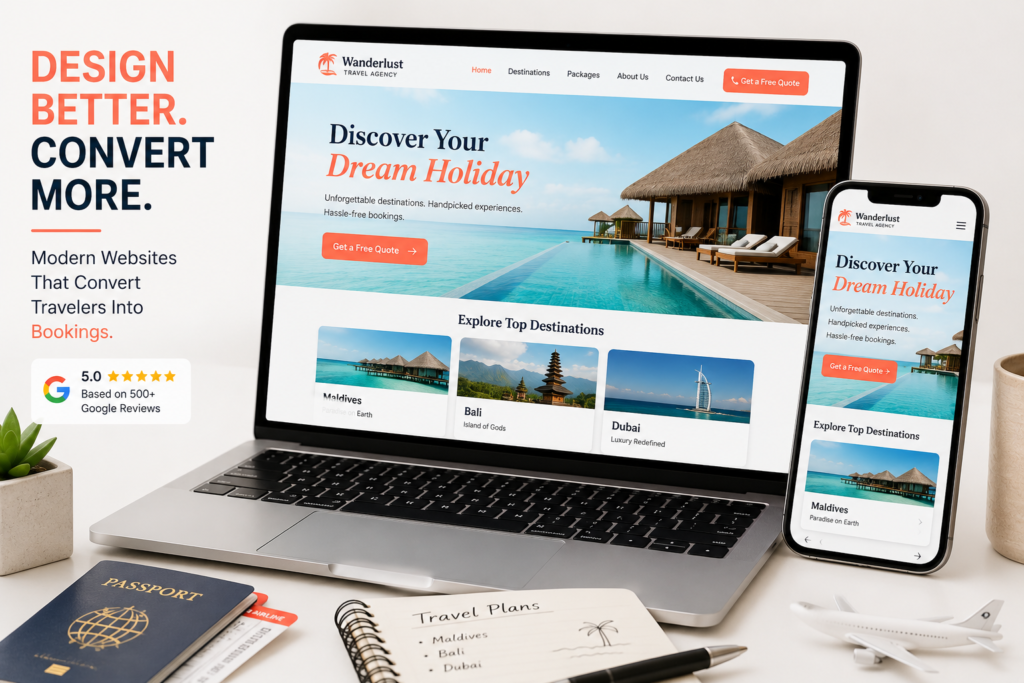
When a visitor lands on your homepage, they make a split-second decision: is this for me? Your homepage headline needs to answer three questions immediately — who you are, who you help, and what they get.
Weak headline: “Welcome to [Agency Name] — We Love Travel” Strong headline: “Bespoke Holiday Packages for UAE Families and Couples — We Handle Everything So You Don’t Have To”
The strong version tells a Dubai-based family or couple exactly who the agency serves, what they offer, and what the key benefit is — before they’ve read a single other word.
Below the headline, add:
– A single, clear call-to-action button: “Plan My Holiday” or “Get a Free Quote”
– Three trust signals: years in business, number of clients, a certification logo
– A brief intro paragraph expanding on who you help and what you specialise in
Keep the homepage focused. Every element should serve the single goal of getting the visitor to click your CTA or scroll to learn more.
Foundation 2 — Dedicated Package Pages for Every Destination
One of the most common and costly mistakes travel agencies make is listing all their destinations on a single page. Each destination or package type deserves its own dedicated page — for both SEO and conversion reasons.
A dedicated Maldives honeymoon package page, for example, can rank for “Maldives honeymoon packages UAE” in Google Search. A generic “packages” page cannot rank for anything specific.
Each package page should include:
– A clear headline naming the destination and trip type
– Key inclusions (flights, hotel star rating, transfers, meals)
– Price range or starting price — hiding prices increases bounce rates
– A photo gallery or video walkthrough
– 2-3 client reviews from people who booked that specific package
– A prominent enquiry CTA above the fold
Internal link: For a deeper guide on building pages that convert visitors into enquiries, read our post on travel landing pages that convert.
Foundation 3 — Trust Signals in the Right Places
Trust signals are the elements that answer the question every first-time visitor is asking: “Can I trust this agency with my money and my holiday?”
Place trust signals at the moments of highest hesitation — not just in the footer or a dedicated “About” page:
| Trust Signal | Where to Place It |
|---|---|
| Google review rating + count | Homepage hero section, every package page |
| Client photos from real trips | Homepage, package pages |
| Years in business | Homepage, About page |
| IATA or ATOL certification logo | Homepage, footer, enquiry page |
| “As featured in” or supplier logos | Homepage |
| Number of clients served | Homepage |
Research consistently shows that trust signals placed near CTAs — not just in the footer — significantly increase conversion rates. A “Get a Free Quote” button next to a 4.9-star Google review badge converts far better than the same button standing alone.
Foundation 4 — A Frictionless Enquiry Process
Your enquiry form is where most travel agency websites lose clients. Forms with too many required fields, no clear value proposition, or no response time expectation create hesitation and abandonment.
Best practice for a travel enquiry form: – Maximum 5 fields: Name, email, phone, destination interest, travel dates
– State the response time: “We’ll respond within 4 hours during business hours”
– Confirm on submission: A thank-you page or message that confirms receipt and sets expectations
– Add WhatsApp as an alternative: Many UAE clients prefer WhatsApp to email forms — a “Chat on WhatsApp” button alongside your form captures this audience
Internal link: WhatsApp is the preferred communication channel for most UAE-based travel clients. Read our complete guide on WhatsApp marketing for travel agencies to build a full WhatsApp enquiry system.
Foundation 5 — Mobile-First Design
In 2026, mobile bookings account for over 60% of all travel reservations. If your website loads slowly, displays incorrectly, or has forms that are difficult to fill in on a smartphone, you are losing more than half your potential enquiries before the first contact.
Mobile-first checklist for travel agency websites:
– Page loads in under 3 seconds on mobile (test with Google PageSpeed Insights)
– Navigation menu collapses into a hamburger menu on mobile
– CTA buttons are thumb-friendly (minimum 44px height)
– Images are compressed and optimised for mobile loading
– Enquiry forms work smoothly on touchscreens — no tiny checkboxes or dropdowns
– Phone numbers are clickable (tap to call)
With LiteSpeed Cache already installed on your WordPress site, focus on image compression and lazy loading as the quickest wins for mobile speed.
The Essential Pages Every Travel Agency Website Needs
The short answer: Beyond the homepage, five pages are non-negotiable for a travel agency website that converts and ranks in Google.
| Page | Purpose | Key Content |
|---|---|---|
| Homepage | First impression, trust, primary CTA | Headline, USPs, trust signals, featured packages |
| Destination/Package pages | SEO + conversion | Package details, pricing, gallery, reviews, enquiry form |
| About page | Build personal trust | Your story, team, certifications, why clients choose you |
| Reviews/Testimonials page | Social proof hub | Google reviews, client photos, video testimonials |
| Contact page | Capture enquiries | Form, WhatsApp button, phone, email, office address, map |
| Blog | SEO + authority | Destination guides, travel tips, agency news |
The blog is particularly important for organic search. Each blog post is an opportunity to rank for a destination or travel-related keyword and funnel that traffic toward your package pages. Your existing 258+ published posts are already doing this work — but they need clear internal links pointing to your commercial package pages.
The Travel Agency Website Conversion Framework
The short answer: The most effective travel agency websites follow the AIDA-T framework — Attention, Interest, Desire, Action, and Trust — mapping each page element to a stage in the visitor’s decision journey.
Here is how AIDA-T maps to a travel agency homepage:
- Attention — your headline and hero image stop the scroll and communicate relevance
- Interest — your USPs and intro paragraph explain what makes you different
- Desire — your featured packages, destination photos, and client reviews create aspiration
- Action — your CTA button, enquiry form, and WhatsApp link make it easy to take the next step
- Trust — your review rating, certifications, and client photos confirm you can be relied on
Apply this framework to every page of your website. If any page is missing one of these five elements, it is underperforming.
Internal link: For a complete guide to how your website fits into your broader digital marketing strategy, read our pillar post on digital marketing for travel agencies.
Quick Wins to Improve Your Existing Website This Week
The short answer: You don’t need to rebuild your website to see improvement. These five changes can be made in under a day and consistently increase enquiry rates.
- Add your Google review rating to your homepage — install a free Google review widget and place it in the hero section
- Add a WhatsApp button to every page — use a free WordPress WhatsApp plugin to add a floating chat button
- Add a price range to every package page — “from AED 3,500 per person” removes a major hesitation barrier
- Add a response time promise to your enquiry form — “We respond within 4 hours” increases form completions measurably
- Add internal links from your blog posts to your package pages — every blog post about a destination should link to the relevant package page
None of these require a developer. All five can be implemented in a single afternoon.
Final Thoughts — Your Website Is Your Best Sales Person
Your travel agency website is the only member of your team that works 24 hours a day, seven days a week, across every time zone. A potential client in the UAE searching for a Maldives honeymoon package at 11pm is on your website right now — and the quality of that experience determines whether they enquire or move on to a competitor.
Build it like a sales system, not a brochure. Every page, every element, every word should serve one purpose: building enough trust and reducing enough friction that the visitor sends an enquiry.
Your action step: Open your homepage right now. Time how long it takes to identify who you are, who you serve, and what the visitor should do next. If it takes more than 5 seconds — rewrite your headline today.
How much does it cost to build a travel agency website?
A professional WordPress website for a travel agency typically costs between AED 3,000 and AED 15,000 depending on the number of pages, design complexity, and whether you hire a developer or use a page builder like Elementor yourself. For most small agencies, a well-structured Elementor or Divi theme-based WordPress site in the AED 4,000–8,000 range delivers everything needed. The ongoing costs are minimal: hosting (AED 300–600/year), a premium theme (AED 200–400 one-time), and your domain name.
What is the most important page on a travel agency website?
Your homepage is the most important page for first impressions, but your package and destination pages are the most important for conversions and SEO. Each destination page ranks for specific search queries and converts visitors who are already in the research phase. If you only have one page for all your packages, splitting them into individual destination pages is the single highest-impact change you can make.
Should a travel agency show prices on its website?
Yes — hiding prices consistently increases bounce rates. Visitors who can’t find a price range assume the packages are out of their budget and leave. You don’t need to show exact prices, but displaying “from AED 3,500 per person” or “packages from AED 8,000 for two” sets expectations, qualifies leads, and reduces the number of enquiries you receive from people outside your target budget.
How do I get my travel agency website to rank on Google?
Three things determine your Google rankings: relevant, helpful content (your blog posts and package pages), technical SEO (fast loading speed, mobile-friendliness, correct meta data via Rank Math), and backlinks from other websites. The fastest wins are publishing regular blog posts targeting specific search queries your potential clients use, optimising each page’s title and meta description, and building internal links between your blog posts and your package pages.
How many pages should a travel agency website have?
At minimum: a homepage, an about page, a contact page, a reviews/testimonials page, and one dedicated page per destination or package type. The number of package pages depends on your specialisations — if you offer 10 distinct destinations or trip types, you should have 10 dedicated pages. Your blog adds additional pages over time, each targeting a different search query.
What is the best platform for a travel agency website?
WordPress is the best platform for most small travel agencies because of its flexibility, SEO capabilities (especially with Rank Math Pro), and the large ecosystem of travel-specific themes and plugins. It is what your site already runs on. Alternatives like Squarespace and Wix are easier to set up but significantly more limited for SEO and customisation. If you are starting fresh, WordPress with a premium theme like Astra or GeneratePress is the recommended combination.
How do I add WhatsApp to my travel agency website?
Install a free WordPress plugin like “WhatsApp Chat” or “Click to Chat” — both available in the WordPress plugin directory. These add a floating WhatsApp button to every page of your site. Set the pre-filled message to something like “Hi, I’m interested in booking a holiday — can you help?” so enquiries arrive with context. This single addition can significantly increase the number of casual browsers who convert into enquiries, particularly for UAE-based visitors who use WhatsApp as their primary communication channel.
How do I measure if my travel agency website is working?
Connect Google Analytics to your website (via Rank Math if it’s not already done) and track: total visitors, top pages by traffic, enquiry form completions, WhatsApp button clicks, and time on page. Set up a goal in Google Analytics for enquiry form submissions so you can see exactly how many enquiries your website generates each month. Review these metrics monthly and look for patterns — which pages drive the most enquiries, and which pages have high traffic but low engagement.