
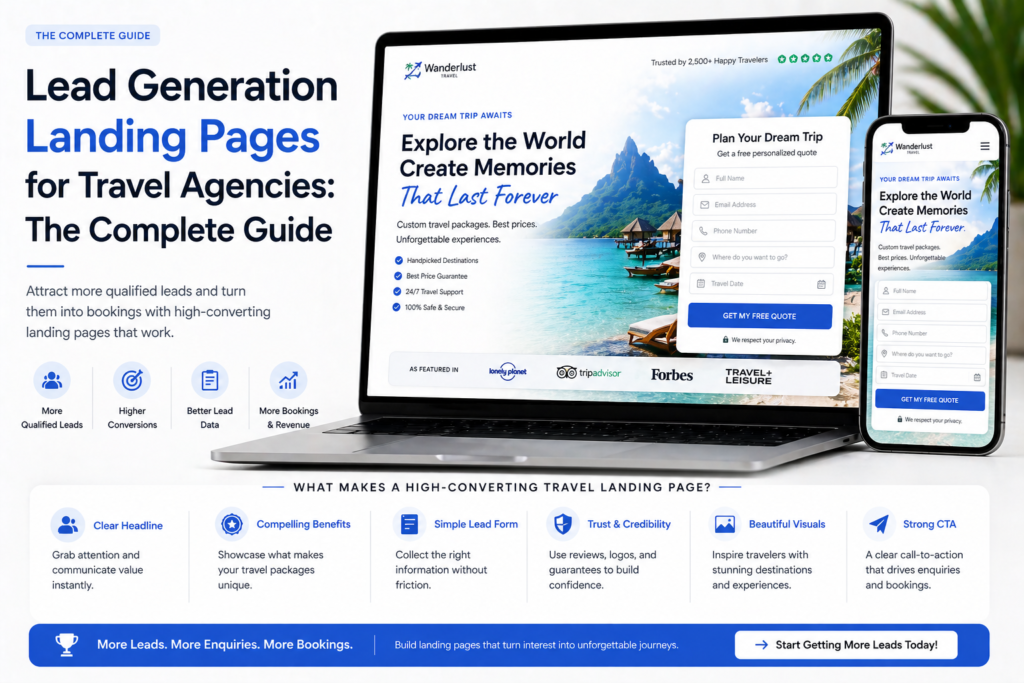
Lead Generation Landing Pages for Travel Agencies: The Complete Guide 🎯
🎯 TL;DR A lead generation landing page for a travel agency is a dedicated, single-purpose page designed to capture enquiries from one specific audience — typically a destination, trip type, or occasion. The highest-converting travel lead generation pages combine a benefit-driven headline, authentic destination photography, a short enquiry form (4–6 fields), specific social proof, and a clear single CTA. Pages built this way convert paid traffic at 4–8% and organic traffic at 2–4%.
💡 Summary Lead generation landing pages are the engine of a travel agency’s digital marketing system — they’re where advertising spend, SEO traffic, and social media audiences become actual enquiries. In this guide, I’ll show you how to build, write, design, and optimise lead generation landing pages specifically for travel agencies, including the exact structure that consistently outperforms generic website pages, common mistakes to avoid, and a testing framework for continuous improvement.
Every travel agency marketing channel — Google Ads, Instagram, Facebook Ads, SEO — has one job: drive the right person to a page that converts them into an enquiry.
That page is your lead generation landing page.
Get it right and every pound you spend on advertising, every hour you invest in content, and every follower you earn on social media compounds into a growing pipeline of qualified travel enquiries. Get it wrong and you’re pouring traffic into a page that leaks leads — visitors arrive, see something that doesn’t match their expectations, and leave without ever making contact.
Lead generation landing pages for travel agencies are one of the highest-leverage assets in your entire marketing stack. This guide shows you exactly how to build them — from the first word of the headline to the final field on the form. 👇
What Makes a Travel Lead Generation Landing Page Different
The short answer: A lead generation landing page has one single goal — capture an enquiry — while a standard website page serves multiple purposes. Everything on a lead gen page is engineered toward that single conversion action.
A lead generation landing page is fundamentally different from a standard page on your travel agency website in three ways:
1. Single purpose, single CTA A website page might have navigation links, social media icons, blog post suggestions, and multiple CTAs competing for attention. A lead generation landing page has one CTA — usually an enquiry form or a phone call — and removes everything that competes with it.
2. Message-matched to the traffic source A lead generation landing page is built for a specific audience arriving from a specific source. A page built for people clicking a Google Ad for “luxury Maldives honeymoon” looks and reads differently from one built for people clicking a Facebook Ad for “Kenya family safari” — even if both are run by the same agency.
3. Conversion-optimised, not brand-optimised Your main website is your brand’s digital home — it needs to communicate your full story, your range of services, and your agency’s personality. A lead generation landing page cares about one thing: getting this specific visitor to take this specific action right now.
The 5 Types of Travel Lead Generation Landing Pages
The short answer: Travel agencies need five types of lead generation landing pages — destination pages, trip type pages, occasion pages, lead magnet pages, and campaign-specific pages — each targeting a different audience segment and conversion goal.
Understanding which type of page to build for each campaign is the first decision you make — because it determines the structure, copy, and CTA of everything that follows.
Type 1: Destination Landing Pages
The most common and most important type for most travel agencies. A destination landing page targets visitors searching for or interested in a specific destination.
Examples:
/maldives-holidays— for Google Ads targeting “Maldives holiday specialist”/kenya-safari— for Facebook Ads targeting safari interest audiences/japan-tours— for organic search targeting “tailor made Japan holiday”
Each page targets one destination, features destination-specific photography, includes testimonials from customers who’ve been there, and has a form with the destination pre-selected.
Type 2: Trip Type Landing Pages
These pages target a specific style of travel rather than a destination — attracting visitors based on how they travel, not where.
Examples:
/luxury-holidays— for luxury travel interest audiences/honeymoon-specialists— for recently engaged audiences/family-holidays— for parents researching family travel/adventure-travel— for adventure and outdoor interest audiences
Trip type pages work well for broad awareness campaigns where destination is secondary to the type of experience.
Type 3: Occasion Landing Pages
One of the most powerful page types for travel agencies — occasion pages target life events that naturally lead to significant travel purchases.
Examples:
/honeymoon-planning— targeting recently engaged couples/anniversary-holidays— targeting couples approaching significant milestones/milestone-birthday-trips— targeting 30th, 40th, 50th birthday travel/multi-generational-holidays— targeting families planning trips across generations
Occasion pages convert at high rates because the visitor is already emotionally invested in the trip — they just need to find the right specialist to plan it.
Type 4: Lead Magnet Landing Pages
These pages don’t ask for an enquiry directly — they offer a free resource (a destination guide, itinerary template, budget breakdown) in exchange for an email address. As covered in our lead magnets for travel agencies guide, this approach captures visitors who aren’t ready to enquire yet but are willing to exchange an email for something valuable.
Examples:
/maldives-honeymoon-guide— “Download our free Maldives Honeymoon Planning Guide”/kenya-safari-planner— “Get the free Kenya Safari Planning Checklist”/japan-itinerary— “Download our 2-week Japan Itinerary Template”
Lead magnet pages typically convert at 25–40% (much higher than direct enquiry pages) because the ask is smaller — an email address rather than a full enquiry submission.
Type 5: Campaign-Specific Landing Pages
These are purpose-built for a specific promotion, season, or offer — used for short-term campaigns where the message needs to be highly specific.
Examples:
/early-bird-maldives-2026— for an early booking offer/summer-safari-deals— for a seasonal promotion/valentines-honeymoon— for a Valentine’s Day campaign
Campaign pages have a defined lifespan — they’re live for the duration of the campaign and then archived or redirected.
The Anatomy of a High-Converting Travel Lead Generation Page
The short answer: Every high-converting travel lead generation page follows the same 8-section structure — hero, value proposition, form, social proof, destination showcase, agency credentials, FAQ, and secondary CTA — in that order.
Here’s each section in detail, with travel-specific guidance for each.
Section 1: The Hero (Above the Fold)
The hero section is everything visible before scrolling. It has three to four seconds to communicate relevance and keep the visitor on the page.
Required elements:
- Headline — benefit-driven, specific to this destination or trip type, matching the ad or search result that brought the visitor here
- Sub-headline — expands the headline promise, states the zero-risk offer, and invites action
- Hero image — authentic destination photography that sets the emotional tone immediately
- Primary CTA — visible without scrolling on all devices (a button or short form)
- Trust bar — ATOL/ABTA logos, star rating, review count — visible immediately
The message match rule: The headline of your landing page must reflect the ad headline that sent the visitor there. A visitor who clicked “Luxury Maldives Honeymoon Specialists” and sees “Tailor-Made Maldives Honeymoons — Planned by Specialists Who’ve Visited Every Resort” feels immediately confirmed. A visitor who sees “Welcome to Sunrise Travel” feels they’ve landed in the wrong place.
As covered in our landing page copy guide, the headline is the single highest-leverage element on the entire page — it determines whether 80% of visitors stay or leave.
Section 2: Value Proposition — Why You, Why Now
Three to four short benefit statements explaining why this visitor should enquire with you rather than going direct or using an OTA.
The feature-to-benefit rule: Don’t list features (“20 years experience”, “ATOL Protected”). Translate every feature into a specific outcome the customer cares about:
- “We’ve visited every resort we recommend” → “You’ll get honest advice about which property actually lives up to the photos — from someone who’s been there”
- “ATOL Protected” → “Your money is 100% protected. If anything changes with your flights or package, you’re covered.”
- “No booking fees” → “You pay the same price as booking direct — but with an expert handling every detail”
Section 3: The Enquiry Form
The enquiry form is the centrepiece of the page. Every design and copy decision on the rest of the page exists to move the visitor toward completing this form.
Optimal field count: 4–6 fields for a direct enquiry page. More than 6 fields significantly reduces completion rates.
Recommended fields:
- First name
- Email address
- Phone number (mark as optional — reduces abandonment while still capturing most)
- Destination (pre-filled or dropdown if destination-specific page)
- Approximate travel dates
- Approximate budget (use ranges — “£3,000–£5,000”, “£5,000–£10,000”, “£10,000+” — easier to select than typing a number)
Form headline: “Get Your Free [Destination] Itinerary” or “Speak to a [Destination] Specialist — Free”
Submit button: “Get My Free Itinerary” / “Start Planning My Trip” / “Request My Free Quote” — never “Submit”
Post-form copy: “We’ll respond within 24 hours with a personalised recommendation. No obligation. No spam. Ever.”
Section 4: Social Proof
Position your strongest social proof immediately adjacent to the enquiry form — either directly above it or to the side on desktop layouts.
The social proof hierarchy for travel lead gen pages:
- Video testimonials (highest impact — even selfie-style)
- Photo + detailed written testimonial with name, destination, trip date
- Written testimonial with trip details (no photo)
- Independently verified rating (Trustpilot or Google widget)
- Review count statement (“Rated 4.9/5 by 600+ travellers”)
The specificity rule: Generic praise (“Great service!”) builds no trust. Specific, experiential testimonials convert. “We had no idea where to start planning our Maldives honeymoon. [Agency] recommended a resort we’d never have found ourselves — the house reef was exceptional. Everything was perfect.” — that converts.
Section 5: Destination Showcase
A curated showcase of what you offer for this destination — resorts, experiences, sample itineraries, or package options. This section does two things: demonstrates the depth of your offering and helps the visitor visualise their trip.
Format options:
- Resort cards (image, name, brief description, “from” price indicator)
- Sample itinerary snippet (Day 1… Day 2… Day 3…)
- Experience highlights (snorkelling, sunset dining, spa — with authentic photography)
- “What’s included” summary for packaged offerings
Keep this section aspirational but specific. It should make the visitor think “I want exactly that” — and then scroll back up to the form.
Section 6: Agency Credentials
A short section establishing why you specifically are the right expert for this destination — not a generic “about us” section but a destination-specific credibility statement.
What to include:
- Number of trips planned to this destination
- Years of specialism
- Number of resorts or properties personally visited
- Key industry accreditations (ATOL, ABTA, AITO)
- A photo of the specialist who handles this destination — human faces build trust
Example: “Our Maldives team has personally visited 40+ resorts across 8 atolls and planned over 1,200 Maldives holidays since 2008. Every property we recommend is one we’ve stayed in ourselves — so when we say a resort is exceptional, we mean it.”
Section 7: FAQ
The FAQ section addresses the objections and concerns that prevent hesitant visitors from enquiring. For travel lead generation pages, the most common objections are cost, process, and protection.
Essential FAQ questions for travel lead gen pages:
- How much will my trip cost? (Be honest — give a “from” price or range)
- Is there a fee to use your service?
- How quickly will you respond to my enquiry?
- Is my money protected?
- What happens after I submit the form?
- Can you match prices I’ve found elsewhere?
- How far in advance should I book?
The honesty rule: FAQ answers that evade or obfuscate reduce trust. Answers that are direct, specific, and honest — even when the answer isn’t what the visitor wants to hear — build significantly more confidence.
Section 8: Secondary CTA
End the page with a final call to action for visitors who’ve scrolled through everything but still haven’t submitted the form. Offer an alternative contact mechanism:
- Phone number with a human invitation (“Prefer to talk? Call us: [number] — Mon–Fri 9am–6pm”)
- WhatsApp button (“Chat with a specialist on WhatsApp”)
- Calendar booking link (“Book a free 20-minute consultation”)
Lead Generation Landing Page Templates by Campaign Type
The short answer: Different campaign types need different page structures — paid traffic pages remove navigation and focus purely on conversion, while organic SEO pages retain navigation and add more content depth.
Template A: Paid Traffic Lead Gen Page (Google Ads / Facebook Ads)
Structure:
- No navigation menu (remove all distractions)
- Hero with headline + CTA visible above fold
- 3-column value proposition
- Enquiry form (prominent, adjacent to social proof)
- Single strong testimonial
- Destination showcase (3–4 options)
- Agency credentials (short)
- FAQ (4–5 questions)
- Secondary CTA (phone + WhatsApp)
Target conversion rate: 4–8% from paid search, 2–5% from paid social
Template B: Organic SEO Lead Gen Page
Structure:
- Full navigation retained (Google needs to crawl site)
- Hero with CTA visible above fold
- Long-form destination or trip type content (1,500–2,500 words)
- Multiple CTA placements throughout the content
- Full FAQ section (8–10 questions)
- Social proof section
- Lead magnet offer as alternative CTA
- Related content links
Target conversion rate: 2–4% from organic search
Template C: Lead Magnet Page
Structure:
- Minimal or no navigation
- Headline focused on the value of the free resource
- 3–5 bullet points of what’s inside
- Cover image/mockup of the PDF
- Simple 2-field form (name + email only)
- Single submit button: “Send Me the Guide”
- Brief privacy reassurance
Target conversion rate: 25–40%
The Lead Generation Page Testing Framework
The short answer: Test one element at a time, starting with the headline, then the CTA button, then form length. Run each test until you have 300+ form views per variant. Use conversion rate — not click rate — as your success metric.
What to Test First (Priority Order)
1. Headline (highest impact) Test two different approaches — outcome-focused vs. benefit-focused, specific vs. aspirational, question format vs. statement format. Even small headline changes can shift conversion rates by 20–50%.
2. Hero image Test authentic photography (your own) vs. professionally sourced alternatives. Test couple-focused images vs. destination-focused images for honeymoon pages.
3. Form length Test your current form against a version with two fewer fields. Test single-step vs. multi-step form layout.
4. CTA button copy Test “Get My Free Itinerary” vs. “Start Planning My Trip” vs. “Speak to a Specialist.”
5. Social proof placement Test testimonial above the form vs. beside the form vs. below the form.
Testing Rules
- Change one element at a time
- Minimum 300 form views per variant before concluding
- Judge by conversion rate, not CTR
- Document every test result — build your own knowledge base of what works for your audience
- Run A/B tests using Unbounce, Google Optimize, or VWO
Connecting Lead Gen Pages to Your Nurture System
The short answer: A lead generation landing page that isn’t connected to an automated follow-up sequence is only capturing half the value of every enquiry it generates.
Every form submission on your lead generation pages should trigger:
Immediate (0–5 minutes):
- Auto-response email confirming receipt and stating response time
- CRM contact record created (HubSpot, Pipedrive, or Zoho)
- Internal notification to the relevant specialist
Within 24 hours:
- Personalised response with initial recommendations or itinerary
- If no response from the lead after 48 hours → automated follow-up email
Days 3–21:
- Nurture email sequence delivering destination content and social proof
- As covered in our email marketing for travel agencies guide, this sequence is what converts enquiries that don’t book immediately
30+ days:
- Re-engagement email for leads that went quiet
- Remarketing ads (Meta and Google Display) to keep your agency visible
Without this connected system, you’re spending money driving traffic to a page, capturing the enquiry, and then losing the lead because follow-up is manual, inconsistent, or non-existent.
Frequently Asked Questions
What is a lead generation landing page for a travel agency? A lead generation landing page for a travel agency is a dedicated, conversion-optimised web page designed to capture enquiries from a specific audience — typically visitors interested in a particular destination, trip type, or travel occasion. Unlike a general website page, it has a single CTA, no navigation menu (for paid traffic), and is specifically message-matched to the ad or search result that brought the visitor there.
How many lead generation landing pages does a travel agency need? A travel agency should have at least one dedicated lead generation landing page per major destination or campaign. For a specialist agency focused on 3–4 destinations, this means 3–4 core pages plus seasonal campaign pages. Agencies running active paid campaigns benefit from having separate pages for each ad group — Google Ads research consistently shows that message-matched landing pages improve Quality Score and reduce cost per lead.
What is the average conversion rate for a travel agency landing page? Well-optimised travel agency landing pages convert paid search traffic at 4–8% and organic search traffic at 2–4%. Lead magnet pages (offering a free guide rather than a direct enquiry) convert at 25–40%. Pages sending traffic to a homepage or generic website page typically convert at under 1%.
Should a travel agency use the same landing page for Google Ads and Facebook Ads? No — Google Ads and Facebook Ads attract visitors at different stages of the buying journey. Google Ads captures high-intent searchers who are actively looking for what you offer; a direct enquiry CTA works well. Facebook Ads reaches people earlier in the funnel who may need more warming up; a softer CTA (free guide, free consultation) or a longer form page often converts better. Separate pages for each channel improve performance for both.
How long should a travel agency lead generation landing page be? For paid traffic, shorter pages (600–900 words) with a clear hero, form, social proof, and FAQ typically outperform longer pages because paid visitors have high intent and don’t need as much convincing. For organic search traffic, longer pages (1,500–2,500 words) with comprehensive destination information perform better because they rank higher and serve the research needs of organic visitors.
What is the most important element of a travel lead generation landing page? The headline is the most important element. It determines whether visitors stay and read the rest of the page or leave immediately. A benefit-driven, specific, message-matched headline can improve conversion rates by 2–3x compared to a generic headline. The second most important element is the enquiry form — specifically its length and the copy surrounding it.
Should travel agency lead generation pages include pricing information? Yes — including at least a “from” price or budget range on your lead generation page significantly improves lead quality. Visitors who enquire knowing your typical price range are much more likely to convert to bookings than those who discover pricing misalignment only during the follow-up conversation. Transparency about pricing also builds trust and differentiates genuine specialists from vague generalists.
How do I drive traffic to a travel agency lead generation landing page? The four primary traffic sources for travel lead generation pages are: Google Ads (highest intent), Facebook and Instagram Ads (demand creation and remarketing), organic search / SEO (long-term, compounding), and email campaigns (warm audiences with highest conversion rates). As covered in our how to generate travel leads online guide, a multi-channel approach combining paid and organic traffic delivers the most consistent pipeline.
Common Lead Generation Landing Page Mistakes ❌
1. One page for all campaigns A single generic landing page receiving traffic from Google Ads, Facebook Ads, Instagram, and organic search simultaneously cannot be message-matched to any of them. Create separate pages for each major campaign and traffic source.
2. Asking too many questions upfront An 8-field form is not collecting more useful information — it’s reducing the number of people who complete it. Keep forms to 4–6 fields. Gather the rest in the follow-up conversation.
3. No connection to a follow-up system A landing page that captures enquiries into a spreadsheet — or worse, an email inbox — with no automated follow-up loses a significant percentage of leads within 24 hours. Connect every form to a CRM and automated email sequence before the page goes live.
4. Prioritising aesthetics over conversion Beautiful design matters — but it should serve conversion, not compete with it. A stunning page with a hard-to-find CTA button or a distracting navigation menu will consistently underperform a simpler, conversion-focused page.
5. Not testing anything Most travel agencies build a landing page once and never change it. The agencies with the highest conversion rates run at least one A/B test per month on their highest-traffic pages and continuously improve based on data.
6. Ignoring mobile Over 60% of travel search traffic arrives on mobile. A landing page that hasn’t been tested and optimised for mobile — particularly the form and CTA — is losing the majority of its potential enquiries.
Final Thoughts
Lead generation landing pages for travel agencies are not a set-and-forget asset — they’re the most actively optimised element of your entire marketing system. Build them with the right structure, connect them to a follow-up sequence, drive the right traffic to them, and test them continuously.
A travel agency with five well-built, well-connected lead generation pages — one per major destination or trip type — has a marketing infrastructure that generates enquiries 24 hours a day from every channel it invests in.
That’s the goal. Build toward it one page at a time.
For everything you need to build high-converting pages, read our guides on how to write landing page copy for travel agencies and landing page design tips for travel agencies. And for the full travel agency digital marketing strategy, head back to our Complete Digital Marketing Guide for Travel Agencies. 🌍