
How to Build a Personal Brand as a Digital Marketer (Complete Guide) 🚀
🎯 TL;DR Building a personal brand as a digital marketer requires four things: a clear niche positioning (you’re not “a digital marketer” — you’re “a Google Ads specialist for travel agencies” or “an SEO consultant for B2B SaaS”), a consistent content presence on one primary platform (LinkedIn for B2B, Instagram for B2C, TikTok for broad reach), a portfolio of demonstrable results (case studies, certifications, measurable outcomes), and a simple way for potential clients or employers to take the next step. Digital marketers who build strong personal brands consistently attract better clients, higher rates, and more opportunities than those who don’t — regardless of years of experience.
💡 Summary In digital marketing, your personal brand is your most valuable career asset. It’s what makes potential clients choose you over ten other marketers with similar skills. It’s what enables you to charge premium rates. It’s what generates inbound opportunities instead of constantly pitching cold. Yet most digital marketers either don’t invest in their personal brand at all, or they start and stop without the consistency that makes it work. This guide covers the complete system for building a personal brand that generates real opportunities.
Two digital marketers. Same skills. Same certifications. Same years of experience.
One has a strong personal brand — a focused LinkedIn presence, a consistent content strategy, a clear niche, and a reputation built over 18 months of showing their thinking publicly. They attract inbound enquiries, command premium rates, and are recommended by name when clients ask for referrals.
The other has no personal brand — a sparse LinkedIn profile, no content presence, and relies entirely on job boards and cold outreach to find opportunities.
The difference in their career trajectories is significant. And it has nothing to do with skills.
Building a personal brand as a digital marketer is one of the highest-leverage career and business investments you can make. This guide shows you exactly how to do it. 👇
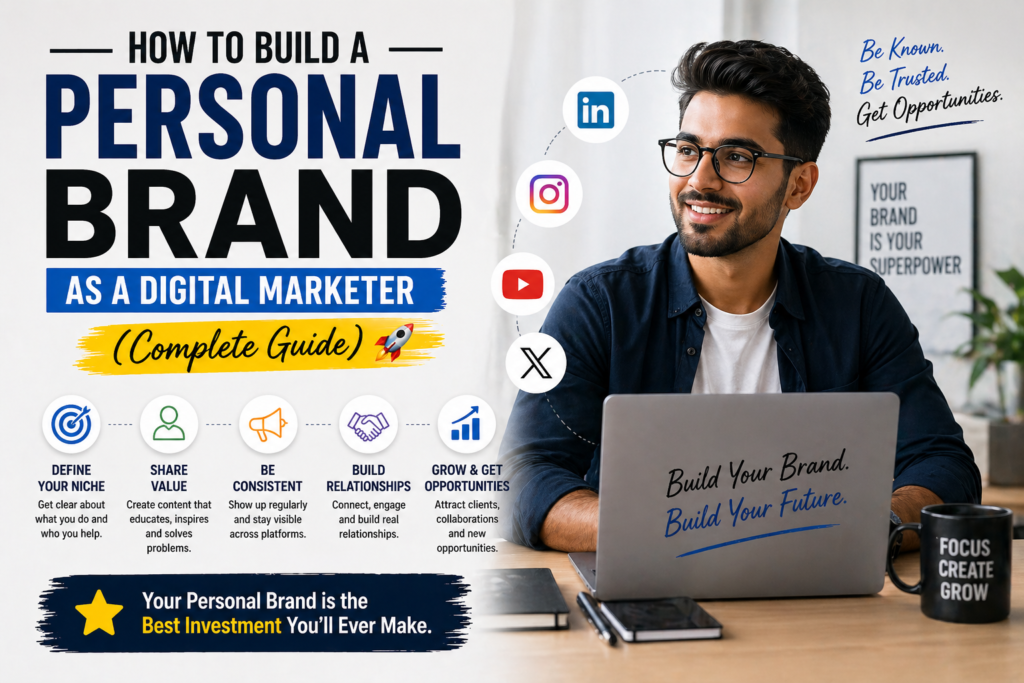
Why Personal Brand Matters for Digital Marketers
The short answer: A strong personal brand means potential clients and employers find you, trust you, and choose you before they’ve even spoken to you — dramatically reducing the effort required to win new business or career opportunities compared to starting every conversation from zero credibility.
The Trust Shortcut
Every new client relationship starts with a trust gap. A potential client doesn’t know you, doesn’t know your work, and has no reason to believe you’re better than the 50 other marketers they could hire.
Building that trust from scratch in every sales conversation is exhausting and inefficient. A personal brand builds that trust in advance — through content, case studies, testimonials, and public demonstrations of expertise — so by the time someone reaches out to you, they already believe in your capabilities.
The Inbound Effect
Digital marketers with strong personal brands attract inbound opportunities — clients contact them, rather than the marketer hunting for clients. This flips the entire power dynamic:
- You can be selective about who you work with
- You negotiate from a position of strength
- Your time is spent on client work, not business development
- Opportunities compound — each client, speaking invite, or collaboration leads to more
The Premium Rate Justification
Commoditised skills compete on price. Recognised expertise commands a premium.
“I need a Google Ads specialist” gets ten applicants all competing on price. “I need someone like Adam Parkar who specialises in Google Ads for travel agencies” has one answer — and that person sets the price.
Niche positioning combined with a visible personal brand is the most reliable way to move from competing on price to competing on reputation.
Step 1 — Define Your Niche and Positioning
The short answer: The foundation of a strong digital marketing personal brand is a specific, defensible niche — not “digital marketer” but “Google Ads specialist for e-commerce brands” or “SEO consultant for law firms” — specific enough to be memorable and searchable, broad enough to have a viable market.
Why Niche Positioning Matters
“Digital marketer” is a commodity. There are millions of digital marketers. Potential clients have no reason to remember you or choose you over anyone else.
“The digital marketing specialist for independent travel agencies” is a category of one. Nobody else is positioned exactly this way. When a travel agency owner asks for a recommendation, your name comes up because you’re the obvious specialist.
The Niche Formula
Your positioning should answer three questions:
- What do you do? (Your primary skill or service)
- Who do you do it for? (Your specific target audience)
- What result do you deliver? (The outcome clients get)
Examples:
- “I help travel agencies generate more bookings through Google Ads and landing page optimisation”
- “I run paid social campaigns for e-commerce brands targeting 3× ROAS”
- “I help B2B SaaS companies grow organic traffic through content-led SEO”
- “I manage digital marketing for UAE-based small businesses”
This positioning becomes the headline of your LinkedIn profile, the bio on your social media accounts, and the opening line of every introduction.
How to Choose Your Niche
Start with your actual experience: What industries have you worked in? What skills do you use most? What results have you achieved?
Consider the market: Is there demand for this specialisation? Are businesses in this niche willing to pay for marketing help?
Choose something you can genuinely own: A niche where you have real expertise and real results — not aspirational positioning you can’t back up yet.
Don’t wait until you’re “expert enough”: You don’t need to be the world’s foremost authority. You need to be ahead of your target client in knowledge and capability — which most working digital marketers already are in their area of focus.
Step 2 — Build Your Foundation Assets
The short answer: Before creating any content, build four foundation assets — an optimised LinkedIn profile, a simple portfolio or case study page, a professional headshot, and a clear bio statement — that make a strong impression on anyone who discovers you through your content or through a referral.
Asset 1 — LinkedIn Profile
LinkedIn is the most important professional platform for digital marketers — it’s where your professional reputation lives and where most B2B opportunities originate.
Headline: Don’t use your job title. Use your positioning statement. “Google Ads & Digital Marketing Specialist | Helping Travel Agencies Generate More Bookings Online”
About section: 3–4 paragraphs that tell your story, articulate your niche, demonstrate credibility, and invite connection.
Opening line: Hook with a result or insight, not “I am a digital marketer with X years of experience.”
Middle: Your background, specialisms, and what you’ve achieved for clients or employers.
Closing: What you’re currently focused on and how people can work with you or connect.
Experience section: For each role, focus on results rather than responsibilities.
- Not: “Managed Google Ads campaigns”
- Yes: “Managed Google Ads campaigns generating £2.3M in booking revenue for travel agency clients across the UAE and UK”
Skills and endorsements: Add your primary skills — Google Ads, SEO, Facebook Ads, Analytics, Email Marketing — and ask past colleagues and clients to endorse them.
Certifications: Add every certification you hold — Google Ads, GA4, HubSpot, Meta Blueprint. They appear prominently on your profile and build instant credibility.
Featured section: Use this to showcase your best work — a case study PDF, a portfolio piece, your most popular LinkedIn post, or a link to your website.
Asset 2 — Portfolio or Case Studies
Results matter more than credentials. A case study showing you took a travel agency’s Google Ads cost per lead from £85 to £42 while increasing lead volume by 60% is worth more than any certification.
Simple case study format:
- The client: Brief description (keep it anonymous if needed)
- The challenge: What problem were they facing?
- The approach: What did you do and why?
- The results: Specific, measurable outcomes
- Key learnings: What makes this replicable?
You don’t need a fancy portfolio website. A well-formatted PDF, a Notion page, or a section on your LinkedIn profile works perfectly.
Asset 3 — Professional Headshot
A clear, professional headshot is non-negotiable for a personal brand. It appears on LinkedIn, your website, your social profiles, and anywhere you’re referenced online.
You don’t need a professional photographer — a well-lit photo taken against a plain background with a modern smartphone is perfectly adequate. What matters: good lighting, clean background, professional appearance, and a natural expression.
Asset 4 — Your Bio Statement
A consistent 2–3 sentence bio used everywhere:
“Adam Parkar is a Dubai-based digital marketing specialist with expertise in Google Ads, SEO, and social media strategy. He specialises in helping travel agencies and small businesses grow their online presence and generate more leads — and shares practical, no-fluff digital marketing guidance at tipsfordigitalmarketing.com.”
Use the same bio (slightly adapted for length) on LinkedIn, your website About page, Instagram bio, and anywhere you’re introduced or quoted.
Step 3 — Choose Your Primary Content Platform
The short answer: Focus your personal brand content on one primary platform where your target audience is most active — LinkedIn for B2B and professional audiences, Instagram for B2C and visual industries, TikTok for broad reach and younger demographics — and build depth there before expanding to other channels.
Platform Selection Guide
| Platform | Best For | Content Format | Time Investment |
|---|---|---|---|
| B2B, professional services, career | Text posts, articles, documents | Medium | |
| B2C, visual industries, lifestyle | Reels, carousels, Stories | High | |
| TikTok | Broad reach, younger demographics | Short video | High |
| Twitter/X | Thought leadership, industry conversations | Short text, threads | Low-Medium |
| YouTube | In-depth education, search discovery | Long-form video | Very High |
| Newsletter | Direct audience ownership, depth | Long-form writing | Medium |
For most digital marketers:
- B2B focus → LinkedIn is your primary platform
- Niche is visually oriented (travel, fashion, food) → Instagram
- Building broad awareness → TikTok
- All of the above → LinkedIn as primary, one other as secondary
Why Focus on One Platform First
Mediocre content on five platforms underperforms great content on one. The algorithm rewards consistency and depth. Audiences on specific platforms have specific content preferences — learning what resonates takes time and focus.
Master one platform first. Once you have a consistent rhythm and growing engagement, repurpose your content to secondary platforms.
Step 4 — Create a Consistent Content Strategy
The short answer: Digital marketing personal brand content should cover three categories — practical expertise (how-to, frameworks, tools), perspective (opinions, industry takes, contrarian views), and personal insight (your journey, lessons learned, behind the scenes) — posted consistently at least 3 times per week on your primary platform.
The 3 Content Categories
Category 1 — Practical Expertise (50% of posts) Demonstrate your knowledge by teaching. Share frameworks, tactics, checklists, and how-to content that your target audience finds immediately useful.
Examples:
- “The 4 Google Ads mistakes I see travel agencies make every week”
- “How I reduced cost per lead by 40% for a Maldives travel agency — step by step”
- “The exact email sequence I use to nurture travel enquiries into bookings”
- “3 landing page changes that doubled this travel agency’s enquiry rate”
Category 2 — Perspective (30% of posts) Share your take on industry trends, news, and debates. Opinions attract engagement and establish you as someone with a genuine point of view.
Examples:
- “Why most travel agencies are running Google Ads the wrong way”
- “TikTok is overtaking Instagram for travel discovery — here’s what it means for agencies”
- “The marketing metric that travel agencies obsess over but shouldn’t”
- “Unpopular opinion: SEO is more important for travel agencies than Google Ads”
Category 3 — Personal Insight (20% of posts) Share your journey, lessons, and behind-the-scenes content. This humanises your brand and builds parasocial connection with your audience.
Examples:
- “What I learned from my first year running a digital marketing blog”
- “The mistake I made with my first Google Ads campaign (and what I’d do differently)”
- “Why I started writing about digital marketing for travel agencies specifically”
- “What working with 20+ travel agencies taught me about what actually drives bookings”
Content Formats That Build Personal Brand on LinkedIn
Short text posts (150–300 words): Highest frequency, easiest to produce, good for opinions and quick insights
Document/carousel posts: PDFs with 5–10 slides — highest engagement format on LinkedIn in 2026. Turn your frameworks and step-by-step guides into visual carousels.
Long-form articles: Detailed guides published natively on LinkedIn — good for SEO within the platform and positions you as a thought leader
Video: Still underused by most professionals on LinkedIn — short 60–90 second talking head videos consistently outperform text posts for reach
Content Consistency — The Make or Break Factor
Consistency matters more than quality when building a personal brand. A decent post published every day outperforms a brilliant post published once a fortnight.
Recommended minimum:
- LinkedIn: 3 posts per week
- Instagram: 4 posts per week + 3 Stories
- TikTok: 3–5 videos per week
Content batching: Spend 2–3 hours once a week creating all your content for the week. Schedule it using Buffer, Hootsuite, or LinkedIn’s native scheduling. This is more efficient than trying to create content daily.
Step 5 — Build Your Network and Visibility
The short answer: Personal brand reach expands through strategic network building — connecting with your target audience on LinkedIn, engaging genuinely with other creators in your space, and getting your expertise in front of new audiences through guest content, collaborations, and industry conversations.
LinkedIn Network Building
Connect strategically: Don’t connect with everyone — connect with people in your target audience (travel agency owners, marketing managers, small business owners) and peers in your industry (other digital marketers, agency founders, consultants).
Personalise connection requests: A brief personalised note dramatically increases acceptance rates: “Hi [Name] — I noticed you’re in the travel industry and I specialise in digital marketing for travel agencies. Would love to connect and share ideas 🌍”
Engage before you post: Comment genuinely on posts by people in your target audience before expecting them to engage with yours. Relationships on LinkedIn are built through consistent, genuine engagement.
Getting Featured and Quoted
Once you have a content presence, actively look for opportunities to expand your reach:
- Guest posts: Write for industry publications, marketing blogs, and travel industry websites
- Podcast appearances: Pitch yourself as a guest on marketing and travel industry podcasts
- Expert roundups: Many bloggers publish roundups of expert opinions — contribute to these
- Industry events: Speaking at or attending industry events builds offline credibility that amplifies your online presence
Collaborations With Other Creators
Collaborating with complementary creators exposes you to their audience:
- Co-author a guide with a travel industry expert
- Do a LinkedIn Live or Instagram collab with a complementary marketer
- Be a guest on another digital marketer’s newsletter
- Create a joint resource (checklist, template) with a partner
Step 6 — Monetise and Leverage Your Personal Brand
The short answer: A strong digital marketing personal brand generates value through four primary mechanisms — attracting freelance or consulting clients, supporting career advancement and salary negotiation, creating passive income through digital products and courses, and building speaking and media opportunities.
Freelance and Consulting Clients
The most direct monetisation path for most digital marketers. A visible personal brand with demonstrated expertise in a specific niche consistently attracts inbound enquiries from businesses that want help with exactly what you do.
How to convert brand awareness into clients:
- Include a clear CTA in your LinkedIn profile: “Open to consulting engagements — DM to discuss”
- Write case studies that demonstrate results in your target industry
- End content posts with a soft CTA: “If you’re a travel agency struggling with [problem], happy to take a look — just DM me”
Career Advancement
For marketers in full-time employment, a personal brand demonstrates expertise publicly — making you more valuable to your current employer and significantly more attractive to future ones.
Hiring managers increasingly check LinkedIn activity before interviews. A candidate with 15,000 followers, regular insightful content, and visible industry engagement starts every interview ahead of one with a blank profile.
Digital Products and Courses
Once you have an engaged audience, productised knowledge generates passive income:
- Digital downloads: Templates, checklists, frameworks — £5–£50 each
- Online courses: In-depth training on your specialist topic — £97–£997+
- Membership community: Ongoing access to your knowledge and community — £20–£100/month
- Ebooks and guides: Detailed written resources — £15–£49 each
Start with a simple £10–£20 digital product to validate demand before investing in a full course.
Speaking and Media Opportunities
Industry conferences, webinars, podcasts, and media features become available once you have visible expertise. These opportunities simultaneously build your brand further and often generate direct business:
- Marketing conference speaking (paid at senior levels)
- Industry webinar presenting
- Podcast guest appearances
- Expert quotes in industry publications
- Judging or mentoring in industry competitions
The Personal Brand Timeline — What to Expect
The short answer: Personal brand building follows a consistent timeline — months 1–3 are about foundation and consistency (little visible growth, high effort), months 4–6 see initial traction (growing engagement, first inbound enquiries), months 7–12 see compounding growth (consistent opportunities, recognised in niche), and year 2+ delivers the full flywheel effect.
Realistic Milestones
| Timeframe | What to Focus On | What to Expect |
|---|---|---|
| Month 1–3 | Foundation, consistency, learning what resonates | Low engagement, building habit |
| Month 3–6 | Doubling down on what works, growing network | First viral posts, early followers |
| Month 6–12 | Compounding growth, first inbound opportunities | Recognised in niche, inbound enquiries |
| Year 1–2 | Monetisation, expanding reach, collaborations | Premium rates, speaking opportunities |
| Year 2+ | Authority status, passive opportunities | Inbound abundance, category leadership |
Most people give up in months 1–3 when growth feels slow. The compounding effect that makes personal brand building so powerful only becomes visible after 6+ months of consistency.
Common Personal Brand Mistakes Digital Marketers Make ❌
1. Trying to appeal to everyone “Digital marketer who does everything” appeals to nobody specifically. Pick a niche, own it, and the right opportunities will find you.
2. Starting on too many platforms simultaneously Three mediocre platforms underperform one excellent one. Pick your primary platform and go deep before expanding.
3. Only posting promotional content “Hire me”, “Buy my course”, “Check out my service” — nobody builds an audience by only asking. Deliver genuine value first. Promotional content should be 20% maximum.
4. Inconsistency Posting 10 times in one week then disappearing for a month destroys algorithmic momentum and audience trust. Consistency is the single most important factor in personal brand growth.
5. Copying others’ style The most effective personal brands are genuinely personal — your voice, your perspective, your specific experience. Don’t try to sound like someone else. Authenticity builds trust; imitation builds nothing.
6. Waiting until everything is “ready” Your LinkedIn profile doesn’t need to be perfect. Your headshot doesn’t need to be professional. Your content doesn’t need to be flawless. Start imperfectly and improve as you go. Every week you wait is a week of compounding you don’t get.
7. Not engaging with others’ content Personal brand building is not broadcast-only. Commenting genuinely on others’ posts, responding to every comment on yours, and building real relationships are what turn a content presence into a community.
Frequently Asked Questions
How long does it take to build a personal brand as a digital marketer? The first meaningful results — inbound enquiries, growing engagement, recognition within your niche — typically appear after 6–12 months of consistent effort. The full compounding effect of a strong personal brand, where opportunities flow inbound without active effort, usually takes 18–24 months. The timeline varies based on consistency, content quality, niche specificity, and how much time you invest in network building alongside content creation.
Do I need a website to build a personal brand as a digital marketer? Not immediately — LinkedIn and one social platform are sufficient to start. A personal website (or a blog like tipsfordigitalmarketing.com) becomes valuable once you’re generating enough content and inbound interest to warrant a central hub. It also provides an SEO-driven channel that isn’t dependent on any platform’s algorithm. A simple portfolio website can be built in a day using WordPress, Squarespace, or Webflow.
What should a digital marketer post on LinkedIn to build their personal brand? Post across three content categories: practical expertise (how-to guides, frameworks, case studies — 50% of content), perspective (industry opinions, trends, takes — 30%), and personal insight (your journey, lessons learned, behind the scenes — 20%). Post minimum 3 times per week, engage genuinely with others’ content daily, and prioritise document/carousel posts and video for highest reach.
Should a digital marketer use their real name or a pen name for their personal brand? Use your real name wherever possible — personal brands built on real identities are more credible, more searchable, and more durable than those built on pen names. If you have legitimate privacy concerns (like not wanting your employer to see your content), a pen name is acceptable — but choose one that sounds like a real name (like Adam Parkar) rather than a brand name.
How do I get my first clients through my personal brand as a digital marketer? Your first clients typically come from your existing network before they come from strangers who discovered your content. Tell people in your network what you do and what problems you solve. Ask past colleagues or employers for referrals. Be specific about who your ideal client is. As your content builds an audience, inbound enquiries will follow — but active outreach to warm network contacts generates first clients faster than waiting for content to compound.
What is the difference between a personal brand and a business brand for digital marketers? A personal brand is built around you as an individual — your name, face, expertise, and perspective. A business brand is built around a company name and entity. Personal brands build trust faster (people trust people more than companies), are more portable (your brand goes with you regardless of employer or business), and generate more authentic engagement. For freelancers and consultants, a personal brand is typically more effective than a business brand. For agencies, a hybrid approach (personal brand for the founder + business brand for the company) often works best.
How do I measure the success of my personal brand as a digital marketer? Track these metrics monthly: follower/connection growth rate (is your audience expanding?), content engagement rate (are people interacting with your posts?), profile views (is your visibility growing?), inbound enquiries (are opportunities finding you?), and referrals received (are people recommending you by name?). Vanity metrics like total followers matter less than engagement rate and inbound opportunity volume — a smaller, highly engaged audience generates more business than a large, disengaged one.
Can I build a personal brand while working a full-time marketing job? Yes — and many of the strongest digital marketing personal brands are built by people in full-time employment. 30–60 minutes per day is enough to create consistent content, engage with your network, and build your reputation over time. Many employers view a strong employee personal brand positively — it reflects well on the company when their team members are recognised experts. Just ensure your content doesn’t share confidential client information or conflict with your employment contract.
Final Thoughts
Building a personal brand as a digital marketer is a long game — but it’s the most valuable long game in the profession.
The digital marketers who invest in their personal brand consistently earn more, attract better clients, have more career options, and generate more opportunities than those who don’t — regardless of technical skill level.
Start with your niche positioning. Build your LinkedIn profile. Commit to three posts per week for six months. Engage genuinely with your community. And document your thinking publicly — even when it feels like nobody is watching.
The audience builds slowly at first, then all at once. The opportunities follow the same pattern.
Your personal brand is being built whether you’re intentional about it or not — every piece of content you create, every client you serve, every conversation you have is shaping how people perceive your expertise. The question is whether you’re building it deliberately or leaving it to chance.
Start today. And keep going. 🚀
For more practical digital marketing guidance, explore everything at Tips For Digital Marketing. And if you work in travel, start with our Complete Digital Marketing Guide for Travel Agencies. 🌍