

🎯 TL;DR
A content calendar for travel agencies is a simple planning system that tells you what to post, where to post it, and when — so you never scramble for content ideas again. The most effective approach combines five content pillars, a seasonal mapping strategy, and a weekly batching workflow. You can build your first calendar in under two hours using a free Google Sheet or a tool like Buffer or Later.
💡 Summary
Most travel agencies either post sporadically (“when I remember”) or burn out trying to maintain consistency across multiple platforms. A content calendar solves both problems by shifting your marketing from reactive to planned.
This step-by-step guide walks you through building a content calendar from scratch — choosing your content pillars, mapping content to travel seasons, picking the right tools, and batching your content so a week’s worth of posts takes under 90 minutes. Whether you’re a solo travel agent or running a small team, this system is designed to work around your actual schedule.
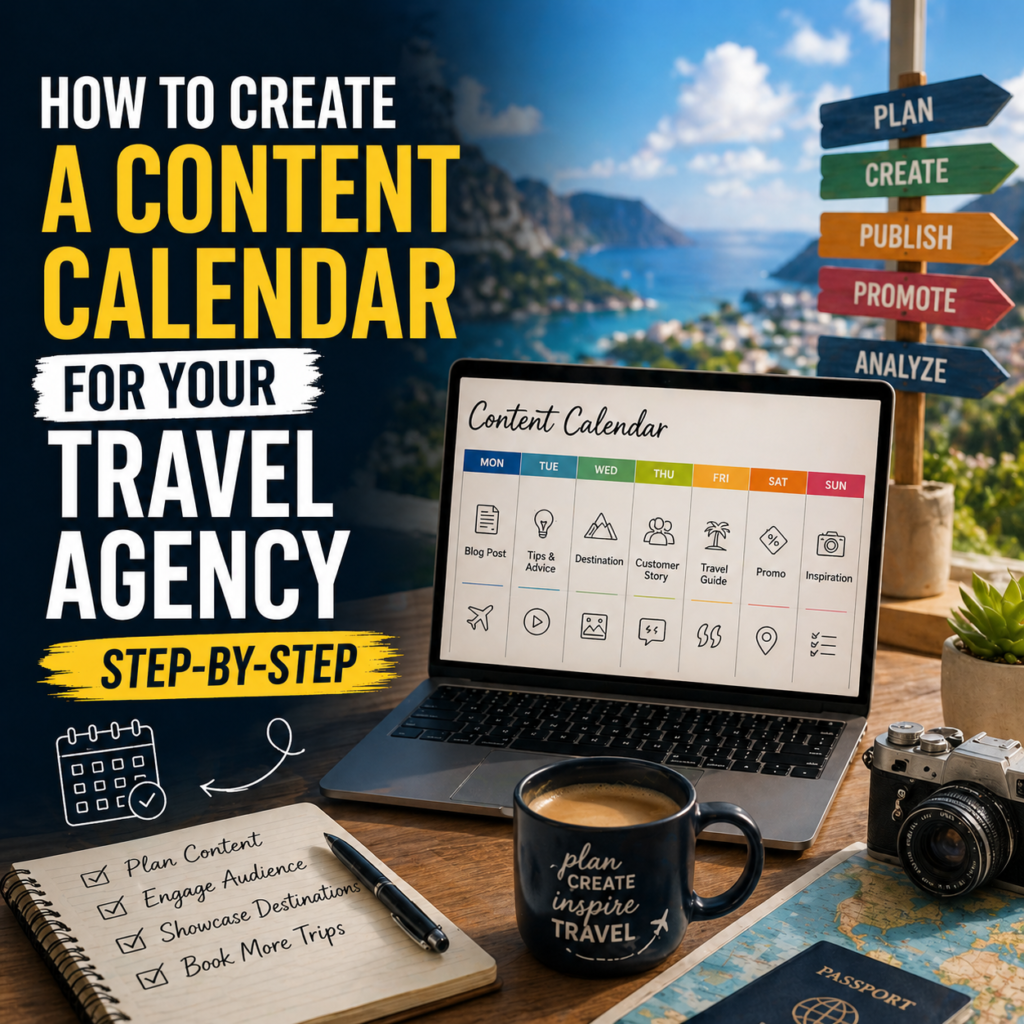
Why Most Travel Agencies Fail at Content (And How a Calendar Fixes It)
The short answer: Without a plan, content gets skipped. A content calendar for travel agencies turns “I should post more” into “here’s exactly what goes out on Tuesday.”
Picture this. It’s Monday morning. You’ve got three enquiries to respond to, two itineraries to finalise, and a supplier on hold. Marketing is the last thing on your mind — and so another week passes without a single post.
This is the “post when I remember” problem. And it’s not a motivation problem or a creativity problem. It’s a systems problem.
A content calendar is not just a spreadsheet. It’s a decision made in advance. When you sit down on a Sunday afternoon and plan your content for the week, you’re removing the daily friction of figuring out what to post. Tuesday’s Instagram destination post is already planned. Thursday’s Facebook travel tip is already drafted. Friday’s email to your list is already scheduled.
Consistent content matters because it keeps your agency visible during the booking consideration window — the weeks or months when a potential client is dreaming about a trip but hasn’t committed yet. The agency that shows up consistently in their feed is the one they call when they’re ready to book.
Step 1 — Define Your Content Pillars
The short answer: Content pillars are the recurring themes that make up your content mix. They keep your marketing varied without requiring you to invent something new every day.
Without content pillars, most agencies default to only posting promotions and deals. That’s the equivalent of a friend who only contacts you when they want something. It kills engagement.
The Travel Agency Content Pillar System gives you five rotating themes that balance inspiration, education, trust-building, and promotion:
| Pillar | What It Looks Like | Why It Works |
|---|---|---|
| 🌍 Destination Inspiration | Beautiful destination photos, “reasons to visit” posts, hidden gems | Triggers the dreaming phase — people save and share these |
| 💡 Travel Tips | Packing guides, visa advice, best time to visit, what to avoid | Positions you as a knowledgeable expert, not just a ticket seller |
| ⭐ Social Proof | Client reviews, testimonials, trip photos shared by past clients | Builds trust — the #1 barrier to booking with an independent agency |
| 🎬 Behind the Scenes | Your team, your process, supplier visits, FAM trips | Humanises your agency — people book with people, not businesses |
| 🎁 Promotions and Deals | Special offers, early-bird packages, seasonal campaigns | The sales pillar — but effective only when it’s 20% of your mix, not 80% |
Rotate through these five pillars across your weekly content. A simple pattern for a travel agency posting five times a week:
- Monday: Destination Inspiration
- Tuesday: Travel Tip
- Wednesday: Social Proof (client review or testimonial)
- Thursday: Behind the Scenes
- Friday: Promotion or Deal
This ensures every week is balanced, varied, and never feels like one long advertisement.
Step 2 — Choose Your Platforms and Posting Frequency
The short answer: Don’t try to be everywhere. Choose two or three platforms where your clients actually are, and commit to consistent quality there.
The biggest mistake small travel agencies make on social media is spreading themselves too thin. Trying to maintain an active presence on Instagram, Facebook, LinkedIn, TikTok, Pinterest, and a blog simultaneously is a recipe for burning out and abandoning everything.
Platform recommendations by agency type:
- Leisure travel agencies (holidays, honeymoons, family trips): Instagram + Facebook + email newsletter
- Corporate or group travel agencies: LinkedIn + email newsletter + blog
- Adventure or niche travel agencies: Instagram + TikTok + blog
Realistic posting frequency for a small agency:
| Platform | Minimum | Sustainable | Ambitious |
|---|---|---|---|
| 3x/week | 5x/week | Daily | |
| 3x/week | 4x/week | 5x/week | |
| Blog | 1x/month | 2x/month | 1x/week |
| Email newsletter | 2x/month | Weekly | — |
Start at “minimum” and increase only when the workflow feels effortless. A consistent three posts per week on Instagram will outperform sporadic daily posting every time.
Internal link: Looking to grow your agency’s reach on social media? Read our guide on Instagram for travel agencies for a platform-specific strategy.
Step 3 — Map Your Content to Travel Seasons
The short answer: The best content is planned 6–8 weeks in advance and tied to when your clients are actively thinking about booking — not when the trip actually happens.
Travel has a predictable rhythm. Families book summer holidays in February and March. Couples plan Christmas trips in September. UAE-based travellers look for holiday packages before Eid and school breaks. If you’re only creating content about a destination when the season arrives, you’ve already missed the booking window.
Key booking windows for travel agencies serving UAE and Middle East clients:
| Period | Content Theme | Start Planning |
|---|---|---|
| Eid Al Fitr holidays | Family trips, short breaks, luxury escapes | 8 weeks before |
| Eid Al Adha holidays | International travel, long-haul trips | 8 weeks before |
| Summer school break (June–August) | Europe, UK, North America packages | February–March |
| Christmas and New Year | Luxury, safari, beach destinations | October |
| Winter sun (Jan–Feb) | Maldives, Southeast Asia, Indian Ocean | November |
The 80/20 content rule: 80% of your content should be evergreen — destination guides, travel tips, and social proof that are relevant year-round. 20% should be timely — seasonal campaigns, limited offers, and event-tied content. This protects your calendar when unexpected events disrupt a planned campaign.
Internal link: Want to understand how the full digital marketing picture fits together for your agency? Our digital marketing for travel agencies pillar guide covers every channel in one place.
Step 4 — Build the Actual Calendar (Tools + Free Template)
The short answer: Start with a free Google Sheet. Graduate to a scheduling tool like Buffer or Later once the habit is established.
You don’t need expensive software to build your first content calendar. A well-structured Google Sheet is enough to plan a full month of content and is free.
The Free Google Sheet Structure
Create a spreadsheet with these columns:
| Date | Platform | Pillar | Format | Caption Idea | Visual Brief | Status |
|---|---|---|---|---|---|---|
| 5 Jun | Destination Inspiration | Photo | “3 reasons the Maldives in June is actually perfect 🌊” | Client water villa photo | Scheduled | |
| 5 Jun | Destination Inspiration | Photo | Adapted from Instagram caption | Same photo | Scheduled | |
| 7 Jun | Travel Tip | Carousel | “5 things to pack for a safari in Kenya” | Canva carousel — branded | Draft |
Add one row per post. Colour-code by pillar for a quick visual overview.
Scheduling Tools Worth Considering
Once your calendar is planned, a scheduling tool allows you to queue everything in advance and walk away.
Buffer is the best starting point for most small travel agencies. The free plan covers three social accounts and unlimited scheduling. Its AI caption generator can draft post copy from a brief description — useful for speeding up the batching step.
Later is excellent if Instagram is your primary platform. Its visual grid planner shows you how your feed will look before you publish — important for travel agencies where aesthetics and brand consistency matter.
Planable is worth considering if you have a small team and need approval workflows before content goes live.
A Sample One-Week Travel Agency Content Calendar
Here’s a real-world example for a leisure travel agency focusing on the UAE market:
| Day | Platform | Pillar | Content |
|---|---|---|---|
| Monday | Instagram + Facebook | Destination Inspiration | Stunning aerial shot of Santorini — “This is why Greece never gets old 🇬🇷” |
| Tuesday | Travel Tip | Carousel: “5 things no one tells you before visiting Japan” | |
| Wednesday | Social Proof | Screenshot of a client review + photo from their Bali trip | |
| Thursday | Instagram Stories | Behind the Scenes | Quick video of the team planning a new luxury Maldives package |
| Friday | Instagram + Facebook | Promotion | “Eid holiday to Mauritius — 7 nights from AED 4,500. DM us to check availability.” |
| Saturday | Email newsletter | Mixed | Roundup of the week’s content + featured destination of the month |
Step 5 — Batch, Schedule and Review
The short answer: Batch your content once a week in a single 60–90 minute session. Schedule everything in advance. Review performance once a month.
The “Content Sunday” Method
Set aside 60–90 minutes every Sunday (or the first working day of your week) to:
- Review the week ahead — what’s in the calendar? Any seasonal hooks or timely angles to add?
- Gather your visuals — select 5–7 images or short videos from your library, client submissions, or Pexels/Unsplash
- Draft your captions — use an AI writing tool (ChatGPT or Claude) to generate draft captions, then edit to match your voice
- Schedule everything — queue all posts in Buffer or Later for the week ahead
- Draft your email — if you send a weekly newsletter, write it now while your content themes are fresh
Done. Your entire week of content is handled before Monday morning.
Internal link: AI tools can dramatically speed up the drafting step. Our guide to AI content marketing tools for travel agencies covers the exact tools and prompts that work best for this workflow.
Monthly Review — What to Track
At the end of each month, spend 20 minutes reviewing your content performance:
- Which posts got the most engagement? (saves, shares, comments — not just likes)
- Which pillar performed best? (destination inspiration almost always wins on reach; social proof wins on conversions)
- Did your posting frequency stay consistent? (if not, was it a time issue or a content ideas issue?)
- Did your email open rates change? (a drop in opens often signals you need to refresh your subject line approach or posting frequency)
Use these insights to adjust next month’s calendar — not to overhaul everything, but to do more of what worked and less of what didn’t.
Final Thoughts — Your First Calendar Takes Two Hours. After That, It Takes 90 Minutes a Week.
A content calendar for your travel agency is not a complex project. It’s a simple decision made in advance: here’s what goes out this week, on these platforms, at these times.
The agencies that show up consistently are the ones potential clients remember when they’re finally ready to book. Consistent doesn’t mean perfect. It means present.
Build your first calendar this weekend. Create a Google Sheet, fill in two weeks of content using the five-pillar framework, and schedule it in Buffer. That’s it. You’ve started.
How far in advance should a travel agency plan its content calendar?
Plan one month ahead as a minimum. Two months ahead is ideal for seasonal content — giving you time to create visuals, write copy, and align promotions with booking windows. Your evergreen content (destination guides, travel tips) can be batched further in advance. Timely content (breaking deals, event-tied posts) will always require some last-minute additions, which is normal.
Three to five times per week on your primary platforms is sustainable for most small agencies. Consistency matters more than frequency — three quality posts per week every week will always outperform sporadic daily posting. Start at three and increase only once the workflow feels comfortable.
Use the Travel Agency Content Pillar System: Destination Inspiration, Travel Tips, Social Proof (client reviews and photos), Behind the Scenes, and Promotions. Rotate through these five pillars to keep your feed varied and engaging. Avoid posting only promotions — it kills organic reach and follower trust.
What’s the best free tool for building a travel agency content calendar?
Google Sheets is the best free starting point — it’s flexible, shareable, and requires no learning curve. Once you’re ready to schedule content in advance, Buffer’s free plan (three social accounts) is the best upgrade. Later is a strong alternative if Instagram is your main platform.
How do I come up with content ideas for my travel agency every week?
Your content pillars do most of the heavy lifting. Beyond that: use client questions as inspiration (if five clients ask the same question, write a post answering it), monitor destination trends in Google Trends, share content from supplier FAM trips, and repurpose past blog posts as social carousels. If you’re ever truly stuck, use ChatGPT or Claude — prompt it with “Give me 10 Instagram post ideas for a travel agency specialising in [your niche].”
es — and the two work together. Your blog drives organic search traffic from Google (people searching “best time to visit Bali” or “Maldives travel tips”). Your social media amplifies that blog content to your existing followers and drives them back to your website. A blog post can be repurposed into multiple social posts, an email newsletter, and a carousel — so one piece of content does the work of many.
How do I stay consistent with my content calendar when things get busy?
Batch content in advance and use a scheduling tool. When you have a busy enquiry period coming up, batch two weeks of content the weekend before. Keep a library of evergreen “emergency posts” — 5–10 destination photos with ready-to-use captions — that you can drop into the calendar whenever you’re short on time. Consistency over perfection.
How do I know if my content calendar is working?
Track engagement metrics monthly — saves and shares (not just likes), profile visits after specific posts, website clicks from your bio link, and direct messages or enquiries mentioning your content. Over 60–90 days of consistent posting, you should see a measurable increase in engagement and inbound enquiries. If you’re not seeing movement after 90 days, review your content pillars — the issue is usually that the content isn’t specific enough to your niche or audience.