
How to Find Keywords for Travel Agency Google Ads (The Right Way) 🔍
💡 Summary Choosing the wrong keywords is the number one reason travel agency Google Ads campaigns fail. Too broad and you burn budget on people who’ll never book. Too narrow and your ads barely show. In this guide, I’ll show you exactly how to find the right keywords for your travel agency — from high-intent booking terms to destination-specific long-tails — using a research process built specifically for the travel industry.
Here’s a scenario that plays out for travel agencies every single day.
They launch a Google Ads campaign targeting “holidays” or “travel deals.” The ads get impressions. They even get clicks. But the enquiries don’t come — or the ones that do are completely wrong. Budget disappears. The agency concludes Google Ads doesn’t work for them.
The campaign wasn’t the problem. The keywords were.
Finding the right keywords for travel agency Google Ads is fundamentally different from keyword research in most other industries. Travel has unique dynamics — extreme seasonal variation, fierce OTA competition, an enormous range of trip types and destinations, and customers at very different stages of the booking journey. A generic keyword research approach simply doesn’t account for any of this.
This guide does. Let’s build a keyword strategy that actually drives bookings. 👇
Why Keyword Research Is Different for Travel Agencies
Before jumping into the process, it’s worth understanding what makes travel keyword research uniquely challenging — because these dynamics shape every decision you’ll make.
The Competition Isn’t Other Travel Agencies
When you bid on a keyword like “Maldives holiday,” you’re not just competing against other local travel agencies. You’re competing against Booking.com, Expedia, TripAdvisor, British Airways Holidays, and every major hotel chain — all of which have Google Ads budgets that dwarf yours.
This doesn’t mean you can’t win. It means you need to be smarter about which keywords you target. The more specific the keyword, the less likely a massive OTA has a well-optimised page and ad for it — and the more likely your specialist expertise becomes an advantage.
Search Intent Shifts Dramatically Across the Booking Journey
A person searching “Maldives” is dreaming. A person searching “best Maldives resorts for snorkelling” is researching. A person searching “tailor made Maldives honeymoon package UK” is ready to book.
Same destination. Completely different stages. Completely different keyword value for a travel agency running paid campaigns.
Understanding where in the booking journey each keyword sits is the most important filter in your research process.
Seasonality Changes Everything
Travel keywords spike and crash in predictable seasonal patterns. “Caribbean holidays” peaks in November–January (winter sun bookers). “Ski holidays” peaks in September–October. “Summer holidays 2026” starts trending in December.
Your keyword strategy needs to account for these cycles — building campaigns around booking windows, not just departure dates.
The 5 Types of Keywords Every Travel Agency Needs
Before using any tool, understand the five keyword types that make up a complete travel agency keyword strategy. Each serves a different purpose.
Type 1: Destination + Trip Type Keywords (Core)
These are your bread-and-butter — the keywords that combine a specific destination with a trip type or qualifier.
Examples:
- “luxury Maldives holiday package”
- “family safari holiday Kenya”
- “tailor made Japan holiday”
- “all inclusive Caribbean cruise”
- “group tours Morocco 2025”
These are high-intent, commercially valuable, and specific enough that you can create genuinely relevant ads and landing pages for them. They form the core of most travel agency campaigns.
Type 2: Travel Agent / Specialist Keywords (High Value)
These keywords signal that the searcher specifically wants to work with a travel agent or specialist — not book direct. These are your most valuable keywords because they’re pre-qualified.
Examples:
- “Maldives travel agent”
- “luxury honeymoon travel specialist”
- “tailor made travel agent UK”
- “Africa safari specialist”
- “best travel agent for Japan”
Someone searching for a “travel agent” has already decided they want help. Close the deal.
Type 3: Destination + Intent Keywords (Strong Converters)
These combine a destination with a transactional word that signals purchase intent.
Examples:
- “book Maldives holiday”
- “Maldives holiday deals 2025”
- “Maldives honeymoon packages price”
- “cheap Kenya safari packages”
- “Japan tour packages 2025”
The transactional language (book, deals, packages, price) tells you this person is actively comparing options and ready to make a decision soon.
Type 4: Trip Occasion Keywords (Highly Targeted)
These keywords are tied to a specific life event or travel occasion — and they dramatically narrow the audience to exactly the right type of customer.
Examples:
- “Maldives honeymoon package”
- “anniversary holiday ideas luxury”
- “family holiday with teenagers”
- “solo travel over 50”
- “group holiday 10 people”
These are incredibly valuable because they tell you not just where someone wants to go, but why — which means you can write copy that speaks directly to their emotional motivation.
Type 5: Competitor and OTA Keywords (Advanced)
These keywords target people searching for your competitors or major OTAs — to position your agency as an alternative.
Examples:
- “Expedia Maldives holidays”
- “Kuoni Maldives alternatives”
- “better than Booking.com for holidays”
- “Trailfinders alternative”
This is an advanced strategy that requires careful messaging (you’re not attacking a competitor, you’re offering a compelling reason to consider you instead). Use with caution and a clear value proposition in your ad copy.
Step 1: Start with Your Specialisms, Not a Tool
The most common keyword research mistake travel agencies make is opening Google Keyword Planner and typing in broad terms like “holidays” or “travel.” You’ll get enormous lists of irrelevant keywords and miss the specific, high-value terms that actually matter for your agency.
Start by mapping your specialisms. For each one, write down:
- The destinations you specialise in
- The trip types you sell most (honeymoons, family, adventure, luxury, group)
- The occasions you frequently cater for (anniversaries, birthdays, milestone trips)
- The specific experiences you offer (overwater villas, Big Five safaris, cherry blossom season Japan)
- Any specific demographics you serve well (solo travellers over 50, multi-generational families, LGBTQ+ couples)
This mapping exercise produces your seed keyword list — the specific, relevant starting points that will generate genuinely useful keyword ideas when you put them into research tools.
Example seed list for a luxury honeymoon specialist:
- “luxury Maldives honeymoon”
- “Bali honeymoon package”
- “honeymoon travel agent”
- “Seychelles honeymoon specialist”
- “tailor made honeymoon”
- “overwater villa honeymoon”
- “Mauritius honeymoon packages”
These seeds are specific enough to generate relevant keyword ideas — and to immediately filter out the generic travel keywords that will drain your budget with no return.
Step 2: Use Google Keyword Planner for Volume and CPC Data
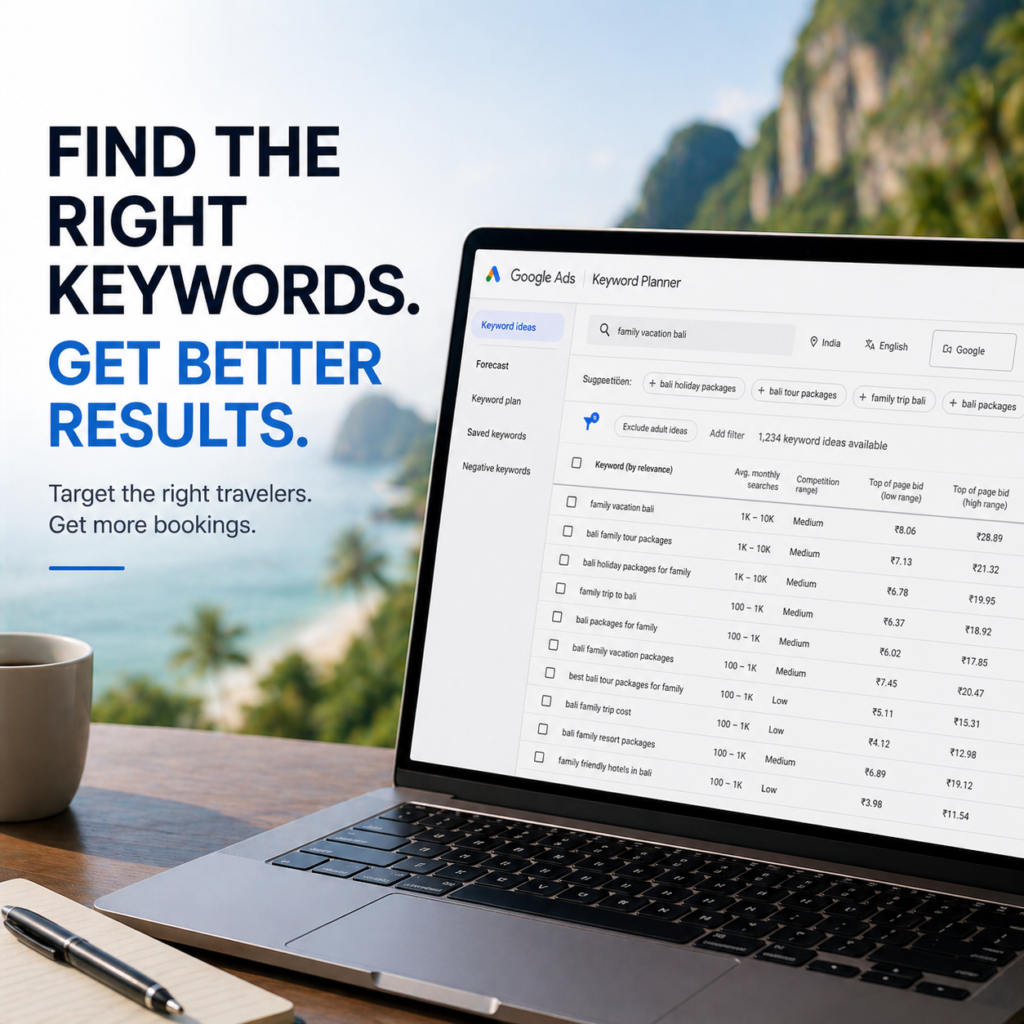
Google Keyword Planner is your primary tool for validating keyword ideas and understanding the commercial landscape. Here’s how to use it specifically for travel:
Setting Up Your Search
- Log into Google Ads → Tools & Settings → Keyword Planner
- Select “Discover new keywords”
- Enter your seed keywords (5–10 at a time)
- Set the location to your target market (e.g. United Kingdom, UAE)
- Set the language to English
What to Look For in Travel Keywords
Monthly search volume: In travel, don’t dismiss lower-volume keywords. A keyword with 100 monthly searches for “tailor made Maldives honeymoon specialist UK” is far more valuable than one with 10,000 searches for “Maldives holidays” — because the intent is infinitely more specific and the competition is far lower.
Top of page bid (high range): This is what advertisers are currently paying for top placement. In travel, you’ll see significant variation — from £0.50 for obscure long-tails to £8–£15+ for competitive destination terms. Use this to estimate your budget requirements for each keyword group.
Competition level: High competition means lots of advertisers are bidding, which usually indicates commercial value. But high competition also means higher CPCs. Balance commercial value against your budget.
Seasonal trends: Click the keyword and look at the search volume trend chart. Travel keywords fluctuate enormously by month. Use this data to plan when to increase or reduce campaign spend.
Building Your Keyword List
Export your Keyword Planner results into a spreadsheet. For each keyword, note:
- Monthly search volume
- Estimated CPC range
- Competition level
- Your assessment of search intent (informational / commercial / transactional)
You’ll use this spreadsheet to prioritise and organise your keywords in later steps.
Step 3: Use Google Search to Find How Customers Actually Talk
Keyword Planner gives you data. Google’s own search interface gives you language — the actual words and phrases your customers use, in their own voice.
Google Autocomplete for Travel Keywords
Type each of your seed keywords into Google and watch the autocomplete suggestions. These are based on real search behaviour — they show you exactly how people phrase their travel searches.
Try these search patterns:
- “[destination] holiday for…” → reveals trip occasions and demographics
- “[destination] holiday [month]” → reveals seasonal intent
- “best travel agent for [destination]” → reveals agent-specific searches
- “[destination] vs [destination]” → reveals comparison searches
- “how much does [destination] holiday cost” → reveals price research searches
Example — typing “Maldives holiday for” might reveal:
- Maldives holiday for couples
- Maldives holiday for families
- Maldives holiday for 2 weeks
- Maldives holiday for anniversary
- Maldives holiday for first time
Each of these is a keyword opportunity with its own specific audience and intent.
People Also Ask
For every seed keyword, check the “People Also Ask” section in Google search results. These questions reveal exactly what your potential customers are thinking about — and many of them make excellent long-tail keywords.
For “Maldives holiday”, PAA might show:
- “What is the best time to visit the Maldives?”
- “How much does a Maldives holiday cost?”
- “Which Maldives island is best for snorkelling?”
- “Is the Maldives worth the money?”
These question-based keywords work particularly well for blog content and can also be used as long-tail ad keywords for lower-funnel searchers.
Related Searches
Scroll to the bottom of the Google results page for 8 additional related searches. Do this for every seed keyword and you’ll surface keyword ideas you wouldn’t have found through Keyword Planner alone.
Step 4: Research What’s Working for Competitors
Your competitors — especially the ones spending consistently on Google Ads — are your best research shortcut. If a travel agency has been running ads on a specific keyword for 6+ months, it’s almost certainly converting for them.
Method 1: Google Search
Search for your key destination and trip type terms and note which travel agencies appear consistently in the ads. Read their ad copy carefully — the keywords they’re targeting are often evident from their headlines and descriptions.
Method 2: Google Ads Transparency Centre
Visit ads.google.com/transparency and search for your competitor’s brand name. You can see their recent ads, which gives strong signals about which keywords and destinations they’re prioritising.
Method 3: SpyFu or SEMrush
If you have access to a paid tool, SpyFu is particularly valuable for travel keyword research. Enter a competitor’s domain and see:
- Which keywords they’re bidding on
- How long they’ve been running ads on those terms
- Estimated monthly spend
- Their top-performing ad copy
This data can cut your keyword research time in half — you’re building on what’s already been proven to work in your market.
Step 5: Build Your Destination Keyword Clusters
Once you have a raw keyword list, organise keywords into destination clusters — groups of related keywords built around each destination or trip type you specialise in. This is the structure that maps directly onto your Google Ads campaign and ad group architecture.
Example: Maldives Cluster
Ad Group 1 — Maldives Luxury Holidays
- “luxury Maldives holiday”
- “luxury Maldives holiday package”
- “Maldives luxury resort package”
- “high end Maldives holidays”
Ad Group 2 — Maldives Honeymoon
- “Maldives honeymoon package”
- “Maldives honeymoon specialist”
- “best Maldives resort for honeymoon”
- “overwater villa Maldives honeymoon”
Ad Group 3 — Maldives Travel Agent
- “Maldives travel agent”
- “Maldives holiday specialist”
- “book Maldives holiday through agent”
- “tailor made Maldives holiday”
Ad Group 4 — Maldives Deals
- “Maldives holiday deals 2025”
- “Maldives holiday offers”
- “cheap Maldives all inclusive”
- “Maldives holiday packages price”
Each ad group gets its own tailored ad copy and its own dedicated landing page. The tighter the keyword cluster, the higher your Quality Score — and the lower your cost per click. As covered in our guide on Google Ads Quality Score, this tight keyword-to-ad-to-landing-page relevance is one of the most powerful levers for reducing what you pay per click.
Step 6: Filter by Intent — The Most Important Step for Travel
Now comes the most critical filter: removing keywords that look relevant but won’t generate bookings.
In travel, the informational vs. transactional distinction is especially important because travel has a very long research phase — and informational keywords attract people who are months away from booking, not days.
Keep (High Intent):
- Destination + “package”, “deal”, “specialist”, “agent”, “book”
- Trip occasion keywords (honeymoon, anniversary, family)
- “Tailor made”, “bespoke”, “luxury” qualifiers
- Destination + year (e.g. “Japan holiday 2025” — active planners)
- “Travel agent” + destination
Approach with Caution (Commercial Intent, Higher CPC):
- Broad destination terms (“Maldives holidays”, “Kenya safari”)
- These have volume and intent but also enormous competition and cost
- Only include if your budget can sustain £5–£15+ CPCs and you have strong landing pages
Exclude (Informational — save for SEO content, not ads):
- “Best time to visit [destination]”
- “What to pack for [destination]”
- “Is [destination] safe to visit”
- “[Destination] travel guide”
- “[Destination] weather in [month]”
These searchers are in the inspiration and research phase. They’re not ready to book — and paying for their clicks will drain your budget with little return.
Step 7: Build Your Negative Keyword List for Travel
Negative keywords are as important as your positive keywords — especially in travel, where broad and phrase match keywords can trigger an enormous range of irrelevant searches.
Essential Negative Keywords for Travel Agencies
Budget / Price Sensitivity:
- free, cheap, cheapest, budget, discount, voucher, coupon, last minute deals
(Note: “cheap” and “budget” aren’t always negatives — if you offer budget travel, keep them. Only exclude what’s genuinely irrelevant to your offer.)
DIY / Self-Booking:
- DIY, self catering, book direct, booking.com, expedia, airbnb, trivago
Informational:
- guide, tips, how to, what is, packing list, weather, visa requirements
Employment:
- jobs, careers, salary, work in travel, travel agent jobs, apprenticeship
Other Industries:
- travel insurance (unless you sell it), travel adapter, travel pillow, travel sickness
Geography (if you don’t serve these markets):
- Any countries or regions outside your service area
Add these as negative keywords at the campaign level before launch. Then review your Search Terms report weekly for the first month to add additional negatives based on what your ads are actually triggering.
Keyword Match Types for Travel Campaigns
Once you have your keyword list, you need to apply the right match types. For travel agencies, this is particularly important because travel keywords can trigger an enormous range of search queries on Broad Match.
Our full guide on Google Ads keyword match types covers this in detail, but here’s the recommended approach specifically for travel:
Start with Exact Match for your highest-value keywords Your most specific, high-intent keywords (e.g. [Maldives honeymoon specialist UK]) should be Exact Match. These are the keywords where you know exactly what the searcher wants and you have a perfect answer for them.
Use Phrase Match for destination cluster keywords Destination + trip type combinations (e.g. "luxury Maldives holiday") work well on Phrase Match. This captures variations like “luxury Maldives holiday 2025” and “best luxury Maldives holiday” without opening up to completely unrelated searches.
Use Broad Match carefully and only with Smart Bidding If you’re using Target CPA or Target ROAS bidding with solid conversion data, Broad Match can work well for travel — Google’s algorithm will use your conversion history to find relevant searches. Without Smart Bidding, Broad Match in travel will drain your budget on irrelevant traffic extremely quickly.
Travel Keyword Research: Seasonal Calendar
Plan your keyword campaigns around travel’s natural booking calendar. Here’s a simplified version for UK-based travel agencies:
| Month | Peak Booking Intent | Keywords to Prioritise |
|---|---|---|
| January | Summer holidays, post-Christmas planning | “summer holidays 2025”, “family holiday summer” |
| February | Valentine’s / Honeymoon | “romantic holiday”, “honeymoon destination” |
| March–April | Summer, school holidays | “all inclusive summer”, “half term holidays” |
| May–June | Late summer, autumn sun | “October half term holidays”, “autumn sun” |
| September–October | Winter sun, ski season | “Caribbean winter sun”, “ski holiday 2025” |
| November–December | January/February getaways, early 2026 | “New Year holiday”, “winter break” |
Increase bids and budgets in the 2–4 weeks before each booking peak. Reduce spend during historically low-volume periods to protect your budget for when intent is highest.
Common Travel Keyword Mistakes to Avoid ❌
1. Targeting destination names alone “Maldives” as a standalone keyword will trigger ads for everything from Maldives weather forecasts to Maldives Wikipedia pages. Always pair destination names with intent qualifiers.
2. Bidding on keywords your landing page can’t match If you bid on “Maldives overwater bungalow package” but your landing page just shows generic Maldives holidays, your Quality Score will suffer and your CPCs will rise. Always match landing pages to keyword clusters.
3. Ignoring long-tail keywords “Maldives holiday” might get 10,000 searches/month but costs £10+ per click. “Tailor made Maldives honeymoon 2 weeks” might get 50 searches/month but costs £2 per click — and every person searching it is exactly your ideal customer.
4. Forgetting seasonal keyword planning Running the same keywords year-round ignores the massive seasonal swings in travel search behaviour. Build a campaign calendar around booking windows.
5. Not reviewing the Search Terms report Your Search Terms report shows the actual queries triggering your ads. Check it weekly. In travel, you’ll regularly find irrelevant searches you need to add as negatives — and valuable new keywords you hadn’t thought of.
Final Thoughts
Finding the right keywords for travel agency Google Ads isn’t about casting the widest net — it’s about finding the most specific, highest-intent terms where your specialist expertise is genuinely the best answer to what the searcher needs.
Start with your specialisms, not a tool. Research how your customers actually talk. Organise keywords into tight destination clusters. Filter ruthlessly for intent. Build your negative keyword list before you launch. And review your Search Terms report every single week.
The travel agencies that win at Google Ads aren’t the ones with the biggest budgets. They’re the ones who’ve done the keyword groundwork that makes every pound of ad spend count.
Ready to make sure your ads are converting those keywords into enquiries? Read our guide on how to write Google Ads copy that drives travel bookings to complete the picture. ✍️